The Buzz.

Read the latest pension news and retirement planning tips, from our team of personal finance journalists, investment professionals and money bloggers.

Your March 2026 market update: the financial fallout from the Middle East conflict
In the wake of the conflict in the Middle East, find out how markets responded to uncertainty in politics and energy supply in March.

This is part of our monthly series. Catch up on last month’s summary here: Your February 2026 market update: conflict in the Middle East, the US market lags, and positive signs elsewhere

It’s probably no surprise where we’re starting with our market update this month.

The US and Israel carried out joint strikes on Iran on 28 February. As a result, March was punctuated with daily updates and headlines about what might happen next. 

Having lasted for the entire month, the conflict is continuing into April. US Secretary of State, Marco Rubio, said on 27 March that he expected operations in Iran to complete “in the next couple of weeks”. 

Even so, there are consequences for the global economy, and markets have already taken notice.

Find out how markets responded in March.

The headlines: global markets dip in the face of geopolitical uncertainty

When the conflict began, the market reaction was fairly muted. Despite small drops, values held steady. But markets reacted as it became clearer that this period of uncertainty was set to last. That’s led to the performance we’ve seen throughout March.

Amid so much uncertainty, markets were unsurprisingly down, especially in Asia. Across some of the world’s biggest market indices, we saw losses of:

  • 6.0% on the FTSE 350 in the UK;
  • 7.8% on the MSCI Europe Ex-UK;
  • 5.1% on the US S&P 500;
  • 12.0% on Japan’s Nikkei 225; and
  • 12.5% on the MSCI Asia Ex-Japan. 

Markets did briefly calm on 10 March when US President Donald Trump said that the conflict was “very complete, pretty much”. He also said that the operation was “very far ahead of schedule”.

But as the conflict continued, so did drops in value.

In our January market update, we noted that the bull market (a period of rising prices) that we’d experienced since 2022 wouldn’t last forever. Key markets hit a series of record highs throughout that period. But it was always likely that we’d eventually see falls in value, even if only temporarily.

The conflict has probably led to bigger dips than we might’ve expected otherwise. Even so, it’s another reminder that this is what markets do - rise and fall over time.

Energy supply disruption has fed through to the market

The biggest factor in these dips has been uncertainty over energy supply.

Markets dislike uncertainty at the best of times, and the conflict in the Middle East has created lots of it. In particular, we’ve seen disruption to oil and gas production and supply.

Iran retaliated to the US and Israel’s attacks by carrying out strikes against neighbouring countries in the Middle East. Many of these nations are important oil and gas exporters. This damaged key production plants.

Iran also struck ships in the nearby Strait of Hormuz, through which 20% of the world’s oil and natural gas travels. This has all but halted movement through this vital waterway.

As a result, oil prices have since risen sharply as supply has restricted. The cost per barrel climbed to almost $120 at one stage, still sitting at around $118 at the end of March.

Most economies rely on oil and gas, at least in part. Those that don’t produce much or any of their own are very exposed to price rises. So, disruption to the energy supply has far-reaching consequences for economies across the world.

Consumers’ spending power has already been restricted by higher prices at the petrol pump. Petrol climbed above 150p a litre in the UK for the first time in two years, and gasoline to more than $4 per gallon in the US

More broadly, UK homes powered by heating oil have seen a dramatic increase in costs, too. We’re yet to see the impact of energy to homes on the grid thanks to the energy price cap. But it’s likely that we’ll see an increase at the next review in July.

Meanwhile, businesses have increased prices, owing to the rising cost of producing goods and services. 

With all this going on, markets have priced in lower consumer spending and economic growth.

Major economies hold their interest rates

We’ve now seen policymakers directly respond to the conflict and supply disruption. 

Since war broke out, many of the world’s most important and influential central banks have held their base rates, which impact everything from savings accounts to mortgages. This includes:

Markets had initially priced in an expectation of rate cuts in 2026. But these central banks held rates over concerns that rising energy prices would keep inflation higher for longer. The markets are now pricing in interest rate hikes this year, ahead of expected rising inflation.

Inflation and limited growth raise fears of stagflation in the UK

UK inflation in the 12 months to February 2026 stayed steady at 3%, as compared to 2.4% in the US, and 1.9% in the Euro area

But these figures don’t include the impact of the conflict and oil prices, which we’ll see reflected in next month’s data. 

For the UK in particular, this has raised the risk of stagflation - that’s a period of high inflation, low growth, and rising unemployment. 

We’ve already seen the UK’s growth forecast cut from 1.2% to 0.7%. With inflation likely to rise over the coming weeks, stagflation becomes a real possibility.

Government bonds fall in value

The other important outcome of holding rates steady has been how the bond market responded.

We saw a sharp global bond sell-off in March, particularly in UK government bonds (otherwise known as ‘gilts’).

While it depends on what you’re invested in, these movements can affect pensions. 

Many providers invest in bonds, especially from reliable borrowers like the UK government. This helps to de-risk from stocks and shares, which tend to rise and fall in value more than bonds. It also offers regular income, which is particularly useful for investors approaching retirement.

For example, some of PensionBee’s plans have a proportion invested in bonds, including the 4Plus Plan, the default plan for over 50s.

The importance of staying invested 

As the Middle East conflict enters its second month, we’re likely to see the fallout, including market volatility, carry over into April. 

Higher energy prices are likely to hang over economies for a little while yet, pushing prices up and potentially damaging growth. Investors will be keeping a close eye on how this develops, with markets pricing in any changes.

You might well see this reflected in your pension balance. This can be disconcerting, especially if you’re close to, or already, drawing your savings.

But, as we explained at the start of the Middle East conflict, markets have historically grown over the longer term, despite the uncertainty of geopolitical events.

As described above, major market indices are down this month. But consider this table of their performance over the past five years:

Despite the drops that we’ve seen in this last month, these markets are still up over the past five years, most of them substantially so. The exception here is the MSCI Asia Ex-Japan, which suffered a tumultuous period due to poor performance of Chinese equities. Yet, it still ended the period with a gain.

This five-year time frame includes Russia’s invasion of Ukraine in 2022. This also disrupted the energy supply and saw inflation spike above 11% in the UK.

Past performance isn’t an indicator of future performance, and nothing is guaranteed. Even so, this shows how markets can continue growing over time.

It could be worth keeping this in mind over the next few weeks as a reminder of the potential power of staying invested.

If you do, you could be better positioned to benefit if and when markets recover. 

Risk warning

As always with investments, your capital is at risk. Past performance is not an indicator of future performance. The value of your investment can go down as well as up, and you may get back less than you invest. This information should not be regarded as financial advice.

Why reaching net zero is cheaper than doing nothing and what it could mean for your pension
The £100 billion cost of achieving net zero in the UK could actually be a price worth paying in the long run. Find out why, and what it could mean for pensions.

Achieving net zero carbon emissions - that’s human-created greenhouse gas emissions and removals being in balance - has been high up on the global agenda for more than a decade.

The Net Zero Strategy was formalised in the 2015 Paris Agreement, an international treaty for combatting climate change. In 2019, the UK became the first major economy to legally commit to net zero by 2050.

According to the Climate Change Committee (CCC), reaching this target is projected to cost around £100 billion. While that might sound expensive, it’s roughly the same amount the UK spent on the energy price shock following Russia’s invasion of Ukraine.

Transitioning from largely imported fossil fuels to domestic renewable energy and green technologies might be beneficial. It could help the UK shield its economy from the price uncertainty that can be triggered by international conflicts - like we’re currently seeing due to the Middle East conflict.

The hidden cost of fossil fuel volatility

The cost of moving to a net zero economy is lower than the potential damage caused by just one major oil or gas price shock. In short, we can either spend £100 billion reacting to a crisis we can’t control, or we can invest £100 billion into a transition that gives us energy independence and long-term stability.

Currently, we’re at the mercy of global oil and gas markets. Instead, investing in a low-carbon economy can create a stable, self-reliant, and ultimately cheaper financial future for the country.

The financial benefits of achieving net zero

Net zero is certainly important for the planet. But the financial benefits make an equally compelling case for the UK investing in the transition:

  • Investment returns - for every £1 invested in the transition to net zero, the UK economy is expected to see between £2 and £4 in benefits. That’s a meaningful investment for the national economy.
  • NHS and health savings - with cleaner air and healthier lifestyles, there’s a projected £2 billion to £8 billion annual saving for the NHS. This could strengthen the wider economy and support a healthier workforce. In these conditions, investments - including pensions - can thrive.
  • Limiting the impact of global events - fossil fuel prices are often dictated by global geopolitics. A low-carbon economy is powered by domestic, renewable energy (such as wind and solar). The cost of this energy wouldn’t spike when there’s uncertainty due to conflict around the world. 

Why this matters for your pension

Most pensions are invested in the world’s biggest companies. Many of these businesses are fossil fuel-dependent, or even fossil fuel producers themselves. 

But as we saw after the conflicts in Ukraine in 2022 and the Middle East in 2026, the national economy can be crippled by energy supply shocks. Plus, the potential cost of climate breakdown is estimated to be between £40 billion and £130 billion by 2050. These factors could affect those companies that your pension invests in, which could cause your money to struggle to grow.

Investing in the ‘traditional’ companies carries the risk of stranded assets - those that are no longer valuable or usable. In this case, that might be fuels themselves that have already been extracted but can’t be burned. Or it might be the infrastructure, such as pipelines or plants, which are still in good working order but are no longer necessary.

Stranded assets could be a risk to investors, shareholders, and financial systems, as the loss of value is often not fully priced into company stocks. We could see values for companies that rely on or produce fossil fuels fall as regulations tighten and demand shifts. 

Pensions are built for the long-term and savers are usually investing their money for 30 - 40 years, too. As the energy transition would take time, it could increase the likelihood of pension investments being exposed to these dips over time.

Meanwhile, investments in the transition to green, renewable energy could be protected from - and even grow thanks to - the decline in fossil fuel dependence. 

How the PensionBee Climate Plan takes action

Transitioning to a green economy might be the key to a more stable financial future for the UK. PensionBee’s Climate Plan is designed to help you invest in companies that are actively preparing for this shift:

  • Fossil fuel-free investing - the plan excludes fossil fuel producers, companies with direct fossil fuel reserves, and those heavily reliant on fossil fuel operations (such as some utility companies).
  • A 10% annual carbon reduction - it aims to reduce the total intensity of greenhouse gas (GHG) emissions produced by companies in the plan by at least 10% each year.
  • Paris-Aligned Benchmark - the plan follows a strict decarbonisation pathway designed to align with the goals of the Paris Agreement to keep the rise in global temperature well below 2°C.
  • Focus on financial opportunity - it invests in companies at the forefront of the transition. That may offer opportunities through green incentives, sustainable practices, and alignment with carbon regulations.
  • Invests in climate solution providers - as well as avoiding polluters, the plan actively invests more in environmentally friendly companies tackling climate challenges, such as solar energy providers.
  • Protects against stranded assets - by moving away from industries that may lose value due to new regulations or shifting consumer preferences, the plan helps protect your savings from assets that could become worth less in a green economy.
  • Excludes other harmful industries - beyond carbon, the plan excludes companies involved in tobacco, controversial weapons, gambling, and those misaligned with the UN Sustainable Development Goals.

You can find out more about the PensionBee Climate Plan on our website. Read more about how it works, what it invests in, and common FAQs about the plan.

Have a question? Get in touch!

Do you want to know more about your pension plan with PensionBee? You can check out our Plans page to learn how your money is invested in different assets and locations, or log in to your account (‘BeeHive’) to see your specific plan. You can always send comments and questions to our team via [email protected].

Risk warning

As always with investments, your capital is at risk. The value of your investment can go down as well as up, and you may get back less than you invest. This information should not be regarded as financial advice.

E48: Are you ready for the ‘great wealth transfer’? With Niaz Azad, Annaliese Barber, and Dan Stean
Over the next 30 years, Baby Boomers are expected to pass down an astonishing £5.5 trillion in assets. It’s being called one of the largest movements of wealth in British history. So are you ready for the ‘great wealth transfer’?

The following is a transcript of a bonus podcast episode of The Pension Confident Podcast. Listen to the episode or scroll on to read the conversation.

Takeaways from this episode

  • The UK is set for a £5.5 trillion ‘great wealth transfer’ over the next 30 years - this transfer will largely go from Baby Boomers to their Millennial beneficiaries, creating an ‘inheritocracy’ in the UK.
  • Inheritance Tax (IHT) rules are changing - pensions are expected to be included in estates for IHT from April 2027, likely pushing many more estates over the £325,000 threshold.
  • Wills are essential to avoid accidental disinheritance - with modern family structures (cohabitation, remarriage, stepchildren) without a valid will your estate will be left in ‘intestacy’.
  • Gift allowances matter - there’s a £3,000 annual exemption, plus small gifts of £250 per person (not the same recipient as the £3,000), and wedding gift exemptions. Gifts fall outside the estate after seven years.

PHILIPPA: Welcome back. Did you know that over the next 30 years, Baby Boomers are expected to pass down an astonishing £5.5 trillion in assets? It’s being called one of the largest movements of wealth in British history. So whether you’re sitting on valuable assets, or maybe hoping to receive some through an inheritance or a gift, are you ready for this ‘great wealth transfer’?

Many Millennials are facing tough financial challenges - lingering student loans, high rent, mortgage costs, and of course expensive childcare for some. So this wealth transfer, it could be transformative for some of them. But here’s the catch: without proper estate and financial planning, many families could face hefty tax bills. And from April next year, pensions will be included in estates for Inheritance Tax purposes, and that could push that tax bill much higher.

So how can families financially, and personally, prepare for this great wealth transfer? I’m Philippa Lamb. If you have a moment, go and hit that subscribe button so you catch every episode as soon as it airs.

Here with me for today’s discussion, I have Niaz Azad. He’s the Co-Founder of Millennial Money UK, an online platform that’s reshaping the conversation around money for young people.

Annaliese Barber’s with us. She’s a Solicitor and Director at Richard Reed Solicitors. She’s also the Head of Wills, Trusts, Probate, and Court of Protection Department - that’s a mouthful, Annaliese - with over 20 years of experience advising families about how to plan and around wealth transfers.

And from PensionBee this time, we’re joined by Senior Performance Management Manager, Dan Stean. He’s in the middle of a house move right now, having been both a diligent saver and recipient of a lump sum gift in his 20s.

I’m just going to start with the usual disclaimer. Please do remember anything discussed on the podcast shouldn’t be regarded as financial advice or as legal advice, and when investing, your capital is at risk.

Hello everyone.

ALL: Hello.

Planning for an inheritance

PHILIPPA: So Dan, as I said, you were fortunate enough to receive a bit of a windfall.

DAN: Yeah, very fortunate. So my grandmother passed away about two years ago and in her will I was one of the beneficiaries. And me and my siblings knew for a while, so I was able to actively plan a little bit.

PHILIPPA: Ah!

DAN: I didn’t know the monetary amount, but I gauged, so I was able to divvy up into “I’m going to invest this amount, I’m going to treat myself with this amount” and just planned for it - which is very ‘type A’. But I know some people would probably get it and then, you know, go off on holiday for four weeks or buy a car or something like that.

PHILIPPA: And did you stick to your plan?

DAN: I did stick to my plan. I had it all typed out on my laptop and my wife said to me, “Oh, what’s that?” and I was like, “Oh, I’m just planning how to spend money I haven’t got yet”.

PHILIPPA: Yeah, that’s a nice way to spend an afternoon, right?

DAN: Yeah, exactly. She did raise an eyebrow.

PHILIPPA: What about you two? Have you inherited or been gifted money?

NIAZ: I did. I’ve received a small contribution to my very expensive year last year. So I managed to buy my first house and decided to get married within the same two months.

PHILIPPA: OK, a big and lovely year.

NIAZ: Yeah, big and lovely and expensive year.

PHILIPPA: Yeah. Did you know it was coming?

NIAZ: I didn’t know how much.

PHILIPPA: Oh yeah.

NIAZ: And I didn’t know what or when, but I knew that I might be gifted something. So it was harder to plan for because obviously it’s a very privileged position to be in and I’m very grateful. So I didn’t want to push it either, but I don’t know, it’s not that my Dad would’ve minded, but I sort of -

PHILIPPA: it’d feel weird though, wouldn’t it? “Dad, I know you’re going to give me some money, how much are you going to give?”.

NIAZ: So I can plan, right? And it actually did make it trickier planning for the year because I didn’t know, even despite having been given a gift.

PHILIPPA: Yes. Annaliese?

ANNALIESE: Oh, it’s a long time ago, but I had the choice of a wedding or a house deposit - and I took the wedding!

PHILIPPA: Why are you looking like that was a mistake?

NIAZ: I think [it’s a] good choice.

Generational divide between Baby Boomers and Millennials

PHILIPPA: Shall we rewind a few decades? Because we’re talking about all this money, but Anneliese, where does all this money come from? How is it that Baby Boomers - and I should say, I mean, this is people born between about 1945 and 1964.

ANNALIESE: Yeah.

PHILIPPA: How did they become the wealthiest generation we’ve yet seen?

ANNALIESE: So a combination of really good timing. So you’ve got them benefiting from historical timings. They’ve got the whole post-war recovery where Britain’s sort of booming, as it were. You’ve got stable wages, you’ve got high job security, houses were affordable, and then you’ve got this huge surge in property values that benefited from that. Education, if you went into higher education, it was usually free or low cost.

PHILIPPA: Yeah, you could get grants.

ANNALIESE: Yeah.

PHILIPPA: Not loans, grants. Imagine.

ANNALIESE: You actually got paid for going to uni. Imagine that. But at the time, I guess less people went to university, pensions were so [much] more generous. There were defined benefit pensions, and they had a guaranteed income at the end. I guess we’d call it ‘gold-plated pensions’, really.

NIAZ: A whole load of pension millionaires from that generation.

ANNALIESE: Yeah. I come across that all the time with clients. And also they benefited from the whole intergenerational wealth transfers as well. So there was a whole, I think it’s historical timing and just being [at the] right place, [at the] right time, really.

PHILIPPA: I tell you what I always think. I always think for [the] Baby Boomers who didn’t benefit from all this. It must be really annoying being characterised as a super wealthy generation, because obviously some people have done astonishingly well, but there’s going to be a whole bunch of people who really didn’t. So we do need to keep that in mind as well, don’t we? But the other thing I wonder about is how different things look from a Millennial point of view.

NIAZ: Yeah, it’s the other end of that spectrum, right? Because I was [in] the first year [of students] that had the increase in tuition fees for universities.

PHILIPPA: Were you?

NIAZ: The 200% increase. Yeah, so I’ve got people in my workplace who’re on the same income as me, for example, and a few months older, and like they’re so shocked by the difference in our take-home pay because of -

PHILIPPA: it’s really, really big?

NIAZ: It’s really noticeable. And unless you’re in that, I guess, those few years, you wouldn’t really realise how different it actually is. So [a] 200% increase in student loan tuition fees. We also came into the job market off the back of a global financial crisis -

PHILIPPA: 2008 crash.

NIAZ: Yeah, the scarring effects of all of that. And then obviously property prices were hugely inflated by the time we’re in our wealth accumulation phase of our lives as well.

PHILIPPA: And we haven’t seen much accumulation on that since.

NIAZ: Yeah, exactly. So it’s really different. And like you say, it’s just a different set of circumstances and opportunities. I always like to be a bit more positive about it as well. It’s a different set of opportunities.

ANNALIESE: The whole ‘SWOT’ analysis.

PHILIPPA: Yeah, ‘Strengths, Weaknesses, Opportunities, Threats’ (SWOT). I mean, Dan, this is you too.

DAN: Yeah, I think seeing it as an opportunity is good. Even in the last five-year period where markets have gone down, people will panic, but it’s quite a good opportunity to then put some money in, whether it’s Stocks and Shares ISAs, normal ISAs, or even your pension. If your pension does go down, people might panic, especially if you’re towards retirement age. But some people my age, like 20s or 30s, where you can’t access it, you might see it as an opportunity to put some money in and hopefully reap the benefits of it in the future.

From meritocracy, to inheritocracy

PHILIPPA: Well, yeah, it’s interesting, isn’t it, what this huge transfer of wealth is actually going to mean for Millennials as a generation?

NIAZ: Yeah, absolutely. I think it comes with a change in values as well. So I think there’s a lot of agency that moves with money, right?

PHILIPPA: Yeah.

NIAZ: I remember having a conversation a couple of years ago about what it’ll mean for all this money and influence. Because actually with money comes a lot of influence.

PHILIPPA: Sure.

NIAZ: And actually the numbers are, I think it’s [over] $100 trillion. I know in the UK it’s £5.5 trillion, but globally it’s seen as $100 trillion. I think that’s because $86 [trillion] is within the US.

PHILIPPA: $100 trillion! Just pause for a moment and think, I mean, that’s a serious number even by global financial standards.

NIAZ: Exactly. And I think intergenerationally there’s a bit of anxiety as well, because what will it mean for the world when all this money moves and you have a generation with a certain set of views and values, potentially moving to another generation with a different set of priorities and values as well.

PHILIPPA: Yeah, but largely in the same geographical area as well of the world.

NIAZ: Exactly. I’ve heard the term ‘inheritocracy’ be used quite a lot. And historically, I guess, like when I was sort of growing up, our parents and mentors told us to just go and get good jobs -

PHILIPPA: yeah -

NIAZ: with high wages. And me and my friends, we’ve been privileged enough to like sort of achieve those jobs and jump through those hoops.

PHILIPPA: But well, you worked for them -

NIAZ: yeah, of course, but you sort of haven’t received the benefits that you were, that you were sold at the start -

PHILIPPA: yes -

NIAZ: of that, of that journey. And funnily enough, now I guess like over 10 years into my career, I’m seeing people, friends, that I know who’ve been able to be a lot more, I don’t know if ‘free’ is the word, with career choices because they’re aware of inheritances are coming down the line.

PHILIPPA: So they have expectations, right?

NIAZ: Yeah. Whereas historically it would’ve been you -  much more, or at least on the surface level, much more meritocratic. So that you work really hard to get [a] high income to save money to then have a good life.

PHILIPPA: Yeah.

NIAZ: Whereas now it’s, I know that I’m coming into this money eventually, so it doesn’t matter how much money I make now. It sort of really changes. 

PHILIPPA: Yeah, you can see how it could change aspiration as well, can’t you?

ANNALIESE: It changes the mindset. Yeah, doesn’t it?

NIAZ: Yeah, for sure.

PHILIPPA: Because Annaliese, you’re all about advising people, you know, for looking ahead, but this wealth, assuming people don’t just blow it, is going to trickle down to subsequent generations as well, isn’t it? So it’s not just a now thing.

ANNALIESE: Yeah, it’s going to have a trickle-down effect. I’d not heard of the term ‘inheritocracy’. Have I said that right? I thought it was really interesting, but I’ve seen it in practice at work when we’ve had sort of large trust funds that are going to children. So it might be that the first firm I worked for, we’ve managed trust funds. And I’ve seen it where children have inherited at 18 [years old], blown the lot.

NIAZ: Wow.

PHILIPPA: Have you really?

ANNALIESE: Absolutely. Yeah. Like blown through it in like a year. So there’s this whole debate as to if you’ve got a trust fund, do you sort of prepare the child for it? There’s always going to be this end date for it. Or you could have what’s called a discretionary trust where it’s - there’s no end point to it, but it’s that whole weighing up, “OK, do we give the child the money at 18, 21, 25, and then they can use it, buy a property, whatever, or is it in a trust with no potential end date?”. It’s that balancing act.

Inheritance Tax (IHT) basics and thresholds

PHILIPPA: We should start with the nuts and bolts of this because tax is the thought in my head. You know, if we’re thinking about planning for this wealth transfer, Annaliese, this is your area. Can you, I mean, Inheritance Tax, it’s a big subject -

ANNALIESE: it is -

PHILIPPA: but can you give us the basics?

ANNALIESE: My favourite quote when I’m talking to clients is Benjamin Franklin, where he basically says, you know, “There’s two things in life [that] are certain, death and taxes”. I get clients coming into the office and one thing they’re really obsessed with is ‘death duties’. They still call it death duties even though it’s not been called death duties for many, many years.

PHILIPPA: OK, yes, so just for the avoidance of doubt, that’s the same thing.

ANNALIESE: It’s the same thing, yep. So it’s actually introduced in 1694 according to my research.

PHILIPPA: Wow.

ANNALIESE: So it’s not a new thing, and you had to pay it when your estate was over £20. So thankfully the threshold’s a bit higher now, but not much. Basically what you need to know is that Inheritance Tax is a tax on a [person’s estate]. Your estate is property, money, possession, and what we call potentially exempt transfers, which you make within seven years of death. And you have to remember that not all estates are taxable. It’s only if it’s over £325,000.

PHILIPPA: Yeah, this is important to say because obviously, you don’t pay Inheritance Tax until you inherit more than £325,000. That’s right, isn’t it? So the rate is high, isn’t it?

ANNALIESE: It is. So it’s 40% [on] anything over £325,000.

PHILIPPA: A big, big tax.

ANNALIESE: But there’s lots of allowances [that] are available. So quite often it can be that although on paper an estate looks like it might pay tax, once you’ve taken into account the nil rate band of £325,000 and you’ve got now the residence nil rate band of £175,000, it might be for most people actually it’s not going to be an issue.

NIAZ: Is that in addition to the £325,000?

ANNALIESE: It is, yeah. But the thing is, I guess what happened in 2017, so everybody focuses on the whole, “Oh, it’s £1 million, you can give £1 million away tax-free”. But you’ve got to bear in mind that’s where you’ve got a married couple or a couple who are in a civil partnership, so that’s their two lots of £325,000, and that’s two lots of £175,000 for the residence nil rate band. But on paper it can look like, “Oh great, yeah, I’ve got £1 million tax-free”, but you’ve got to remember the money, the residence nil rate band, can only be used against property. So you have to have a property that’s worth at least £350,000.

PHILIPPA: Well, and that brings us to the key point, doesn’t it? Because I mean, anyone take a guess at the average UK property price now?

DAN: It’s under £300,000?

ANNALIESE: Yes.

PHILIPPA: Yeah, Dan nails it at £270,000. Well, yeah, in January [2026] I think it was £270,000. Numbers vary, but between that, somewhere between that and £300,000. So that’s the average for the whole country. You’re nearly at that point where you’re paying Inheritance Tax already, aren’t you?

ANNALIESE: Yeah.

PHILIPPA: So it used to be, well, I suppose my sense was that only people with big estates paid Inheritance Tax, but not anymore. It feels quite low?

ANNALIESE: It is. I mean, until the 2009 tax year, it actually used to increase each year. So in April it would go up. So it’s been frozen since, oh gosh, it’s been frozen since the 2009/10 tax year at £325,000, and it’ll stay at that level until 2030/31. So it's like 22 years, which -

PHILIPPA: 22 years with all the inflation that we’ll see in 22 years. That’s amazing, isn’t it? Something that’s so far, far more people are going to be caught by Inheritance Tax than they ever used to be.

ANNALIESE: Yes.

PHILIPPA: What should the number be?

ANNALIESE: So it should be more like £535,000, which is a huge difference.

PHILIPPA: It is, isn’t it? Because if we’re saying that, you know, the average house price is under £300,000, then that gives you quite a lot of wriggle room with your estate, doesn’t it, for other investments and savings and belongings and all the rest of it to be part of your estate before you’d have to pay any Inheritance Tax.

ANNALIESE: And I think it's something that sneaks up on people as well. They don't appreciate how much their property’s worth.

Wills matter, even when young

PHILIPPA: So Dan, I mentioned at the top that, you know, what counts towards your estate at the moment, pensions don’t, but from April next year, they will.

DAN: Yeah.

PHILIPPA: So talk us through that. How’s that going to work?

DAN: It’ll mean - it’ll be very big, actually. So people’s biggest financial assets are their house and their pension. So that’s most likely going to tip people over that £325,000 [threshold]. And I imagine there’s going to be a lot of big Inheritance Tax bills because some people’s pensions might be worth that [£325,000] already. So combining that with their property value as well as other assets is going to be quite a big deal. So people probably do need to plan and have conversations and get ready for April 2027.

PHILIPPA: And talking of things that people like to kick down the road, Annaliese - wills.

ANNALIESE: Oh!

PHILIPPA: It’s important to have one, particularly in this context -

ANNALIESE: oh, absolutely.

PHILIPPA: I mean, obviously generally it’s important to have one, but because things can get really complicated if you don’t.

ANNALIESE: It can be. So I think, you know, it’s rare that I get younger - I’m sorry, I feel so old!

DAN: I’ll take younger!

ANNALIESE: Do you have a will?

PHILIPPA: She’s looking at Dan.

ANNALIESE: I feel so old. Do you have a will? I’m putting you on the spot.

DAN: I don’t have a will -

ALL: [Gasps]

DAN: yet. Yeah, I’ll caveat and say yet -

PHILIPPA: and you bought a property and you don’t have a will? Yeah, so we’re all shocked around the table.

DAN: We’re in the process of upsizing, but we’ve said, my wife and I, that once we, once we bought the place and once we have had kids, which hopefully will be the next one-to-two years.

ANNALIESE: I’ve heard this so many times!

PHILIPPA: For people [who] aren’t watching this series [on YouTube], Annaliese is literally clutching her head. Yeah. Tell them why that’s a bad idea, Annaliese.

ANNALIESE: Oh my goodness. Oh, the amount of times I hear that. It’s - I’ll get people coming in the office saying, “Oh, we’ve been meaning to make a will since we had the kids”. And you’ll say, “Oh, how old are the kids?” “30”. OK, right.

I think, you know, I’ve been in practice quite a long time now, which makes me feel terribly old. I guess in my early days of doing the work I do, it was like families were very typical. You had Mum, Dad, kids. Whereas now you’re on to remarriage, marriages, or people have been together an awfully long time and have children.

PHILIPPA: Or people not married with kids.

ANNALIESE: Yeah, it’s just, you know, the potential for things to go wrong is, is just so huge. And I think people think wills are expensive, but I think there are - there are - of course I think they’re a good thing to have, but it’s - if you make a will, you’re, you’re deciding what happens to what you’ve got. It’s important to have a will just to make sure, well, from a tax planning point of view, because [there] might be things you can do in your will to structure stuff to be more tax effective.

[There] can be reasons you want to exclude people in your will, for example. It could be you want to put trusts in your will because it might have children who have a disability and you want to make sure that they’re provided for, but you can’t give money to them directly.

NIAZ: I always hear that it’s like giving you ‘agency insurance’ rather than having the government decide for you and step in.

ANNALIESE: Yes. Yeah, ‘intestacy’ can be really unfair.

NIAZ: I’ve been meaning to - I’ve actually been sitting here quietly and letting you take the heat, but I’ve been meaning to -

PHILIPPA: you’re kidding me?

DAN: You don’t have one either?

NIAZ: I’ve been meaning to have my will written for the last 18 months -

PHILIPPA: Annaliese, I’ve been feeling really smug, because I’ve had a will since my 20s.

ANNALIESE: Excellent!

NIAZ: I’m meaning to have my will written… before I die.

PHILIPPA: I can’t believe you.

NIAZ: Annaliese, maybe I’ll come to you straight afterwards.

Estate planning conversations create clarity

PHILIPPA: So your Dad didn’t have one for a long time, did he?

DAN: My Dad didn’t have a will for ages, and it wasn’t until my Mum passed in 2021 where I said, “Oh, what’s, what’s the situation with yours?”. He was like, “I don’t have one”. And my Dad’s very laid back. He’s so laid back, he’s basically diagonal. And we sat down and said, “OK, well, your house is near the threshold we need to plan for it, because in an ‘X’ amount of years it might go over, so we need to have something written down”. And I’ve got two older siblings, and my Dad originally said, “Oh, in the will I’ll just leave everything to you, and you can divvy it up three ways”.

PHILIPPA: Oh wow, no pressure.

ANNALIESE: Oh no!

DAN: Absolutely not. So that’s not what happened and we’re all in that. And he does - it’s literally just his house, which he said, “Oh, once I’ve gone, sell the house and split it three ways”. There [are] no massive antiques or paintings or anything like that.

NIAZ: If you don’t [mind] - so my Mum also passed in 2021, and I remember they just got - my parents came and told me that they just got their wills done a few years before, and that sort of like sprung it to mind at the time because I think it meant that my Mum’s portion, that you mentioned earlier and her allowances, were passed to my Dad, and it saved - because it was fairly premature in terms of my Mum’s passing, but it sort of forces you to realise that you can never be too prepared.

PHILIPPA: So, OK, so ‘need-to-knows’. A will, because A. It’s a good idea, right? And [B.] also getting back to this, you know, transfer of wealth it means you can plan, right, Annaliese?

ANNALIESE: Absolutely. So I mean, the thing is with a will, it’s again, as you were saying, agency, tax planning, clarity, because I think when it’s when people are second-guessing and things like that, a will makes it absolutely crystal clear, this is what you want. Even if you make a straightforward will and you’re just leaving everything to your partner or to the children or whatever, it just makes it - a simple will can create clarity.

A will can be as easy or as difficult as you want to make it. Most clients will come in, and they’ve got the weight of the world on their shoulders, and they’ve put off making a will because they think that their family setup is complicated or their finances are complicated or whatever. But actually, when you sit and unpick it, a lot of the time it’s really quite straightforward. It just needs somebody on the outside going, “Actually, it’s not that bad, we can deal with this”.

PHILIPPA: There’s a lot of emotional resistance to people making wills as well -

ANNALIESE: oh, totally -

PHILIPPA: because they think somehow it’s going to hasten their death.

ANNALIESE: Well, we were saying this earlier!

Gifting rules and pitfalls

PHILIPPA: So we’ve talked about wills. What we haven’t really talked about is gifts in life, when people are still alive. So, Annaliese, how - I mean, can parents just give money to their kids?

ANNALIESE: You can do whatever you want. You could - you know, if you, if you want to give it to the kids or whatever, that's absolutely fine, but you’ve got to remember that potentially it can come back and haunt you a little bit. So you’ve got your annual allowance of £3,000 per year, and then you’ve got gifts of £250 that you can give to people not part of the people that you gave your £3,000 to. Anything over that you need to keep a record of, because if you survive for seven years after making a larger gift, it’ll drop out of your estate from an IHT point of view.

PHILIPPA: So you can hand over a really seriously large sum of money, and as long as you survive for seven years, there’s no tax liability -

ANNALIESE: and no strings attached to it as well. So it’s got to be a true gift. So it’s going to - it can’t just be a gift on the surface, it’s going to be a true gift. So it’s “Here you go, here’s £50,000, see you later”.

PHILIPPA: So you can’t give your kids the house and say, but, but I want to live in it until I die.

ANNALIESE: So that’s what we call a gift with reservation of benefit. So it’s - it’s a gift on the surface, but it’s not really. So that can come back into your estate. Another thing that can catch people out as well is that if you give [your] children a deposit for the house, or you then go and live with them, it can come back as a gift with a reservation of benefit because it was a gift to start with, but now you’re benefiting from it because you’re living in the house.

PHILIPPA: Who knew?

ANNALIESE: So that’s a little quirky one that can catch people out.

PHILIPPA: Yeah, I mean, we’re talking about parents, but is there, are there other rules around things like uncles, aunts, godparents? I mean, can anyone pass down money?

ANNALIESE: Yeah. You know, for children you can give up to £5,000, £2,500 if it’s a grandchild or a great-grandchild, and £1,000 to any other person. So that’s your exemption, but you know, if you wanted to give a larger sum of money to people, that’s absolutely fine. You’ve just got to make sure you survive the seven years.

PHILIPPA: I could see how - I’m not really in this position, but I can see how handing over like a big sum of money and then thinking, well, OK, it’s gone now, but what then? What if I live another 20, 30 years? What if I need the money?

NIAZ: Is there a way around the seven years? Is there any workaround, or is that the - that’s it?

ANNALIESE: No. Well, you get some relief. So, if you survive for three years after making the gift, then there’s some Inheritance Tax relief.

PHILIPPA: There’s a taper, isn’t there?

ANNALIESE: Yeah, so the closer you get to seven years, the greater the relief is.

PHILIPPA: So I think what we’re getting from this is [to] take advice.

ANNALIESE: Absolutely.

PHILIPPA: Don’t guess, don’t wing it, because - and it doesn’t necessarily need to be expensive, does it?

ANNALIESE: No.

PHILIPPA: I mean, basic - and also good advice on, you know, online, reputable advice online if you don’t want to pay someone immediately to get advice. But you don’t want to just guess, do you Annaliese?

ANNALIESE: No.

When family dynamics and money collide

PHILIPPA: I tell you what I’m also wondering about this wealth transfer. I mean, it all sounds great, doesn’t it? But I am wondering how it’s going to affect family relationships, because there’s nothing that disrupts goodwill in families like money, is there? We all know this, sad but true. And how it’s shared out is going to be a whole thing, isn’t it, Annaliese? I mean, I bet you’ve come across situations with clients where there’s been a lot of strife.

ANNALIESE: So it can be if [a] child’s received money in their lifetime, then the parents might do something in their wills to try and level things out because they want to be fair. Or like, there can be uncomfortable situations where people have gifted property and then people fall out and it’s, “I’ve given them my property, I’m still living in it, but things are really uncomfortable now because we’re not speaking”.

PHILIPPA: But there’s a question about how you divide up. I mean, if you’ve got a bunch of kids, we’re talking about parents and kids, and the kids are grown up and some of them are earning more than others, or maybe some of the married partners who’re earning more than others.

And as time goes on, we’ve all seen this, like you get this gap growing up between siblings, you know, the ones who [are] really very comfortable, and maybe the ones who’ve gone into jobs that aren’t high-paying, but are rewarding in other ways. There’s a big gap there. So should parents means test it?

ANNALIESE: Oooh!

PHILIPPA: If I put it that way, when it comes to passing down money? I mean, if you’ve got a really wealthy child, do they need your money as much as someone working, I don’t know, in the NHS on a lower salary? I mean, what do we think?

ANNALIESE: I think the value that I can add as a Solicitor is, we’re on the outside looking in, so we can remove the emotion out of it. Most of the time clients will go, right, “OK, we’ll just do an equal division”. And it might be the child themselves has removed themselves out of it, going “Do you know what, actually I’m doing OK, leave me out of it”. Or it might be they say, “Skip me because if I get anything from you, it’s actually going to cause me an Inheritance Tax issue. So [a] generation skip and stuff like that and go to my children instead”.

PHILIPPA: So there’s no one-size-fits-all, because certainly as people get older with, you know, a bunch of kids, there’s usually one who’s sorting out the elder care, isn’t there? There’s usually one who’s -

DAN: yeah.

PHILIPPA: And I’ve done this too, and that can be a lot of work and expense, can’t it? You can’t think - well, in fairness terms, they should probably, you know, that can be years and years of input, can’t it?

DAN: Yeah, so my siblings, they’re both older than me, so they’re in their early to mid-40s and I’m in my late 20s. And I’ve always been interested in finance and like learning how to make your money work for you, whereas they haven’t been as interested. So I said to them both “I’m going to set Dad’s will up”. I’ve talked them through it, so they know it’s not going to be a case of like it’s only just me in it.

ANNALIESE: Yeah, so there’s no surprises.

DAN: Yeah, so they know what’s happening. But I think sometimes there are like siblings that’ll take a lead on it, and sometimes you might have people that will be more involved, and it’s split.

NIAZ: And you always feel like the old grievances pop up, as we were saying earlier, like when someone’s not here to sort of hold everyone at bay, you see the grievances pop up again and you wonder like, “Where has this come from?”. And, sort of the inheritance becomes like the means to fight over all of that.

PHILIPPA: Oh yeah, so this isn’t very positive, but should we wrap up?

ANNALIESE: Which is why you should make a will. There’s that.

PHILIPPA: Well, yeah, I was going to say, should we wrap this up. Things listeners could maybe think about doing right now. What would be useful steps for them to take?

NIAZ: I think making the will, which I’m going to be speaking to Annaliese about. So I think that’s really important. And then I think the other thing is to try and step, for me, I found step beyond the awkwardness of certain conversations. As you said at the start, Annaliese, death and taxes are the two things that you can’t avoid. So I think to get comfortable as quickly as possible to have conversations about these things will probably help for longer-term financial and estate planning.

PHILIPPA: So if you’re siblings and you know there’s money in the family, even if it’s not a huge amount, maybe that’s the thing, be bold enough to start the conversation?

DAN: Yeah, probably the first step’s the trickiest, but I think one thing I’ve taken is you can have a will at any age and it’s very important.

ANNALIESE: Excellent. I think what I’d say is that you need to plan actively, otherwise you can risk sort of accidental disinheritance of family members, stepchildren and things like that. So yeah, I’d say that the takeaway would be to talk early, plan clearly, structure wisely, and review regularly.

PHILIPPA: Yeah, and it doesn’t have to be one conversation, does it? Because I think people dread it because they think it’s going to be like everyone sitting around the table staring at each other. It’s going to be this one conversation where it’s like make or break. But actually it’s a series of conversations.

ANNALIESE: It can be a drip drip, you know, plant the idea and then go back to it.

PHILIPPA: That’s a whole other conversation. I think we’re about there. Thank you very much, everyone. Thank you.

ANNALIESE: Thank you.

PHILIPPA: If you’re enjoying this series, please rate and review it so other listeners just like you can find us. If you’ve missed an episode, don’t worry about it, you can catch up anytime on your favourite app. We’re on YouTube, we’re in the PensionBee app too if you’re a PensionBee customer.

And just a final reminder, anything discussed on the podcast shouldn’t be regarded as financial advice or as legal advice. And when investing, of course, your capital is at risk. Thanks for joining us. We’ll see you next time.

Risk warning

As always with investments, your capital is at risk. The value of your investment can go down as well as up, and you may get back less than you invest. This information should not be regarded as financial advice.

How can you pay yourself from your business?
What to know about salary, dividends and pensions, and how to take income from your business in a way that supports you now and over time.

Starting a business can feel exciting. You’re betting on yourself, meeting new people and learning new skills. But income can also feel uncertain, especially in the early days.

Plus, managing money can also feel like a minefield. You’re setting prices, tracking costs and working out how to pay yourself. As an accountant, I often meet business owners who aren't aware of all the ways they could be paid from their businesses. This can mean taking home less pay.

In the early stages of running a business, paying for financial advice might feel like a stretch, which can leave you trying to figure it out on your own. To help, below are some practical ways to pay yourself beyond just taking a salary.

Rethinking how you pay yourself


If you're reviewing your income, or thinking about how to reward yourself more effectively this year, it can help to think in layers rather than just salary.

Many people stop at 'how much can I earn?', but longer-term wealth often builds when you're thoughtful about how you're paid. That means considering the different ways money can support you today and in the future.

The suggestions below are split into two sections. This can help you decide what to prioritise based on where you are in your business and what needs the most attention right now.

Rewards for the future

These options focus on building money for later, not just increasing income today.

Pensions contributions

If you run a limited company, you can pay into your pension as a business expense via employer contributions. These contributions are tax-deductible for Corporation Tax and aren't treated as a taxable benefit to you personally.

You can also set up regular payments, so part of your profit goes straight into your pension each month. This helps build future security without you having to make a fresh decision every time.

There are limits on how much can go into a pension each year - this is known as the annual allowance. The annual allowance is the limit on the gross amount that can be saved into a pension each tax year without incurring tax charges. The current standard annual allowance for pension contributions is £60,000 (2025/26) - this includes personal, employer and any third party contributions.

Because of this, employer pension contributions usually work best when they’re planned carefully, rather than treated as an unlimited pot.

 {{main-cta}}

Dividends

Dividends are payments you take from company profits as a shareholder. They’re usually taxed at a lower rate than salary. The first £500 (in 2025/26) of dividend income is tax-free. Dividends also aren’t subject to National Insurance (NI), which can make them a tax-efficient way to pay yourself.

Many business owners take a modest salary and then top up their income with dividends. This can help balance the higher tax and NI on salary with the lower tax rates on dividends.

Dividends can also give you some control over when you take income. However, they must be paid from available profits and properly declared and recorded in your company’s accounts.

Company investments

You don’t always have to take profits out straight away to benefit from them. Leaving surplus profit in the company and investing it could increase what’s available to you later. This might mean larger dividends in the future, more value if you sell the business, or an additional long-term income stream.

Used carefully, your company can grow in value over time, not just provide income today.

Rewards for today

These options may help increase the amount of money available to you in the short term.

Director’s bonus

A director’s bonus is a discretionary payment that’s treated like salary. Some business owners use it towards the end of the financial year to help reduce Corporation Tax (tax on profits) or to reward performance.

It can also give you flexibility around when you’re paid, which may support tax planning.

To use this approach effectively, you’ll need a clear view of your company’s expected profits, decide when paying a bonus makes sense, and understand how it could affect your personal tax position.

Company funded insurance and wellbeing support

Some insurance, wellbeing and professional development costs can be paid through your company rather than from your personal income. In many cases, the company can deduct the cost as a business expense.

Whether it's tax-efficient for you personally depends on how HMRC treats it. Employer pension contributions, relevant life insurance and job-related training are usually efficient options, with no personal tax to pay.

Other benefits, such as private medical insurance, therapy or broader wellbeing services, can still be funded by the company. But they're often treated differently for tax, usually as a benefit in kind.

If something is treated by HMRC as a benefit in kind, the company pays the bill, but you still pay personal tax on the value of what you receive. For example, if your company pays for your private medical insurance, you may still be taxed on its cost as if it were part of your salary.

These costs can be paid directly by the company or reimbursed to you, as long as they're recorded properly and, where required, reported to HMRC.

Eligible business expenses


Unlike the benefits listed above, eligible business expenses are costs that are 'wholly and exclusively' for your business. They reduce your taxable profit without creating a personal tax charge.

Commonly missed expenses include business travel and home-related costs such as internet bills, home office expenses or mobile phone usage.

If you reimburse yourself correctly, it can improve your take-home pay. Keep clear records in case you're ever asked to show evidence.

If this all feels overwhelming, you're not alone. Many business owners I work with tell me they didn't realise how much they could legitimately claim, or that they've been overpaying tax for years because they didn't know the rules.

Business expenses aren't about loopholes. They're about not being taxed on the real cost of earning your income.

Taking the next step

There’s no single ‘right’ way to pay yourself. The best approach is one that supports your lifestyle today while protecting your long-term plans. Keep it simple, review it often, and build from there.

Krystle McGilvery is a Behavioural Finance Specialist and Chartered Management Accountant who helps people build money confidence and make better financial decisions. Her work explores how psychology shapes our relationship with money, and how we can design habits and systems that actually work. Krystle has featured on ITV Tonight and BBC Radio 4, and has written for Behavioural Economics, FM Magazine, and Habit Weekly, among others. She believes that financial confidence is as much about mindset and systems as it is about numbers.

Risk warning

As always with investments, your capital is at risk. The value of your investment can go down as well as up, and you may get back less than you invest. Tax rules can change and benefits depend on individual circumstances. This information shouldn't be regarded as financial advice.

Pension changes: What you need to know if you turn 55 between April 2026 and April 2028
The normal minimum pension age is set to rise to 57 from 6 April 2028. Find out why this could be important if you were born between 6 April 1971 and 5 April 1973.

If you were born between 6 April 1971 and 5 April 1973, there’s a key pension change coming up that could be important for you.

From 6 April 2028, the Normal Minimum Pension Age (NMPA) will rise from 55 to 57. This is the earliest you can usually access your defined contribution pension(s) (also known as a DC pension). This might include workplace or personal schemes.

Those born before or on 5 April 1971 won’t be affected as you’ll already be 55 by the time this change comes into place. And individuals born after 5 April 1973 will have the earliest date they can access their pension benefits delayed by two years.

However, there’s a slight quirk for people in that 1971 to 1973 bracket. 

If you turn 55 between 6 April 2026 and 5 April 2028, you’ll have a short window to start drawing from your pension. If you don’t, you’ll have to wait until your 57th birthday to access your pot.

Find out why, what it might mean for you, some examples of how this could work in practice, and what to think about before you act.

Please note: work on the transitional regulations supporting the implementation of the increase to the NMPA is ongoing. These regulations are intended to ensure that individuals who are entitled to and have already begun receiving their pension benefits can continue to do so without interruption. 

As the transitional regulations have not yet been finalised, please note that this article is based on our understanding as of March 2026 and shouldn’t be taken as advice. Further details may emerge as the work on transitional arrangements concludes. Please see GOV.UK for more information.

The rule change creates a window for those born between 6 April 1971 and 5 April 1973 to access their pensions

You can find out more details about the upcoming changes in our guide to what’s happening from 6 April 2028. 

In summary:

  • since 2010, you’ve been able to start accessing a defined contribution pension from the NMPA of 55;
  • there are various different ways you can start drawing your pension, including taking 25% tax-free, going into pension drawdown, buying an annuity, and more;
  • the NMPA will rise from 55 to 57 on 6 April 2028;
  • if your date of birth is between 6 April 1971 and 5 April 1973, you turn 55 within two years of this change;
  • that creates a window in which you’ll be able to access your pension while you meet the criteria;
  • if you don’t unlock (or ‘crystallise’) your savings before 6 April 2028, you then won’t be able to before you turn 57; and
  • this could be up to two years longer depending on when your 57th birthday falls after the age change.

Essentially, if your date of birth is within that age range, you’ll be able to access your fund before 6 April 2028. Crystallising (that’s, unlocking) your savings will mean you retain access, even if you’re then under 57 once the age limit rises. 

There are various pros and cons to crystallising your pension at 55 to ensure you have access to it ahead of your 57th birthday. 

For instance, drawing your pot could allow you to retire sooner. So, you might want to access your savings before the age change so you can give up work.

But you could also run the risk of spending the money in your pot quicker. This is a large part of why the government is putting this change in place. 

Life expectancies are rising, making it more likely that you’ll need enough in your pension to last for a longer life. The delay in accessing could give you a few additional years of contributions and investment growth. This could result in a larger pot, ensuring that you can support yourself throughout the whole of your retirement.

Depending on how you access your pension, you could also trigger the money purchase annual allowance (MPAA). This limits how much you can tax-efficiently pay into your pension each tax year moving forwards (2025/26).

Read our guide to the changes for some more things to consider before you access your fund.

{{main-cta}}

Examples of how the rule changes work

So how does this work in practice?

Imagine that you were born on 1 July 1972, and turn 55 on 1 July 2027. In that case, you won’t turn 57 until 1 July 2029.

Here are two different outcomes of what could happen before and after 6 April 2028, depending on whether you draw from your pot once you turn 55.

Example 1: you access your fund at 55

  • you access your pot as soon as you turn 55 on 1 July 2027;
  • as this involves crystallising your fund, you’ll be able to continue taking funds you have elected to designate into drawdown moving forwards, without waiting until your 57th birthday on 1 July 2029; but
  • if you draw taxable income from your pot, you’ll trigger the MPAA. This would see your annual allowance permanently reduced to £10,000 a year. This assumes that the rules stay the same as they are in the 2025/26 tax year.

Example 2: you don’t access your fund before 6 April 2028

  • you don’t touch your pot ahead of the age increase on 6 April 2028; and
  • you now won’t be able to until you turn 57 on 1 July 2029.

Don’t rush - take your time and make an informed decision

Before you act to ensure you can access your pension, it’s worth taking a beat to decide whether it’s the right choice.

Without planning ahead, you could arrive at or after 6 April 2028 thinking you’ll be able to draw your pension, only to discover that you can’t until you turn 57. That could lead you to have to delay retiring, or even create a shortfall that you have to cover until you can withdraw from your pot.

You could only have to wait a few days or weeks. But it could be a matter of months, or even almost two years. 

Equally, just because you can draw your pension at 55, doesn’t necessarily mean you should. Leaving your savings untouched until 57 - or later - could be more appropriate. This might potentially help your savings last the whole length of your retirement.

In fact, if you hadn’t planned on drawing from your pension before 57, you don’t need to do anything. You can simply stick to the plan you already had.

Either way, it’s worth being aware of these changes and thinking about what you want to do now so there are no surprises later.

Depending on your situation, it might also be worth speaking to an Independent Financial Adviser (IFA). As an impartial professional, they’ll help you come to the right decision for you.

You could also use the PensionBee Pension Calculator to see how much income your pension might generate in retirement. You can factor in changes such as when you want to retire, and see what sort of income your pot could provide from 55 or 57 to help you make an informed choice.

Risk warning

Please note that tax rules change regularly, and the actual tax benefits you receive will depend on your individual circumstances. If you’re not sure, please seek professional advice.

As always with investments, your capital is at risk. The value of your investment can go down as well as up, and you may get back less than you invest. This information should not be regarded as financial advice.

Six money conversations you need to have with your family
From pensions and inheritance to later life care, these six family money conversations can help bring clarity and peace of mind.

As you move into later life, money often becomes about more than just income. It’s about security, care, and what you leave behind.

Yet many families still avoid talking about it. Whether it’s discussing wills, inheritance or how you plan to fund later life care, money can feel like an awkward topic. 

But open conversations about money can help build financial confidence across generations. They can also reduce the risk of misunderstandings and help make sure your wishes are understood.

Here are six important topics to consider.

1. Have your kids learned enough about money?

Young adults often leave school with little practical understanding of budgeting, credit, debt or long-term saving. Yet they’re expected to make complex financial decisions as adults.

As a result, some adults end up learning about money the hard way - through missed payments, overdraft charges or rejected credit applications.

Open, judgement-free conversations about how money works in real life can help.

For example, parents might talk about:

These simple discussions can support good money habits that last a lifetime.

2. Who will get what?

Few topics can create more tension in families than inheritance. Silence can lead to assumptions, and assumptions can sometimes lead to disputes. That’s why it helps to explain your wishes clearly and talk openly about who’ll inherit what - and why.

For example, if one child is likely to receive the family home while another inherits savings or investments, sharing your reasoning can help manage expectations and reduce the risk of misunderstandings.

These conversations can also highlight ways you could support loved ones sooner. Lifetime gifting could be both tax-efficient and rewarding option, allowing you to see the impact of your generosity.

This might include:

3. Where is your will?

It’s worth talking openly with your family about practical details such as:

  • where your will is stored;
  • who your executors are; and
  • what your funeral wishes might be.

A will is only effective if people know it exists and can access the original document. Copies may help explain your intentions, but only the signed and witnessed original is legally valid.

Choosing executors is also an important step. Executors are responsible for administering your estate (all your money, investments, pensions, property and possessions minus any debts), so clear communication about their role can help prevent confusion.

Many people appoint at least two executors, with substitutes in case one is unable to act. Some choose to appoint a solicitor for their professional expertise, although this usually comes with additional cost.

Funeral wishes are another detail that’s often overlooked. Writing down your preferences can help guide your family at a difficult time. Whether you’d prefer a simple service, a favourite piece of music, or to have your ashes scattered somewhere meaningful, sharing these details can help ensure your wishes are respected.

4. Who will make decisions if you can’t?

One of the most important yet often overlooked money conversations is about who’d make decisions if you were unable to.

Illness, accidents or cognitive decline can sometimes leave families struggling to manage finances or care arrangements without clear authority.

A Lasting Power of Attorney (LPA) allows you to appoint trusted individuals to act on your behalf. There are two types - one covering financial matters and another covering health and welfare.

Without an LPA in place, even a spouse may struggle to access your bank accounts or make certain decisions.

Setting this up early can help provide clarity and avoid the stress of emergency applications to the Court of Protection, which can be costly and time-consuming.

When choosing attorneys, it may help to think beyond immediate family. Close friends who understand your values could also be suitable. Talking through possible scenarios - such as how savings should be managed or what healthcare decisions align with your beliefs - can also help.

5. What are your care plans?

One of the biggest financial questions for people in their 50s and beyond is how care might be funded later in life.

Whether it’s residential care, support at home or medical costs, the expenses can be significant and sometimes unpredictable. Families often avoid this topic until a crisis forces decisions, which can add pressure at an already difficult time.

Starting the conversation earlier can help you explore options more calmly. This might include:

It’s also a good time to share your preferences. For example, whether you’d prefer to remain at home with support or move into a care setting if needed.

Just as importantly, families can discuss how responsibilities - both financial and practical - might be shared. Talking through these issues now can help reduce uncertainty later and give everyone more peace of mind.

6. How will your digital assets be managed?

More of our lives now take place online, yet digital assets are often overlooked in estate planning.

From bank accounts and investments to social media profiles and streaming subscriptions, these accounts can cause confusion if family members don’t know how to access them.

Start by addressing passwords and access arrangements. A secure password manager or legacy access features may help trusted people reach important accounts if needed.

You might also want to think about your digital legacy. This could include deciding what should happen to social media profiles, websites or online photo libraries.

Finally, talk about online investments. Make sure family members know how to locate and access accounts such as ISAs, crypto wallets or trading platforms.You may also want to review your beneficiaries across pensions and investment accounts to ensure your wishes are clear.

Including digital assets in your planning can help avoid unnecessary stress and reduce the risk of anything valuable - or costly - being overlooked.

Making money conversations work

Starting these conversations can feel uncomfortable at first, but the right approach can make them easier.

Choose a calm moment, such as a family gathering, rather than a rushed phone call.

Be clear about your reasoning, but keep the tone compassionate. This can help avoid defensiveness and encourage understanding. Listening is just as important. Giving family members space to share their views can help the discussion feel collaborative.

Once decisions are made, it may help to record them through updated wills, notes or formal arrangements.

And remember, money conversations rarely need to happen just once. Life changes, so revisiting them from time to time can help keep everyone aligned.

Emma Lunn is a multi-award winning Freelance Journalist. She’s written about personal finance for 20 years, with a career spanning several recessions and their consequences. Her work has appeared in The Guardian, The Mirror, The Telegraph and MoneyWeek. Emma enjoys helping people learn to manage their money well, in both the short and long term.

Risk warning

As always with investments, your capital is at risk. The value of your investment can go down as well as up, and you may get back less than you invest. Tax rules can change and benefits depend on individual circumstances. This information shouldn't be regarded as financial advice.

What tax changes are coming in April 2026?
From higher dividend tax rates to Inheritance Tax (IHT) changes, here’s a clear guide to what’s changing in April 2026.

The new tax year introduces a range of changes that could affect how much tax you pay.

These include higher dividend tax rates and changes to Inheritance Tax (IHT). While not everyone will be affected, it’s helpful to understand what’s changing in 2026/27 and where it might apply to you.

Here are some of the key changes to know ahead of the new tax year starting 6 April 2026.

State Pension increase

Each tax year, the State Pension amount increases. This is known as the ‘triple lock guarantee’. It means the State Pension rises in line with the highest of:

  • the rate of inflation;
  • the increase in average earnings; or
  • 2.5%.

From April 6 2026, both the new State Pension and the basic State Pension will rise by 4.8% (in line with the average weekly earnings index).

State Pension Table
  Annual amount (2025/26) Annual amount (2026/27)
Full new State Pension £11,973.00 £12,547.60
Basic State Pension £9,175.40 £9,614.80

Making Tax Digital

From 6 April 2026, digital reporting will be a requirement for all sole traders and landlords. This is known as Making Tax Digital (MTD). MTD will replace the traditional Self-Assessment tax return, and it’ll first impact those with a gross income of £50,000. The threshold will then drop to:

  • £30,000 in April 2027; and
  • £20,000 in April 2028.

You’ll need to sign up for MTD with HMRC - this won’t be automatic. Read up on the changes ahead of 6 April.

New dividend tax rates

When the 2026/27 tax year starts on 6 April, so will a rise in the dividend tax rate.

Dividend taxes are paid by:

Most people have a £500 annual dividend allowance. This means they can earn £500 a year before paying tax on their earnings.

There are three bands for dividend tax and from April 2026, new rates will apply.

So if you’re a basic rate taxpayer and earn £2,000 in dividends, your tax bill would rise from £131 to £161 in the 2026/27 tax year.

Dividend Tax Table
  Existing rates (2025/26) New rates (2026/27)
Basic rate dividend tax 8.75% 10.75%
Upper rate dividend tax 33.75% 35.75%
Additional rate dividend tax 39.35% 39.35%

Inheritance Tax changes

From 6 April 2026, IHT relief on agricultural and business property will be reduced.

A new £2.5 million allowance will apply to assets qualifying for 100% Agricultural Property Relief (APR) and Business Property Relief (BPR) combined. Assets exceeding this allowance will no longer be fully exempt from IHT and may face a 20% tax charge. 

London Stock Exchange Alternative Investment Market (AIM) and private company shares may no longer be fully exempt from IHT. Instead, only half of their value could be tax-free at the time of death.

The government has also published plans for IHT to apply to most unspent pension funds from 6 April 2027. However, the details of how this may work in practice are yet to be confirmed.

Elizabeth Anderson is a Personal Finance Journalist and Editor (Times Money, Telegraph, Metro and i paper).

Risk warning

As always with investments, your capital is at risk. The value of your investment can go down as well as up, and you may get back less than you invest. This information should not be regarded as financial advice.

What is stagflation and why does it matter for your pension savings?
As the conflict in the Middle East has caused disruption to global energy supplies, find out why stagflation - that's inflation and slow growth - could affect the UK.

The outlook for energy prices in the UK has been very uncertain recently due to the conflict in the Middle East. The UK imports lots of its energy, leaving the economy particularly exposed when energy costs increase. Now, there’s a risk that the UK could slide into a period of stagflation - that’s stagnant economic growth and rising inflation.

Rising energy prices can affect the entire economy, pushing up costs across various industries. When combined with low economic growth, this can spark a period of stagflation.

This isn’t a healthy state of being for an economy. It can also be important to be aware of this when managing your pension, especially if you’re approaching retirement and have plans to withdraw money in the nearer term (from age 55, rising to 57 from 2028).

Find out what stagflation is, and what it could mean for your savings.

Economic stagnation + rising inflation = stagflation

Stagflation is a combination of the words ‘stagnation’ and ‘inflation’. It describes an economy where growth is stagnating (not developing or growing) and inflation is increasing. Unemployment will often be high or rising at the same time.

  • Economic growth - the rate at which a country is increasing the goods and services it produces and provides. Usually measured in Gross Domestic Product (or ‘GDP’), rising economic growth often signals higher incomes and improving living standards.
  • Inflation - measures the speed at which prices are increasing. The higher the rate of inflation, the faster prices are rising. For example, imagine that inflation is 2% for a year. In that case, goods and services worth £100 the year before would now cost £102.

Usually, inflation and economic growth move together.

When inflation is rising, it’s typically because consumers are spending freely, stimulating economic growth.

Meanwhile, inflation tends to fall when consumption is lower. As this means people aren’t spending as much, economic growth is weaker. 

But stagflation breaks the logic of this relationship. Instead, inflation and economic growth move in opposite directions.

This tends to happen when an economy faces a supply-side threat alongside weak growth. In this case, it’s the energy supply that’s threatened by the conflict in the Middle East, which has far-reaching consequences.

Not only do energy costs increase, but so do other prices as businesses face higher energy input costs. Typically, these costs are passed on to consumers in the form of higher prices for end goods and services.

Alongside this disruption, there are a few other factors that suggest the UK could be headed towards stagflation:

  • High(ish) inflation - inflation in the 12 months to January 2026 was 3%, already above the annual 2% target (albeit down from 3.4% in December 2025). That was before the energy supply was disrupted, and is predicted to rise as a result of the ongoing conflict.
  • Slow/no growth - the UK’s economic growth forecast was downgraded from 1.4% to 1.1% for 2026, and the economy achieved no growth in January, again before the energy supply was disrupted.
  • High unemployment - unemployment hit its highest level in nearly five years in February, and is predicted to rise amid the ongoing conflict.

Solving stagflation is tricky for policymakers. Usually, central banks (like the Bank of England in the UK) use interest rates to balance inflation and growth. 

Increasing interest rates can slow inflation when it gets too high, while decreasing them can spark economic growth.

But add an external factor, like the Middle East conflict restricting the energy supply, and that becomes harder.

Now, moving interest rates to try to curb increasing inflation may further dampen growth.

Maike Currie, VP Personal Finance at PensionBee says: “Geopolitical tensions can quickly ripple through financial markets, affecting everything from oil prices to volatility in the capital markets. While markets tend to recover from short-term shocks, the longer-term impact is often felt in household finances - through higher living costs and volatility in investments, including pensions.

“When energy prices surge at a time of weak growth, it raises the risk of stagflation, which can make the economic outlook even more challenging for families and investors alike.”

What might stagflation mean for you and your pension?

Energy supply disruption could continue over the coming weeks and months. As a result, we might see a period of stagflation marked by:

  • increased costs, especially for fuel, food, and manufactured goods;
  • pauses on interest rate cuts from the Bank of England; and
  • volatile markets, rising and falling more than usual - you could see this reflected in your pension balance in the coming weeks and months, as stock markets move up and down in response.

So what does this mean for how you manage your pension savings?

If you’re saving for retirement

Amid rising costs, it can be sensible to continue paying into your pension and keep focused on the long-term horizon. 

Even if the UK enters a period of stagflation, ensuring that you continue to contribute could help you build a pot for later life. You could even benefit by increasing contributions when markets are lower.

If you’re close to or already in retirement 

You might be planning to access, or may already be drawing from, your pension (from 55, rising to 57 from 2028). This is where having an emergency fund can be useful. 

If you’re yet to crystallise (‘unlock’) your pension, you might want to draw from those emergency savings first to preserve your pension.

Meanwhile, if you’re drawing your pension already, doing when markets are down could see you deplete your pot faster than you initially planned. In this case, having emergency savings to use while you wait for markets to recover can be helpful.

In retirement, a good rule of thumb for an emergency fund is to have between one and three years’ expenses in a savings account.

Sticking to your strategy during stagflation

Rising costs are inevitable, at least in the short term, while the Middle East conflict is ongoing. While nothing is certain, it might lead to a period of stagflation.

When it comes to your pension and other investments, remember they’re built for the long term and staying invested could be the most sensible course of action.

As Maike Currie, VP Personal Finance at PensionBee explains: “Market ups and downs are part and parcel of long-term investing. For pension savers, this may show up as fluctuations in the value of their pension pot. 

“While this can be unnerving, it’s important to remember that pensions are ultimately long-term investments, typically spanning decades. Over that time, markets have repeatedly demonstrated their resilience, recovering from wars, recessions, pandemics and political shocks.”

Risk warning

As always with investments, your capital is at risk. The value of your investment can go down as well as up, and you may get back less than you invest. This information should not be regarded as financial advice.

Economic abuse is more common than we think - so what can be done?
Millions in the UK experience economic abuse, often hidden in everyday finances. Here’s how to recognise it and what needs to change.

Having your own money can make a big difference to how independent you feel. It gives you options and a sense that you can make decisions for yourself. That’s why it’s so closely connected to our sense of security and control.

That sense of control shouldn’t disappear in a relationship. In healthy partnerships, financial decisions are discussed openly and respected by both people.

But in some relationships, financial power can shift quietly. What begins as concern or careful budgeting can turn into tighter control. Access to money can become restricted. Over time, the imbalance can grow more serious and harmful.

Because money affects almost every part of daily life, this type of control can make it much harder to leave an unhealthy situation.

And the impact doesn’t always disappear when a relationship ends. Damaged credit scores, lost savings, and pension gaps can affect financial security for years.

When money becomes a tool of power

Economic abuse was formally recognised in the UK’s Domestic Abuse Act in 2021. This marked an important shift. Controlling someone’s finances isn’t simply difficult behaviour. It’s abuse.

And it may be more common than many people realise. Research suggests that 4.1 million women in the UK experienced economic abuse from a current or former partner in 2023/24. Around 1.2 million said a partner restricted their access to a personal bank account during that time.

These behaviours often exist within the everyday financial systems most of us rely on.

However, not all economic abuse is obvious. 

Some warning signs can include:

  • monitoring spending or demanding access to someone’s bank account;
  • insisting on joint accounts while keeping personal finances separate;
  • pressuring someone to take out loans or credit they don’t want; and
  • taking on debts in someone else’s name without their knowledge or consent.

Even something as routine as a bank transfer can be used to cause harm. Around 21% of victims report receiving threatening or abusive messages through payment references.

How financial products can enable control

Economic abuse often appears through everyday financial tools. These include current accounts, joint accounts, mortgages, credit cards, and personal loans.

These systems were designed to prevent fraud and make payments easier. They weren’t built to recognise coercive control within relationships.

That can create real vulnerabilities, for example:

  • Joint accounts - often allow either account holder to withdraw the full balance at any time.
  • Online credit applications - can sometimes be completed quickly using basic personal details.
  • Mortgage agreements - may legally tie two people together for decades, even after a relationship ends.

Banks are usually required to treat both parties in a joint contract equally. This can make it difficult to intervene, even when something appears wrong.

Why help often comes later than it should

In recent years, many banks have taken steps to support customers experiencing domestic abuse. These include specialist teams, safe spaces in branches, and tools that hide abusive payment messages. 

However, support often arrives after harm has already occurred.

In many cases, women must recognise the abuse themselves. They then have to disclose it. This can happen while their movements, phone, or bank account are being monitored.

It’s also important to recognise that economic abuse doesn’t affect everyone equally. 

Younger women, disabled women, and racially minoritised women report higher rates of economic abuse. Migrant women, or those without access to their own bank account, can face additional barriers when seeking help.

Building better safeguards

Financial institutions may be able to help spot economic abuse earlier. They can also help people take back control of their finances.

Here are some changes that could help:

  • Ask about abuse during vulnerability checks - victims may be more willing to speak about abuse when asked in a safe and supportive way.
  • Train frontline staff - people often share concerns with the first person they trust. Better awareness across teams could lead to more supportive responses.
  • Review joint financial products - clearer ways to separate finances or split joint balances could help people regain control.
  • Use technology carefully - banks already use technology to detect fraud. Similar tools could help flag unusual activity, such as repeated transfers or sudden loans. Staff would still need to review these cases carefully.

Signs that things are changing

Despite these challenges, there are reasons to feel hopeful.

The Financial Conduct Authority’s (FCA) Consumer Duty requires firms to act in good faith, prevent harm, and support their customers’ financial goals. Domestic abuse is recognised as a key driver of vulnerability within this framework.

The Financial Abuse Code from UK Finance also sets out principles for how banks should support customers experiencing abuse. These include encouraging disclosure and improving product design.

Awareness is growing across the financial sector and wider society. More organisations are taking their responsibility to vulnerable customers seriously. Regulation is pushing for better outcomes. Survivor-led research is helping shape safer financial systems. Change takes time, and there’s still work to do. But progress is happening.

Economic abuse can leave deep and lasting marks on someone’s financial security and mental health. With greater awareness and stronger safeguards, there’s hope that fewer people will experience its impact.

If you or someone you know has experienced economic abuse, Surviving Economic Abuse offers guidance, resources, and support.

Risk warning

As always with investments, your capital is at risk. The value of your investment can go down as well as up, and you may get back less than you invest. This information shouldn't be regarded as financial advice.

4 smart ways to use your ISAs in retirement
With tax-free growth and withdrawals, ISAs can be a useful part of your retirement income alongside your pension. Read four ways you could use them.

When you approach the end of your career and start thinking about retirement, your pension tends to take centre stage. But, it’s worth thinking about how you could use ISAs alongside your pension in your retirement income plan. 

ISAs are tax-efficient saving and investment accounts. There are a few different types, but the main ones are Cash ISAs (for saving) and Stocks and Shares ISAs (for investing). 

You can contribute across your ISAs up to the ISA allowance each tax year (£20,000 in 2025/26). Any interest or investment returns you then receive are tax-free.

The average 65-year-old has £64,386 saved in ISAs. Used wisely, that money could reduce your tax bill in retirement and give you more financial freedom. 

That’s because, alongside facing no tax on interest or investment returns, your ISA withdrawals are also tax-free.

The difference with pensions is that you get tax benefits on the way in – tax relief boosts your contributions and your pot grows tax-free. 

When you start withdrawing from your pot, you can take the first 25% tax-free. That’s up to the lump sum allowance of £268,275 (2025/26).

However, anything you draw above that may be subject to Income Tax, depending on your total income in that tax year.

Withdrawals from an ISA – whether that’s a cash withdrawal or dividend income – don’t count as income. So, they attract no tax charge, don’t use up your tax-free Personal Allowance, and won’t push you into a higher Income Tax band.

ISAs Pensions
Make contributions up to the ISA allowance each tax year (£20,000 in 2025/26). This applies across all ISAs you hold. Receive tax relief on personal and third party contributions up to 100% of your relevant earnings, capped at £60,000 per year (2025/26).
Interest and investment returns generated are tax-free. Interest and investment returns generated are tax-free.
There's no tax charge on withdrawals, and they won't affect your Personal Allowance or push you into a higher tax band. Take up to the first 25% of your fund tax-free. Withdrawals above that could be subject to Income Tax, depending on your total income.

Here are four smart ways to make the most of your ISAs in retirement.

1. Bridging the gap

Historically, retirement could be quite simple. You'd finish your last day of full-time work and, if you’re eligible, claim your State Pension (from age 66, rising to 67 by 2028). Now, you have more choices for what your retirement could look like.

You may want to retire once you can access your personal or workplace pensions - in 2025/26, that’s from age 55 (rising to 57 from 2028). Or you might want to semi-retire, gradually winding down with part-time work or a side hustle.

ISAs can help bridge the gaps between these ages as you can access most ISA savings at any age. So, they can be a helpful pot to tap into if you want to stop working before you can access your State, workplace, or private pensions.

Used like this, ISAs can help smooth your transition into retirement.

{{main-cta}}

2. Topping up your income

As already mentioned, after you’ve withdrawn your 25% tax-free lump sum, most pension withdrawals (from 55, rising to 57 from 2028) are potentially taxable. This can be expensive in the early years of retirement, when pension withdrawals alongside part-time work or other income streams can push you into a higher tax bracket.

ISAs can help by offering a tax-free income stream. This could allow you to draw less from your pension and potentially lower your taxable income.

For example, think back to the average £64,386 ISA balance. Someone earning 5% in interest or investment returns from their ISA savings would receive £3,170 a year, tax-free. 

They might also receive dividends on some of their investments. Assuming a 2% dividend return, that’s another £1,270 tax-free. Combined, that’s £4,440 a year that could be added to your income without incurring a tax charge. 

That £4,440 doesn’t count as income at all for tax purposes, so it won’t affect your Income Tax bracket. 

Drawing income from your ISAs while reducing pension withdrawals could lower your tax rate. Or, it could even bring your income below the Personal Allowance.

3. Covering big costs

ISA savings can help pay for one-off items. That might be:

  • bucket list trips; 
  • building work that future-proofs your home; or 
  • gifts to family

Often, you’ll encounter many of the big costs in the early years of retirement when you may be paying higher levels of Income Tax. Using your ISAs in this period can make a big difference to your tax planning, as you can take as much as you like from them without triggering a tax bill. 

You’ll also preserve more of your pension in investments that could continue to grow.

4. A home for emergencies

A Cash ISA can be a helpful home for your emergency savings. By choosing a high-interest account, you’ll get tax-free growth with the certainty that your money’s there when you need it. 

While you’re working, the rule of thumb is to work out your essential outgoings and have three-to-six months’ savings in an emergency pot. This rises to one-to-three years in retirement.

That’s because you no longer have a salary to fall back on and may be relying on the investments in your pension to fund your lifestyle. A larger emergency fund reduces the risk of having to sell investments unexpectedly. That could matter during a market downturn when those investments might have temporarily lost some of their value.

An ISA can be an effective place to store a rainy-day fund.

Summary

In retirement, it’s important to step back and look at all your savings, investments, and potential income streams. Then, you can be confident you’re making the most of what you have. 

That means: 

  • limiting your tax bill; 
  • keeping a mix of easily accessible cash savings and long-term investments; and 
  • thinking carefully about the right ways to draw income throughout your retirement. 

ISAs could be a useful part of that plan.

Ruth Jackson-Kirby is a Financial Journalist passionate about making money matters clear and accessible. She’s written for The Mail on Sunday, MoneyWeek, The Sun, and Good Housekeeping, helping readers navigate pensions and personal finance with confidence. She believes everyone deserves financial security and is on a mission to cut through jargon and make finance relatable.

Risk warning

As always with investments, your capital is at risk. The value of your investment can go down as well as up, and you may get back less than you invest. This information should not be regarded as financial advice.

Can I use my business as a pension?
Thinking of using your business as your pension? Here’s what it could offer you - and what it might not.

Instead of setting up a private pension, many small business owners see their business as their retirement fund. Technically, you can use your small business to fund your retirement - there aren’t any laws which prohibit this. If you’re able to sell your business when you want to stop working, you could then use the money as retirement income. Or to top up your State Pension payments.

While it’s possible, it’s not always the best idea to rely on your business alone to generate your retirement income. There are pros and cons, considerations and tax benefits that you may miss out on when prioritising your business over setting up a pension.

What are the risks of using your business as a pension?

There’s no reason not to use your business as a pension, but it’s important to be aware of the risks.

  • No one can predict what might happen with the economy - small businesses may be hit by anything from changing markets and supply chain issues to a loss of customers or even a global pandemic.
  • It can be hard to predict the value of your business - looking into the future, it’s not always possible to know how much your business will be worth when you retire. Which makes it more difficult to then budget for how much money you have to live off.
  • There are no guarantees you’ll be able to sell your business - or make a profit on it, and if this happens and you don’t have a back-up option, such as a pension, you could have a lot less to live off than you planned for.
  • The money from your business may not be enough - depending on the lifestyle you want, your business may not cover the living costs needed for your ideal retirement.

{{main-cta}}

What are the benefits of a pension as a business owner?

Most employed workers are eligible for Auto-Enrolment. Which means they have a workplace pension set up for them which benefits from tax relief and employer contributions. But self-employed workers and small business owners can also benefit from saving into a private pension. Here’s how.

  • Tax relief on personal contributions - usually basic rate tax payers get a 25% tax top up from the government. For example, if you made a £100 contribution, HMRC would add £25 making it £125. Higher and additional rate taxpayers can also claim further tax relief. However, this has to be claimed through a Self-Assessment tax return.
  • You can pay into your pension from your limited company - if you make employer contributions from your limited company directly to your private pension, you won’t have to pay National Insurance (NI) on the contribution. The current NI rate is 15% (2025/26) - by contributing directly to your pension (rather than paying it as a salary) your company could save up to 15%.
  • Lower your corporation tax bill - pension contributions from a limited company are treated as an allowable business expense. This means they can be offset against your business’s Corporation Tax bill which could save your company up to 25% in Corporation Tax.

It’s worth keeping in mind that tax relief is only available on your net relevant earnings and dividends aren’t included in this. If you have a small salary but large dividends, it could be a better option to make employer contributions from your company. Watch the video below to find out more.

Is a pension a better product for Inheritance Tax planning?

Until recently, pensions were a great tool when it comes to paying less Inheritance Tax (IHT). Most pension pots could be passed to a beneficiary when a person dies without the money being subject to IHT. If you were to pass your business onto your beneficiaries, the money would usually be counted as part of your estate and therefore subject to IHT.

However, the rules around pensions and IHT are set to change from April 2027 when unused pension funds are set to be included in a person’s estate.

What are the alternatives to using a business as a pension?

How you fund your retirement will be completely down to your personal circumstances and the kind of retirement you’re hoping for.

You could choose to rely on your business for this, or use one (or more) retirement products alongside it. Having one or more other savings vehicles as well as your business can give you more options.

As well as a private pension, you could also use property, investment accounts or ISAs which are another tax-efficient way to save. The key to retirement planning is to choose products that work for you and your long-term goals.

Rebecca Goodman is an award-winning Freelance Journalist. For the past 15 years she’s been working for national newspapers and magazines including The Guardian, The Independent, The Times, The Mail on Sunday, This is Money, and MoneySavingExpert. Her work is driven by wanting to help people to make their money work harder, exposing wrongdoing in the financial services industry, de-mystifying money issues, and sharing great easy money-boosting tips.

Risk warning

As always with investments, your capital is at risk. The value of your investment can go down as well as up, and you may get back less than you invest. This information should not be regarded as financial advice.

Bonus episode: “I switched my pension so it complies with my faith”
In this bonus episode, we hear from PensionBee customer, Sanna, as she tells us her pension story about how she’s balancing raising a family, saving for a home and her retirement hopes.

PHILIPPA: Hi, welcome to another listener story bonus episode. I’m Philippa Lamb, and if you’re new here, or maybe you haven’t subscribed to the podcast yet, why not do it right now so you never miss an episode? Recently, we’ve been really enjoying hearing listeners tell us about their savings and retirement stories.

This time we’ve got Sanna’s story. Like so many of us, she’s doing a balancing act. She’s looking after her family finances, she’s buying her first home, and she’s trying to save for her retirement. As usual in these bonus episodes, we’re going to see if we can pull out some useful money lessons for the rest of us.

Rachael Oku’s back with us. She’s going to help with that. She’s VP Brand and Communications at PensionBee. Hi, Rachael, welcome back.

RACHAEL: Hi, thank you.

PHILIPPA: Just before we get into it, here’s the usual disclaimer. Please remember, anything discussed on the podcast shouldn’t be regarded as financial advice or legal advice. And when investing your capital is at risk.

So let’s start by hearing Sanna. She’s going to tell us about the arrival of her daughter and the dream of owning a home and how they shifted her financial priorities in the past few years.

Homebuying vs. saving for retirement

SANNA: My name’s Sanna. I’m married with a 2-year-old daughter and I currently work part-time. My current approach to saving for retirement has taken a bit of a back seat, so especially since I fell pregnant.

Our focus has really shifted towards trying to buy a home, which has been quite difficult in the current economic climate. But I’ve been trying to save quite diligently for a deposit trying to cut back where we can. But that means I haven’t contributed much to my pension pot, unfortunately.

We’ve had to make some major life decisions, especially during maternity leave and returning to move back with family to try and save of course, we’re still paying towards our living costs, but probably a lot less than what we would be if we were living and renting somewhere quite close to our offices - which are quite high rental areas.

PHILIPPA: This is such a familiar story, isn’t it, Rachael, having to trade off one financial priority against another, buying a home vs. saving for your retirement. You really feel for Sanna, don’t you? It feels like it’s just getting harder and harder to get on the property ladder. The average age is really high now, isn’t it? Is it nearly 34 now for first-time buyers?

RACHAEL: Yes, it’s close to 34 [years old]. Yeah, you really feel for people like Sanna because it’s very different to my parents’ generation. So I’m almost 40 and parents were having children younger, they were buying property younger, things were a lot more affordable.

I mean, at the time they were still expensive, of course, but they weren’t as out of reach. So now the average age of a first-time buyer in England is close to 34, and the average age that a woman has her first child has gone up to just under 31. So we’re a generation that are doing things later, which does make it challenging.

PHILIPPA: Yeah, so it means these young families, they’re navigating the property ladder at the same time as they’re dealing with childcare costs. So the potential for income disruption is just enormous.

RACHAEL: It’s huge, yeah, definitely.

Rising costs and financial impact

PHILIPPA: So Sanna’s strategy, they’ve moved back in with family to try and save money. It’s something we see a lot of because, as we said, rents are so high, it’s also difficult to save for a deposit. We’ve spoken about this a lot on the podcast. I think most recently in episode 41, we did hear from lots of guests that are doing the same thing. And I know, I think I saw a recent report that said 98% of adults living at home, they can’t afford to leave. So it’s not even just about saving for a deposit, they literally can’t leave.

RACHAEL: Yeah, that’s a really sobering statistic. So yeah, I mean, everything you’ve said, it’s cost of living, it’s rising rents, the availability of affordable housing, and these life pressures mean that sometimes pension contributions can take a back seat. For huge periods of time, but particularly when you’re in this kind of age bracket, let’s say kind of mid-20s to mid-30s, these are quite crucial pension contribution years.

PHILIPPA: This can be particularly bad news for women, right?

RACHAEL: Yeah, because when they’re taking parental leave and having career breaks to raise young children, they can have long-term impacts on their savings. We know that there’s a gender pension gap. Our latest data shows that it’s 37%, so that means that men typically have 37% more money in their pensions than women. The gap only increases the closer they come to retirement.

PHILIPPA: And this is largely because women take time out to raise kids and they stop contributing to their pensions.

RACHAEL: Yeah. 

PHILIPPA: OK, let’s hear a bit more from Sanna. In this clip, she’s talking about the financial pressures of having a family, but also about how central her faith is to all her financial choices.

Faith-driven investing options

SANNA: I think the biggest challenge when it comes to saving [into] a pension, or for retirement, is probably the immediate need to secure a roof over our heads, especially with a child in the picture. I’m relying solely on our own savings. We have no external financial help, so we really are trying to stretch every penny.

Obviously, the cost of living has skyrocketed and that’s utilities, everyday expenses, and of course, nursery fees. I’m hoping the new childcare scheme that’s coming into play will ease things a little bit.

Another factor is our faith influences the type of financial product we can use, so we’re unable to take out a conventional mortgage, so the alternatives that do align with our values tend to be much more expensive and the options are quite limited.

That was actually the deciding factor in me switching my pension to PensionBee because it’s compliant, Shariah-compliant, so it complies with my faith and my values, and I actually take a lot of comfort in knowing that my investments are going to the right place. So when I do eventually start paying in, I can do that with peace of mind.

PHILIPPA: Let’s talk about the cost of living and specifically children first. Just remind us, because we saw changes, didn’t we, quite recently to childcare arrangements?

RACHAEL: Yes, so the expansion has been a real game changer for working parents. So since September [2025], eligible working parents can get 30 hours free childcare a week from when their child is nine months and over.

PHILIPPA: That’s a big change, isn’t it?

RACHAEL: Yeah, so it used to start age three and now it has gone down to nine months. So that’s typically within the realm of time that parents start to begin thinking about going back to work.

PHILIPPA: Yeah, so that’s potentially a huge boost for family finances.

RACHAEL: Yeah.

PHILIPPA: So Sanna also talked about her faith and how it shaped her financial decisions. And of course, millions of people do need to factor that into their finances one way or another. For her, she’s Muslim, so it’s about her investments being Shariah-compliant, so in line with Islamic principles. We have talked about this on the podcast before, actually way back at the beginning, back in episode 6. So just remind me, Rachael, how does that requirement change her financial options?

RACHAEL: Well, there aren’t that many options on the market in the UK, unfortunately. So I think savers like Sanna, they’re quite limited on lots of the financial products that they can choose, including pensions. So our Shariah Plan is only one of a handful on the market, and all of the investments are vetted by an independent Shariah committee. So savers like Sanna can feel really confident [about] their money and the choices they’re making with their money are aligned with their values.

But what I’d say is that the Shariah Plan, any Shariah investments, aren’t just for Muslim people. Anybody can invest in these plans. There are ethical exclusions and they focus on things like tech companies like Apple and Microsoft, for example. These are considered Shariah-compliant. So it isn’t just for people from certain communities or faiths. It’s an investing strategy that could potentially benefit everybody.

PHILIPPA: OK, well, finally, let’s hear from Sanna on her long-term view and where she thinks she might be money-wise, when she does come to retire.

Exploring multiple income streams

SANNA: I’m not sure what my pension income will be when I retire. I do know what it’s currently at. However, because I haven’t obviously paid into that, it’s not - it’s not moved up. Also hasn’t budged since. I probably don’t foresee it being enough, however, especially considering how living costs are only going up.

So that’s why the priority has shifted in terms of getting on the property ladder, because owning a home can eventually lead to opening up other opportunities like equity release or other investments. As it really does feel like we’ll need to start looking at multiple income streams, which will probably be becoming - will become a necessity for a lot of people just to get by, especially in the future, when we do edge closer to retirement age. So I don’t see that changing anytime soon.

PHILIPPA: OK, so two key points there as far as I can see. Sanna wasn’t exactly sure where her pension income potentially is right now, and she talked about this need for multiple income streams going forward. Pension calculators are great for this, right?

RACHAEL: They are, yeah. There are lots of calculators on the market, but the PensionBee one is particularly handy because it helps you to forecast what your savings might be worth when you come to retire, and you can adjust things like how much you’re paying in, how much your employer is paying in, the age you want to retire. And how much you want to retire with as an annual income. And you can adjust these and see how much you should really be saving now to potentially get you there in future.

PHILIPPA: It’s nice, isn’t it, because you can play with numbers and see how if you were able to put a bit more in, what a difference it would make in 10, 20, 30 years. And equally, if you’re thinking, “I don’t want to pay in this much”, what that’ll mean to you. So it makes it really real, doesn’t it?

RACHAEL: Yeah, yeah. Being able to sort of see what you could end up with, I think, is quite motivating. And I think it’s important to do that research and to start thinking about it sooner rather than later, so you can see what you need to achieve.

PHILIPPA: And she talks about these multiple income streams. I mean, what sort of thing might you think about?

RACHAEL: It could be money that she might make from self-employment. It could be a rental property. She might be talking about savings, so investment accounts, ISAs, Stocks and Shares ISAs. Some of these ideas you’re paying money [for] and you’re watching it potentially grow.

RACHAEL: Yeah, yeah. Something that can just sit in the background and make you money while you focus on your day-to-day life. So for Sanna, that’s saving, that’s raising her child and working.

PHILIPPA: Thank you, Rachael.

RACHAEL: Pleasure.

PHILIPPA: Thanks too to Sanna for sharing her story with us. It’s always so fascinating to hear what drives people’s financial choices and where their real lives are at that intersection of money and values. Choosing financial products can be a lot more complex, I think, than just looking at predicted returns.

If you’d like to find out more about pensions and retirement planning generally, head to the show notes on this episode. We have shared a tonne of resources there for you to explore and use.

And here’s a final reminder just before we go: anything discussed on the podcast shouldn’t be regarded as financial advice or as legal advice, and when investing, your capital is at risk. Thanks for being with us.

Risk warning

As always with investments, your capital is at risk. The value of your investment can go down as well as up, and you may get back less than you invest. This information should not be regarded as financial advice.

Modernising pension transfers: unlocking choice and engagement for savers
In a changing pensions landscape, choice for savers is arguably more important than ever. Lisa Picardo, Chief Business Officer UK, PensionBee, explains why.

The UK pensions landscape is changing rapidly. As defined benefit schemes decline and defined contribution pensions become the norm, more responsibility than ever is falling on individuals to build the retirement they want.

That’s why the personal pensions market - particularly direct-to-consumer digital platforms - has become such an important part of the system. 

Today, households hold around £4.8 trillion in pension wealth across the UK, with a growing share sitting in defined contribution pensions. Within that, digital personal pension platforms are a fast-growing segment that give savers greater control, transparency, and choice over their retirement savings. 

Alongside a coalition of major pension and investment platforms, PensionBee recently helped commission new research. In it, we examine how this part of the market is evolving - and what needs to change to ensure it delivers the best outcomes for savers.

The findings are clear: while the personal pensions market is growing in importance, the systems that support it are struggling to keep up.

A growing pillar of the pensions system

Direct-to-consumer digital personal pensions have moved from niche products to a mainstream option for many savers. Our analysis estimates that this part of the market held around £139 billion in assets in 2025 - equivalent to roughly 5% of UK GDP. 

Looking ahead, the potential impact is even greater. By 2055, digital personal pension platforms could contribute around £18 billion annually to the UK economy through higher productivity and stronger pensioner incomes. 

For savers, these platforms provide something equally important: flexibility and engagement. They make it easier for people to manage their retirement savings, choose investments, and consolidate multiple pension pots in one place.

This is particularly valuable for groups that have historically been underserved by the traditional pensions system.

Take the UK’s 4 million self-employed workers. Many don’t benefit from automatic enrolment into workplace pensions and instead need flexible ways to save for retirement. Yet only around 20% of the self-employed currently contribute to a private pension. That leaves many at risk of reaching retirement with little more than the State Pension

Digital personal pensions can help close this gap by making it easier for people with irregular incomes to save and stay engaged with their long-term finances.

The transfer system holding savers back

But while the technology powering modern pensions has moved forward, the infrastructure behind the scenes hasn’t always kept pace.

One of the biggest challenges highlighted in the report is the current pension transfer process. In theory, transfers are key for allowing savers to consolidate pots, switch providers, and take control of their retirement savings.

In practice, however, the system is often slow, complex, and frustrating.

Under current regulations, pension transfers can take up to six months. In a world where bank accounts can be switched in seven days and ISAs transferred in a matter of weeks, this timeline feels increasingly out of step with modern financial services. 

At PensionBee, we believe savers deserve better. That’s why we’ve been campaigning for faster transfers through our 10-day Pension Switch Guarantee initiative, which calls on the industry to dramatically reduce switching times. 

Faster transfers would make it easier for people to consolidate their pensions, stay engaged with their savings, and ultimately make better decisions about their financial future.

A once-in-a-generation opportunity

The pensions system is approaching an important turning point.

The introduction of Pensions Dashboards - expected to connect schemes from 2026 - could transform how people view and understand their retirement savings. By bringing multiple pensions into one place, dashboards have the potential to dramatically improve engagement. 

But visibility alone isn’t enough. If savers can see all their pensions but still face slow or complicated transfer processes, frustration will quickly follow.

That’s why the report calls for several practical reforms, including: 

  • reducing the statutory transfer deadline to 30 working days; 
  • introducing a digital-first approach to transfers; and
  • creating clearer, standardised processes across the industry. 

These changes may sound technical, but their impact would be significant. A faster, more transparent transfer system would make it easier for savers to consolidate pots, switch providers, and engage more actively with their retirement planning.

Putting savers back in control

Ultimately, pensions belong to the people saving into them. Individuals carry the risk if their retirement savings fall short, so they should have genuine freedom to choose how and where their money’s managed.

Modernising the ‘plumbing’ of the pensions system may not always grab headlines. But it’s essential if we want a system that truly works for savers.

By embracing digital processes, improving transfer timelines, and focusing on consumer outcomes, policymakers and industry leaders have an opportunity to build a pensions system that’s fit for the future - and gives people the control they deserve over one of the most important financial decisions of their lives.

Can I go back to work after retirement?
You can return to work after retiring. But before you do, there are a few things to consider, from the higher income to the tax rules. Here's what to think about first.

Retirement has many benefits. You can do whatever your budget and health allow, you no longer have to work, and you can now make the rules. 

However, for some people, retirement isn’t always the answer. They may realise they have less money than planned. Or, they could miss the routine or social interaction of a job.

The average retirement age in the UK is around 64.7 for women and 65.8 for men, yet many people choose to stop work before this age. Although you can’t receive your State Pension until 66 (rising to 67 from 2028), you can take most private pensions from 55 (rising to 57 from 2028). This can give you an income while you’re no longer working before you hit State Pension age.

Going back to work after you’ve officially retired, also known as ‘unretiring’, may be by choice or a financial necessity. If you’re considering it, you’re not alone.

One study showed that around 34% have already returned to work because of the rise in living costs, while 29% of UK retirees are considering it

But what happens if you go back to work after retiring? Can you still receive benefits such as your State Pension, how much more can you continue to contribute to a private pension, and what are the tax rules?

Can I start working again after I’ve officially retired?

Yes, you can go back to work even if you’ve retired. There are no rules to say you can’t and it’s completely up to you what type of job you go back to. It can be full or part-time, there are no restrictions on the hours you work, and you can choose whether it’s paid or unpaid.

What are the pros and cons of going back to work after retirement?

Before we look at the financial impact of returning to work after you’ve retired, there are lots of positive reasons and a few drawbacks to consider too.

Pros

  • Higher income - returning to paid work will give your overall income a boost.
  • New skills - if you’re going into a new job, you may learn a new range of skills which can be a great way to keep your brain active.
  • Social benefits - depending on the work you’re doing, you might enjoy the social side of interacting with colleagues.

Cons

  • Tax and impact on your pension - you may pay more tax if you start earning while taking your pension.
  • Health - while many retirees are in excellent health, it’s important to consider the impact of returning to work on your health and wellbeing as you get older.
  • Less free time - once you commit to returning to work, you’ll have less free time to enjoy.

{{main-cta}}

Will I still receive the State Pension if I return to work?

You can still claim the State Pension if you’re working. The current State Pension age is 66, rising gradually to 67 between April 2026 and April 2028.

If you choose not to take your State Pension, you can defer it. In return, you’ll receive larger weekly payments when you do decide to start taking it again.

Note that if you’ve already started receiving your State Pension, you can only defer it once.

Do I need to pay National Insurance if I am earning again?

Once you reach State Pension age, you’re no longer required to pay employee National Insurance contributions (NICs) on the money you earn. 

Will I still be able to take my pension if I return to work?

If you’ve stopped working, retired, and then go back into full or part-time paid work, this may have an impact on your pension. Contact your pension provider to see where you stand, as what happens will depend on things like how much you now earn and your existing pension pot.

You can continue to receive your pension if you want to. But, the money you receive will typically be added to your earnings and counted towards your overall income. This may push you into a higher tax bracket, so you may have to pay more Income Tax. 

Tax band Taxable income Tax rate
Personal Allowance Up to £12,570 0%
Basic rate £12,571 to £50,270 20%
Higher rate £50,271 to £125,140 40%
Additional rate Over £125,140 45%

Can I put the same amount of money into my pension if I go back to work?

You can continue taking money from your private pension and go back to work. However, if you want to keep making contributions to your pot, there may be a change to the amount you can put away. This is down to the ‘annual allowance’.

The annual allowance is the limit on the gross amount that can be saved into a pension each tax year without incurring tax charges.

The current standard annual allowance for pension contributions is £60,000 (2025/26) - this includes personal, employer and any third party contributions.

But if you’re already flexibly taking money from your pension and want to continue making contributions to the pot, your annual allowance will normally be reduced. This is known as the money purchase annual allowance (MPAA) which is set at £10,000 (2025/26).

However, there are many options when it comes to where to put any extra money you’re earning. You could be using it for everyday living costs, putting it into a savings account, investing the money, or gifting it to relatives, for example.

Summary

Nothing stops you from returning to work after retiring. Whether you miss the routine and social side of work, or you want to earn some extra cash, you’re free to return to work in whatever role you want, full or part-time.

Before you take the plunge, it’s important to keep in mind that you may pay more tax. And, if you’ve already accessed your pension, your tax-efficient contributions could be reduced.

It’s also worth asking yourself whether you’re happy to lose some of the freedom you’ve enjoyed having given up work. 

As long as you’ve considered these factors, returning to work can be a great way to supplement your income, spend time with other people, and perhaps even learn some new skills.

Rebecca Goodman is a freelance personal finance journalist.

Risk warning

Please note that tax rules change regularly, and the actual tax benefits you receive will depend on your individual circumstances. If you’re not sure, please seek professional advice.

As always with investments, your capital is at risk. The value of your investment can go down as well as up, and you may get back less than you invest. This information should not be regarded as financial advice.

Self-employed? 7 things to tick off before the end of the tax year
If you're self-employed make sure to act before the tax year ends on 5 April with our end of tax year checklist to help maximise your pension.

If you’re self-employed, seize the chance before the end of the tax year to claim expenses, make the most of pension tax relief and stash cash where the taxman can’t touch it.

The clock is ticking down until allowances reset after 5 April, but there’s still time to shrink your tax bill and pocket more of your profits.

1. Work out income and expenses

Start by adding up all the income you have received and the money spent on allowable expenses. This can also help spot any unpaid invoices you need to chase, and track down  expense receipts. Once you’ve worked out your profit for the year, you can plan how to make the most of the money.

2. Tot up your taxes

Make sure you’ve set aside enough money to cover any tax due for the 2025/26 tax year that ends on 5 April. Depending on your turnover for the previous 2024/25 tax year, you may have to make a payment on account before the end of July, in addition to any tax bill at the end of January. 

Planning ahead for tax payments will bring peace of mind, and avoid any panic when the bills are due. Plus, if you pop the money in a high interest savings account, you could earn some interest on top.

3. Bump up pension payments

If you can afford to, increasing your pension contributions can help slash your tax bills and boost your retirement savings at the same time. Plus, once you put money inside a pension, you won’t have to pay any Income Tax, Dividend Tax or Capital Gains Tax (CGT) on the returns, and 25% of any withdrawals are tax-free (from the age of 55, rising to 57 from 2028 and up to a maximum of £268,275).

As a sole trader, for every £1 you pay into a pension, you automatically get 25p added in basic rate tax relief. If you’re a higher rate or additional rate taxpayer, you can claim another 25p or 31p respectively in tax relief via your Self-Assessment tax return, bringing down your tax bills. 

Most people can put a maximum of 100% of their earnings during the tax year into a pension while still getting tax relief - this is capped at £60,000 a year (2025/26).

If you have a limited company, you can make employer contributions into a pension. These count as business expenses that can be deducted from your profits, potentially saving up to 25% in Corporation Tax.

The drawback to most pensions is that your contributions get locked away until you reach 55 (rising to 57 from 2028), which isn’t ideal if you get hit by unexpected bills or need to invest in your business. 

By checking your profits towards the end of the tax year, you can work out how much you can afford to pay into your pension. 

4. Claim expenses and buy equipment

Every penny you claim in allowable expenses will reduce your profits, and therefore cut your tax bill. So, if for example you have equipment that needs replacing or upgrading, consider buying it before the end of the tax year, so you can deduct the cost. 

Under the annual investment allowance (AIA) for example, you can claim tax relief on qualifying plant and machinery, such as tools, computers and commercial vehicles but not cars. You can deduct the full cost worth up to £1 million from your profits in the year you bought it, rather than having to spread the cost over several years. The AIA can be used by sole traders as well as limited companies

Make sure you meet the small print - for example, business equipment must be ‘wholly and exclusively’ for the purposes of your business, and something that you do actually need, whether right now or soon. 

Then identify other allowable expenses you could claim, such as software subscriptions, professional indemnity insurance, any uniform or other clothing required specifically for your work or membership fees. Sadly, you can’t claim for all memberships (gym, anyone?) only for professional bodies listed by HM Revenue & Customs (HMRC).

{{main-cta}}

5. Use your ISA allowance

Alternatively, Individual Savings Accounts (ISAs) offer more flexibility, which can be handy if you might need to whip money out. 

Currently, you can put up to £20,000 each tax year in ISAs (2025/26), whether as cash savings or invested in stocks and shares, and make withdrawals whenever you want. As with pensions, any returns on money inside ISAs are tax-free. 

If you want to take advantage of your ISA allowance, you need to do it soon, because this is a ‘use it or lose it’ situation. ISA allowances can’t be carried over. However, as of 6 April, you’ll be able to use next year’s (2026/27) ISA allowance. 

If you’re under 40, you can divert up to £4,000 of your ISA allowance each tax year into a Lifetime ISA (LISA), where the government will add a 25% bonus, up to a maximum of £1,000. 

LISAs do have strings attached. You can only take money out to buy a first home for under £450,000 or after the age of 60. Otherwise, you’ll have to pay a 25% penalty, which works out as larger than the original government bonus.

LISAs can work well for retirement saving if you’re self-employed and a basic rate taxpayer, because you won’t miss out on higher rates of tax relief, but you have the flexibility to make withdrawals if really needed, albeit with a 25% penalty.

6. Consider donating to charity

Feeling generous? If you donate to charity as a taxpayer, and sign a Gift Aid declaration, the good cause can claim basic rate tax relief. 

The advantage to higher rate and additional rate taxpayers is that, as with pensions, you can claim extra tax relief through your tax return and so cut your tax bill. 

7. Mop up miscellaneous tax allowances

And finally, it’s worth checking whether you can also take advantage of any other tax allowances before the tax year ends. 

  • Personal Allowance - you can earn £12,570 per year before paying tax.
  • Trading Allowance - you can earn £1,000 per year before paying tax for self-employment, hiring personal equipment or for casual services.
  • Property Allowance - you can earn £1,000 per year in income from property before paying tax. 
  • Dividend Allowance - you can earn £500 in dividends per year before paying dividend tax. 
  • Personal Savings Allowance - you can earn £500 (basic rate tax payers) or £1,000 (higher rate taxpayers) in interest per year before paying tax.
  • Marriage Allowance - you can transfer up to £1,260 of your Personal Allowance to your spouse or civil partner each tax year.
  • Tax-free Childcare - you could get up to £2,000 per year in government top ups.
  • Junior ISA - you can save up to £9,000 into a Junior ISA a year per child.
  • Capital Gains Tax Allowance - you can earn £3,000 in capital gains per year before paying tax.
  • Inheritance Tax (IHT) annual exemption - you can give away up to *£3,000 per year in ‘gifts’ without it being added to your estate and therefore subject to IHT.

*The rules around IHT and gifts are complex. For more details, visit GOV.UK.

Faith Archer is a Personal Finance Journalist and Money Blogger at Much More With Less. Check out Faith and Lynn’s videos about spending during lockdown and after lockdown.

Risk warning

As always with investments, your capital is at risk. The value of your investment can go down as well as up, and you may get back less than you invest. This information should not be regarded as financial advice.

Your February 2026 market update: conflict in the Middle East, the US market lags, and positive signs elsewhere
Flat US performance was offset by positive signs in other markets - at least before the start of the Middle East conflict. Read more in your latest market update.

This is part of our monthly series. Catch up on last month’s summary here: Your January 2026 market update: gold reached an all-time high and Trump tariffs briefly spooked investors

It’s difficult to write a market update for February without starting at the end.

Last month was already mixed for markets across the world. That was before the joint US-Israel military action in Iran on 28 February, the very last day of the month. The ramifications of this conflict for economies around the world are yet to be fully understood, but there’ll likely be ripples across markets.

Looking back to before the start of the conflict in the Middle East, we’d seen patchy performance in the US. Tech stocks slipped over concerns around Artificial Intelligence (AI). Meanwhile, trade uncertainty returned as US President Donald Trump introduced new tariffs. That came in the wake of the Supreme Court ruling his previous taxes illegal.

Otherwise, markets around the world remained buoyant, particularly in the UK and Asia.

Find out what happened in markets last month, including what the Middle East conflict could mean moving forwards, uncertainty in the US over AI and tariffs, and why performance was brighter elsewhere.

The headlines: mixed market performance around the world in February

Dips in Silicon Valley companies and political turmoil created uncertainty in the US. Markets often react to such events, offering an explanation for why performance on the S&P 500 (an index of the 500 largest public companies in the US) was so uneven.

Fortunately, it wasn’t all bad news. Positive data in the UK bolstered the FTSE 100, an index of the UK’s 100 largest public companies, which reached yet another record-high. These companies drove growth on the FTSE 350 too.

Elsewhere, Japan’s Prime Minister, Sanae Takaichi, secured a landslide win after calling a snap election in January. That drove the Nikkei 225 index up by more than 5%. Asian stocks performed well as a whole, particularly in South Korea.

This varied performance is another example of why diversification can be useful. Investing across industries and geographies can see short-term dips offset by gains elsewhere.

The PensionBee plans are well-diversified and contain investments from a range of sectors and regions.

This graph doesn’t reflect the impact of the military action in Iran and the escalating conflict across the Middle East - find out more below.

Conflict across the Middle East sets market volatility in motion

When looking back at February market performance, the arguably most important day of the month to consider is the final one.

Following the collapse of diplomatic talks, the US and Israel carried out joint military strikes across Iran on Saturday 28 February. These killed the country’s Supreme Leader, Ayatollah Ali Khamenei, and other high-ranking officials. 

The move sparked unrest throughout the Middle East. In response, Iran launched strikes against US bases in countries across the region, including Bahrain, Kuwait, Qatar, the United Arab Emirates, and Saudi Arabia. Conflict also spilled into Lebanon, reigniting warfare between Israel and Hezbollah, an organisation with close ties to Iran.

Markets reacted with increased volatility over the following days. Many global markets recorded swings in value, influenced by uncertainty over what might happen next.

It also caused a rise in oil and gas prices, with many of the biggest exporters in the world affected by the conflict. Many economies depend on these resources, so this will likely affect a range of countries.

However, as markets were closed over the weekend until Monday 2 March, these movements weren’t included in the February data.

We’ll explain the impact of the conflict in next month’s update. In the meantime, read our explainer of the Middle East conflict and what it might mean for your investments.

The Supreme Court rules President Trump’s tariffs to be illegal 

February was very mixed in the US. Early on, the Labor Department announced that job growth was better than expected in January.

2025 was the weakest year for US job growth since the Covid-19 pandemic. So, the 130,000 jobs added to the economy and a fall in the unemployment rate to 4.3% was very welcome.

However, this early optimism was somewhat dampened by tariff uncertainty.

On 20 February, the Supreme Court ruled that US President Trump’s trade tariffs announced in April 2025 were illegal

The Supreme Court said that the US President needed congressional approval to put the tariffs in place.

In response, he announced 10% tariffs on all imports under a never-used trade law, effective for six months. He also announced plans to increase this to 15%, the maximum allowed under the law. 

However, when these came into effect on 24 February, it was at a flat 10% global rate, with no directive to increase it.

Markets were jittery over these developments. In the wake of the Supreme Court’s ruling, markets rose. But these gains were quickly wiped off after President Trump announced the new tariffs.

AI uncertainty and wobbles in tech stocks

There was also uncertainty in the technology sector in the US, especially around AI.

The so-called ‘AI bubble’ - which suggests that AI companies are overvalued - hasn’t exactly burst. But markets were nervous around tech and AI stocks:

  • IBM shares fell by 13% as Anthropic said its AI bot, Claude Code AI, could replace certain coding languages;
  • Californian technology giant, Nvidia, had its worst day since April 2025, despite announcing strong Q4 earnings; and
  • the tech-heavy Nasdaq stock market index had its worst month since March 2025.

All these developments contributed to flat performance in the US.

There was positive market news from around the world

Despite uncertainty in the US and geopolitical conflict late in the month, there was still good news for global markets.

In the UK, the FTSE 100 reached another all-time high on 26 February, boosted by a rally in Rolls-Royce shares. And, the UK market felt the positive impacts of year-on-year inflation falling from 3.4% to 3.0%, marking a slight slowdown in rising prices. 

The UK government also posted a record budget surplus of £30 billion. That was most welcome news for Chancellor Rachel Reeves, ahead of presenting her Spring Statement on Tuesday 3 March.

Elsewhere, the landslide election victory for Prime Minister Sanae Taikachi drove a rally in the Japanese market. For a country with an economy that’s in desperate need of revival, this was a positive development. Taikachi will now need to follow through on promises to get the economy moving.

Asian stocks also performed well as a whole. With expanding AI infrastructure in the region, investors looked to get in on the growth. In particular, South Korea drove this performance. Its national index gained around 18% this month, taking it to 46% year-to-date.

Of course, with the implications of the conflict in the Middle East, markets may find March to be harder. But for now, February will be recorded as a positive month for these nations.

Risk warning

As always with investments, your capital is at risk. Past performance is not an indicator of future performance. The value of your investment can go down as well as up, and you may get back less than you invest. This information should not be regarded as financial advice.

5 sources of support every woman needs for a better retirement
This International Women’s Day, the ‘Give to Gain’ theme reminds us that support matters. Here are five ways workplaces, partners and communities can shape women’s pensions.

This year’s International Women’s Day theme is ‘Give To Gain’. The idea is that when people, organisations and communities give support, women’s opportunities grow.

That principle also applies to pensions. Retirement savings don’t build in isolation. They reflect pay, time spent out of work, access to education, and the support people receive at different stages of life.

In the UK, the gender pension gap remains significant. By midlife, women often have far less saved than men, largely due to lower earnings, career breaks and part-time work. PensionBee research shows this gap stood at 37% in 2025.

For years, the focus has been on women’s ‘confidence’ around money. But evidence suggests the gap is rooted in structural and social realities.

A University of Edinburgh study found women approaching age 60 hold around 75% less in private pension savings than men, pointing to long-term pressures such as lower pay and unpaid care. Research from University College London (UCL) also shows women in their early 30s are paid less than men in similar roles, even with comparable qualifications and experience.

We need to change the narrative. For too long, the responsibility has been placed squarely on women’s shoulders - to earn more, save more, negotiate harder. But pensions don’t simply reflect personal choices. They reflect the economic systems women move through every day.

Here are five sources of support that shape women’s pensions over time.

1. What employers can give: transparent pay and pension contributions

Workplaces play a significant role in shaping long-term financial security. For many people, a workplace pension is the main way they save for retirement, with contributions linked to salary and supported by employer payments.

Because of this, the decisions employers make around pay, progression and flexibility can have a lasting impact on women’s pensions.

Small differences in earnings or time out of work can build up over the years, but supportive workplace policies can help close that gap.

Employers can make a meaningful difference by:

  • offering fair and transparent pay structures;
  • supporting career progression at all stages of life;
  • providing flexible and part-time roles with opportunities to grow; and
  • helping employees stay enrolled in pension schemes during key life moments.

Workplace pensions also include employer contributions, which is money added on top of an employee’s own savings. Staying enrolled means benefiting from that extra support, which can make a significant difference over time.

When workplaces recognise different life paths and provide the right support, they can help more women build strong and secure retirements.

 {{main-cta}}

2. What partners can give: shared financial responsibility

Financial outcomes are often shaped at home as much as at work. Many women take time out of paid work or reduce their hours to care for children or relatives. While these choices can make sense for families, they can also reduce pension contributions over time.

Time out of the workforce usually means:

  • lower earnings;
  • fewer pension contributions; and
  • slower long-term growth.

That’s why shared financial responsibility can make a real difference. When partners support each other financially, it can help protect both people’s long-term security.

Support might look like:

There are also practical steps that can help. For example, the partner who claims Child Benefit for a child under 12 usually receives NI credits, which count towards the State Pension. If the wrong partner claims, those credits can be missed.

It’s also possible to pay into a non-working partner’s pension. Up to £2,880 a year can be contributed, topped up to £3,600 with tax relief, even if they have no earnings.

Pension Sharing Orders (PSO), meanwhile, may allow part of one partner’s pension to be transferred to the other after a divorce. Since pensions are often one of the biggest assets in a relationship, including them in settlements can help create a more balanced financial future for both people.

3. What the State can give: protections and policies

Government policies also play an important role in shaping pension outcomes. The State Pension forms the foundation of many people’s retirement income, and the rules around it can help soften some of the gaps caused by life events.

For example, National Insurance (NI) credits can protect State Pension entitlement during periods when someone isn’t working. This can include:

  • time spent caring for children; or
  • time spent caring for a family member who’s ill or disabled.

These credits recognise that unpaid work still has value. Without them, many carers would see their State Pension reduced simply because they stepped away from paid work to support others.

Auto-Enrolment has also changed the way people save for retirement. By automatically enrolling eligible workers into pension schemes, it’s helped millions start saving without having to take the first step themselves.

More changes are on the way. The government has passed legislation to expand Auto-Enrolment to younger and lower-paid workers, which could help more women start saving earlier in their careers.

But gaps remain. Many part-time and self-employed workers still miss out on workplace pensions, and NI credits aren’t always easy to understand or claim. That means there’s still a role for policy, employers and the wider system to do more.

Policies like these show how support can be built into the system. When the rules recognise different life paths, they can help create more equal outcomes in retirement.

4. What communities can give: knowledge and mentoring

Financial confidence doesn’t always develop on its own. Many people grow up without learning about pensions, investing or long-term saving. 

That’s where communities can make a difference. When people share knowledge, experiences and encouragement, financial confidence tends to grow.

Support can come from many places, including:

  • financial education programmes;
  • mentoring at work;
  • community groups;
  • online learning platforms; or
  • open conversations with friends and family.

Talking about money can feel uncomfortable, but it can also be powerful. A single conversation can lead to a new habit. A piece of advice can lead to a long-term financial decision.

Over time, those small moments of support can add up. When knowledge is shared, more people feel able to plan, save and invest for the future.

5. What independence can give: flexibility, control and momentum

Not everyone has a partner to share financial responsibilities with. Many women live alone, are single parents, divorced, widowed, or running households on one income. Others are self-employed, freelancing or managing irregular earnings.

In these situations, financial planning can look very different. There may be no second income to rely on, no shared bills, and no partner’s pension to fall back on. That can make retirement saving feel more challenging.

Community and structural support matter, but they can take time to change. Sometimes the most powerful shift comes from feeling able to take small, practical steps yourself.

Independence can bring flexibility and control. Without needing to coordinate finances with someone else, many women can shape their saving plans around their own goals, timelines and priorities. Small actions, taken consistently, can build real momentum.

That support might come from:

For single-income households, the focus is often on consistency rather than perfection. Small, regular contributions, made when possible, can still build momentum.

Support multiplies over time

This year’s International Women’s Day theme reminds us that support compounds over time. It doesn’t just help in the moment, but it can shape financial outcomes for decades.

Fair pay and workplace pensions can strengthen savings. Shared responsibility at home can balance retirement security. State policies that recognise unpaid care can narrow gaps. Communities that share knowledge can build confidence. 

And personal habits, built slowly and consistently, can turn small contributions into meaningful pots.

No single action will close the gender pension gap. But layers of support, built up over time, can start to change the picture.

Risk warning

As always with investments, your capital is at risk. The value of your investment can go down as well as up, and you may get back less than you invest. This information should not be regarded as financial advice.

Why the Middle East conflict has affected markets, and what it could mean for your investments
After joint US-Israeli strikes in Iran and conflict across the Middle East, markets have responded with volatility. Find out why, and what it might mean for you.

This article was last updated on 11/03/2026

Markets are reacting with increased volatility after military intervention by the US and Israel in Iran has led to broader conflict across the Middle East. 

Here’s a brief summary of what’s happened so far:

  • Following the collapse of diplomatic talks, on 28 February the US and Israel carried out military strikes across Iran to halt its nuclear ambitions and spark internal political change. Iran’s Supreme Leader, Ayatollah Ali Khamenei, and other senior leaders were killed. 
  • Conflict quickly widened across the Middle East, as Iran retaliated with strikes targeting US bases across the region, including Bahrain, Kuwait, Qatar, the United Arab Emirates, and Saudi Arabia, as well as ships passing through the Strait of Hormuz. Iran also fired missiles at Israel, although these were largely intercepted.
  • A drone attacked a UK-owned RAF base in Akrotiri, Cyprus, with two more intercepted. This prompted the British Prime Minister, Keir Starmer, to permit the use of British military bases for defensive purposes, and to send a Navy warship to Cyprus. 
  • Regional conflict spread to Lebanon, reigniting warfare between Hezbollah (an organisation with close ties to Iran) and Israel.
  • Oil and gas prices rose significantly as production was disrupted in the region. Oil reached almost $120 a barrel on 9 March in response.
  • Mojtaba Khamenei, son of Ayatollah Ali Khamenei, was named as Iran’s new Supreme Leader.
  • Energy prices - and stock markets - have since calmed as US President Donald Trump indicated that the US operations might be close to finishing after calling them “very complete” and “very far ahead of schedule”. 
  • However, messages have been mixed. The US Secretary of War, Pete Hegseth, said that Tuesday 10 March would be the “most intense” day of US strikes.

Geopolitical conflicts and events like this create uncertainty over what might happen moving forwards.

This usually affects markets too, although reactions can vary. This often causes increased volatility as investors make changes to their portfolios during these periods as they seek to understand the longer-term implications. 

History shows that markets typically rebound as the situation stabilises, highlighting the market’s long-term resilience. Markets may react more strongly to conflicts impacting energy prices, or involving key global regions. 

As a result, you may also have seen an impact on your investments. However, periods of market volatility are often short-lived. 

The Financial Conduct Authority (FCA) encourages people to stay patient and remain invested. It highlights that if you sell when the market is down, you’ll likely suffer a loss in the value of your investments, and might miss out on any increases in value in the future if markets recover.

Rising energy prices and global market uncertainty  

The initial reaction was muted when markets re-opened following the start of the conflict in early March. The US-Israel strikes on Iran were broadly expected, given the build-up of military presence and the exchange of threats between the nations. 

Since then, the global stock markets have responded more strongly, as conflict in the Middle East has intensified and concerns have grown over how long it’ll last. 

The market reaction also reflects the risk around energy supply disruption. The Middle East region is key to many global energy supplies and shipping routes, so the wider macroeconomic impact of rising energy prices could have a knock-on effect on inflation and interest rates.

In response to the US and Israel’s military intervention, Iran carried out strikes on US bases in countries in the Middle East. Many of these are OPEC (the Organization of the Petroleum Exporting Countries) members. QatarEnergy, one of the world's biggest exporters, halted gas production following military attacks on its facilities.

Alongside these strikes, Iran attacked oil cargo ships in the nearby Strait of Hormuz. This waterway is crucial to the global economy, with about 20% of global oil and gas exports usually travelling through it. 

Traffic effectively came to a halt with a warning from Iranian leaders not to follow that route, and insurers cancelled coverage for ships.

Since then, the US has introduced government-backed shipping reinsurance. Lloyd’s of London, a leading insurer provider, has said it'll also continue to provide cover.

This turbulence has caused oil and gas prices to rise significantly. As many world economies rely on oil and gas, higher energy costs could in turn affect production prices for other goods, leading to higher inflation (the rate of change of prices). If inflation picks up, this may make central banks less likely to cut interest rates in the months ahead.

Oil prices have fallen since reaching almost $120 a barrel, falling back below $90. However, this is still higher than before the start of the conflict.

As a result of increasing energy prices, we’ll likely see oil and gas company stocks rise in value. Conflict can cause swings in the value of stocks across other industries, too. Defence stocks tend to perform well, with an increase in demand.

At the same time, investors may move towards traditionally safer assets like gold, bonds, or currencies perceived as ‘safe havens’. Meanwhile, other industries can suffer losses. For example, travel stocks could struggle as flights are cancelled in the Middle East.

The value of staying patient during periods of volatility

You might feel concerned about what could happen next. In reality, we won’t know for some time yet. 

As markets come to terms with these events, volatility may well continue. But it’s worth remembering that such periods are often short-lived.

Think back to the market volatility we saw in 2022 after Russia’s invasion of Ukraine.

Markets reacted after the invasion, with the S&P 500 (an index of the 500 biggest companies in the US) falling by more than 7% in the following weeks. Meanwhile, oil prices reached as much as $139 a barrel, as Western nations put embargoes on Russia, one of the biggest oil exporters in the world.

Yet, just over a month later, the index had rebounded, even increasing in value above where it had been before the invasion, as shown in the graph below:

For context, oil was still trading at more than $100 a barrel by the end of March.

The recovery from this market fall was fairly swift. But if you’d sold your investments during the dip, you’d have missed out on the subsequent recovery. If you’d instead stayed invested, you’d have seen your investment value rise back up when the market did. 

While past performance isn’t an indicator of future results, historical events and data can help to provide context.

What this volatility might mean for your investments

It’s worth bearing in mind that markets have consistently been resilient over decades. Whether it’s recessions, political shocks, pandemics, or conflict like this, history shows us that markets can recover from such dips, regaining losses and growing in value in the long term.

Consider this table which shows the 5, 10, and 20-year performance of the S&P 500:

As you can see, the market’s long-term performance - both the average annual and total returns - has been strong. That’s despite experiencing various shocks over the period, from the dot-com bubble in the early 2000s, to the 2008 financial crash, all the way to the Russian invasion of Ukraine in 2022. After each of these events, the market continued climbing.

Even though dips in value can be unsettling, they still pale in comparison to what the market’s delivered over the long term.

Nothing is guaranteed, and past performance is not an indicator of future performance. Your investments can go down as well as up in value and you may get back less than you invest. But if you make changes now, you could lock in a loss that would have likely recovered over time.

By staying invested, you could be well-positioned to benefit when the market does recover. In fact, you may be able to make the most of lower prices, too.

Summary

Market volatility is a normal part of investing. Learning how it works and understanding how your pension is invested can help you navigate it. You can check where your money’s invested on our Plans page or log in to your online account (your ‘BeeHive’) to see your specific plan.

Risk warning

As always with investments, your capital is at risk. The value of your investment can go down as well as up, and you may get back less than you invest. This information should not be regarded as financial advice.

How could the Inheritance Tax changes affect your pension?
Learn how the April 2027 Inheritance Tax (IHT) changes could affect pensions and how retirement savings may be passed on to loved ones.

The way pensions are treated for Inheritance Tax (IHT) is due to change from April 2027. These changes could affect how some people think about retirement and estate planning.

Currently, pensions can be used as a tax-efficient way to pass money on after death. But under the new rules, unused private pension money and certain death benefits will be included when calculating IHT.

While the new rules will only apply from April 2027, some people are already making changes, to avoid landing their loved ones with bigger tax bills.

Research by PensionBee found that more than half of respondents said they were considering changes to their financial strategy with:

What exactly is Inheritance Tax?

IHT is usually paid after someone dies. It's based on the value of their ‘estate’. This means their property, money, and possessions, minus any debts - above certain thresholds. The standard rate is 40%.

At present, around 5% of deaths result in an IHT bill. However, frozen thresholds, rising house prices, and proposed changes to pension taxation mean this could rise to almost 10% of estates by 2030, according to the Office for Budgetary Responsibility (OBR).

Currently, most people can leave up to £325,000 free from IHT. This is known as the nil-rate band.

There's also a £175,000 residence nil-rate band if you leave your home to direct descendants, such as children or grandchildren.

However, if your estate is worth more than £2 million, the residence nil-rate band is reduced by £1 for every £2 above this level. Once an estate reaches £2.35 million, the allowance is removed entirely.

Anything left to a spouse or civil partner is usually free from IHT. Any unused allowances can also be passed on to a spouse or civil partner.

This means married couples and civil partners could potentially leave up to £1 million without paying IHT. However, an unmarried person with no children can usually only leave £325,000 free from IHT.

What currently happens with pensions and inheritance?

Up until April 2027, pensions aren't included when calculating IHT.

This means that if you die with money left in a defined contribution pension, it can usually be passed on without an IHT charge.

That said, inherited pensions aren't always tax-free. Income Tax may still apply, depending on your age at death.

If you die before age 75, withdrawals by beneficiaries are generally free from Income Tax, as long as the funds are paid out within two years of the provider becoming aware of the death. If you die after age 75, beneficiaries usually pay Income Tax on withdrawals at their marginal rate.

Because of this, many people have historically chosen to spend assets that fall inside their estate first when funding their retirement. For example, money from ISAs or proceeds from property. They could then delay withdrawing any pension money for as long as possible.

What's set to change from April 2027?

From April 2027, the government plans to include unused pension money when calculating the value of your estate for IHT.

Pensions left to a spouse or civil partner will remain free from IHT. However, the change could affect people who hoped to pass pension wealth on to children or grandchildren.

If your pension pot pushes your estate above the IHT thresholds, anything above those limits could be taxed at 40%.

If your estate rises above £2 million, this could also reduce or remove the residence nil-rate band.

On top of this, beneficiaries may still need to pay Income Tax on pension withdrawals if you die after age 75. In England, the highest rates are:

  • 20% for basic rate taxpayers;
  • 40% for higher rate taxpayers; and
  • 45% for additional rate taxpayers.

In certain worst-case scenarios, this combination of taxes could lead to very high overall tax rates on inherited pension money. In Scotland, where the additional rate of Income Tax is 48%, the combined impact could be even higher.

It's worth stressing that these figures represent extreme outcomes. Government estimates suggest only 10,500 estates (1.5% of total UK deaths) will become liable for IHT due to the pension changes.

What could this mean for retirement planning?

The proposed changes may affect how some people think about using their pension in later life.

These decisions will depend on personal circumstances, health, family set ups, and other sources of income.

Here are some considerations.

How people may think about funding retirement

If unused pension money becomes subject to IHT, some people may decide to draw on their pension earlier in retirement, rather than relying on other assets.

This might not be right for everyone. Pensions are designed to provide income throughout retirement, and drawing too much too soon could increase the risk of running out of money later on.

Reviewing investment choices

If pension money is more likely to be used during retirement rather than passed on, some people may review how their pension is invested.

For example, they may think about whether their current investment risk level still suits their time horizon and income needs.

Any changes would usually depend on how soon the money is expected to be used and how comfortable someone is with investment risk.

Increasing withdrawals or making gifts

One way people reduce IHT is by spending money or giving it away during their lifetime.

The proposed changes have prompted some wealthier savers to consider withdrawing more from their pensions, either to spend or to pass money on to family members. Pension savings can usually only be accessed from age 55, rising to 57 from 2028, and withdrawals may have tax implications.

Under IHT rules, most lifetime gifts only become fully exempt if you live for seven years after making them. If you die sooner, some or all of the gift may still count towards your estate.

The key risk is balance. Withdrawing or giving away too much could leave you short of income later in life.

Using the tax-free lump sum

Most people can usually take up to 25% of their pension pot tax-free, capped at £268,275 (2025/26).

This can be taken as:

  • one tax-free lump sum; or
  • a series of instalments, where 25% of each withdrawal is tax-free.

While pensions currently sit outside IHT, this is due to change from April 2027. Some people may therefore choose to access tax-free cash earlier.

Taking money out sooner may give more time for gifts to fall outside the estate, if the seven-year rule is met.

Others may use phased withdrawals to help keep their taxable income within lower tax bands.

Using annuities

An annuity is a way of turning pension savings into a guaranteed income. You exchange a lump sum with an insurer, who then pays you an income for life or for a fixed period.

Using part of your pension to buy an annuity could reduce the value of your estate, and therefore any potential IHT liability from April 2027.

However, the tax treatment depends on how the annuity is set up. Some annuities may fall within the scope of Inheritance Tax, for example where payments continue under a guarantee period after death.

Some people use annuity income to make regular gifts. These may fall outside IHT if they are made from surplus income and do not affect your standard of living.

Marriage and civil partnerships

Anything left to a spouse or civil partner is usually exempt from IHT. This means IHT often only becomes an issue when the surviving partner dies.

Because of this, some unmarried couples in long-term relationships may consider marriage or a civil partnership. This could give the surviving partner more time and flexibility to plan their estate.

Reviewing beneficiaries

The new treatment of pensions could mean more estates fall within the scope of IHT. In some cases, it may also increase the tax burden for the next generation.

In response, some people may consider changing who they leave assets to. However, there are important practical points to review.

First, most pension death benefits are paid at the provider’s discretion and are not governed by your will. If your will was written on the assumption that pension benefits would be paid tax-free, you may wish to revisit it.

Second, it’s important to review your nomination or expression of wish form with your pension provider. This can usually be updated and may be aligned with your will, or reflect different beneficiaries, depending on your circumstances.

Using life insurance

Some families may consider life insurance to help cover a larger IHT bill. A ‘whole of life’ policy is designed to pay a lump sum on death, as long as the premiums continue to be paid.

The policy can sometimes be placed in trust. This means a legal arrangement is set up so that trustees become the policy’s legal owners and manage the payout for the beneficiaries. In many cases, this allows the payout to sit outside the estate. As a result, it may not be subject to IHT and can often be paid more quickly, without going through probate.

This can be important because IHT is generally due by the end of the sixth month after death. Delays in settling an estate could make it harder to meet this deadline. A life insurance payout paid outside the estate may therefore help cover an IHT bill without forcing loved ones to sell assets, such as the family home, in a hurry.

However, whole of life policies can be expensive, and the cost of premiums will depend on individual circumstances.

In the November 2025 Autumn Budget, the government also announced a change to help executors manage IHT on pensions.

  • executors may be able to ask pension scheme administrators to hold back up to 50% of a pension pot for up to 15 months after death;
  • this amount could then be paid directly to HMRC to help settle any IHT due;
  • this may reduce the risk of executors needing to find the money from other parts of the estate.

The takeaway

From April 2027, the IHT treatment of pensions is set to change. For some people, this could affect how pensions are used in retirement and passed on after death.

If you're likely to be affected, it may be worth reviewing how your pension fits into your wider plans. This could include thinking about withdrawals, investments, or other ways of providing income and support for loved ones.

These are complex decisions with long-term consequences. If you're unsure what's right for your circumstances, you may wish to consider speaking to an Independent Financial Adviser.

Faith Archer is a Personal Finance Journalist and Money Blogger at Much More With Less. You can find her YouTube series on retirement planning online.

Risk warning

As always with investments, your capital is at risk. The value of your investment can go down as well as up, and you may get back less than you invest. Tax rules can change and benefits depend on individual circumstances. This information shouldn't be regarded as financial advice.

E47: The ‘Singles Tax’ - how much is it costing you? With Bobby Seagull MBE, Emma Barnes, and Valentina Adaldo
The so-called ‘Singles Tax’ is real. Cohabiting couples pay less per person on everything from energy bills to hotel rooms. So if you’re single, or living alone, how much extra are you paying?

The following is a transcript of a bonus podcast episode of The Pension Confident Podcast. Listen to the episode or scroll on to read the conversation.

Takeaways from this episode

PHILIPPA: Welcome back. Now, I know this is a bit of a personal question, but are you single? One in every three households in the UK right now is single occupancy. And here’s the kicker: being single is actually costing you. The so-called ‘Singles Tax’, it’s real. Couples pay less per person on everything, from energy bills to hotel rooms. So if you happen to be single, exactly how much is your relationship status costing you every year? And how can you keep that cost down? That’s what we’re talking about today.

I’m Philippa Lamb. And if you haven’t subscribed to The Pension Confident Podcast yet, click right now and catch every single episode in 2026.

Here to crunch those ‘Singles Tax’ numbers for us, we have Bobby Seagull [MBE], Britain’s favourite Maths Teacher-turned-Broadcaster. He’s written for the [Financial Times] (FT), and you may have seen him on University Challenge, or pursuing love on the Netflix hit series, Indian Matchmaking. He’s also the host of FUBAR Radio’s new money podcast, Broke and How to Fix It.

Emma Barnes, she’s a self-styled real-life Bridget Jones. She’s a former Sales Manager-turned-Content Creator since she became a breakout star of Married at First Sight in 2024. You may have seen her recently in a certain big brand’s Valentine’s ad.

And from PensionBee this time, we’re joined by Valentina Adaldo. She’s a Senior Manager in the Marketing team. She knows all about the added costs of not being coupled up right now.

Welcome, everyone.

EMMA: Thanks for having us.

VALENTINA: Hello!

BOBBY: Hi.

PHILIPPA: Here’s the usual disclaimer. Just before we start, please do remember, anything discussed on the podcast shouldn’t be regarded as financial advice or as legal advice. And when investing, your capital is at risk.

Now look, the thing I want to ask you right now, and I know it’s a bit personal, but who’s single right now? 

VALENTINA: I am.

BOBBY: Mine is complicated. In physics, there’s something known as Schrödinger’s cat in a box. So the cat is both dead and alive at the same time. So I’m dating someone, so we’ll see where it progresses.

PHILIPPA: OK, but everyone’s living alone?

EMMA: Living alone.

VALENTINA: No, I live with flatmates.

PHILIPPA: OK, but in charge of your own finances? 

VALENTINA: Yeah, that’s correct. 

PHILIPPA: OK. You know, it’s amazing, we were looking at the numbers on this. Single people can expect to pay over £10,000 more on average every year compared to those who are in shared households. So Bobby, where does that £10,000 come from? How does that break down?

BOBBY: So the ‘Singles Tax’ isn’t actually a government official, like you check your pay slip and “there’s the ‘Singles Tax’, we know you’re not dating anyone, we’re getting back £10,000”. All it is, is like the small penalties of your housing, your bills, your travel. All these are there’s a premium if you live by yourself and you’re not having to share with someone. But again, if you live in the big cities like London, you think about your housing and your travel, they’ll be more expensive. So in London, it’s actually £20,000 additional per year on living and lifestyle costs.

PHILIPPA: Bobby, do we know how much extra single people are paying each year on things like rent and bills?

BOBBY: So in the UK, in 2025, I think unattached Brits - or single people, as I’d like to call them.

EMMA: Yes! Singletons!

PHILIPPA: We need a shorthand, don’t we?

BOBBY: Shall we call them single, singleton?

EMMA: Which is a growing number in itself, right? More and more people are single nowadays. That number is growing.

BOBBY: Yes, it’s a sad state for people’s hearts - and their finances.

PHILIPPA: This is true, but you’re singles, yes.

BOBBY: I think it’s just under £4,000 (£3,844 a year) more on average than couples for household expenses. That’s a huge whack.

PHILIPPA: So you’ve experienced this yourself, haven’t you? I mean, were you aware of it at the time?

EMMA: I used to live in Bristol with a £2,000-a-month property. It was £1,500 a month plus bills, so about £500 a month on bills. That’s £2,000 a month. If I had a partner living with me in that property, it’d half the rent, it’d half the bills, it’d be £1,000 a month of bills. So that’s £12,000 a [year] just in that flat alone before you even start taking into account all your fun stuff, you’re going out, you’re dating, the gender pay gap and things like that. So I can totally see how those numbers are being brought out.

BOBBY: By yourself.

EMMA: Yeah.

PHILIPPA: And as Valentina says, that’s why you’re house sharing, right? Would you rather be living on your own?

VALENTINA: Probably, yes, I’d love to, but location is actually much more important for me right now because I really love London, so you have to compromise in a way.

PHILIPPA: Yeah, and you’re looking at travel costs if you live outside and work in London anyway, aren’t you?

VALENTINA: Yeah, absolutely.

PHILIPPA: But bills are the thing, aren’t they? Because I remember this, and when I had a flat by myself, you’re paying all the bills, at least if you’re sharing. So have you ever done the maths on that? Because you use almost as much by yourself, don’t you, in terms of utilities when it comes to it? Whereas if there’s three or four of you?

VALENTINA: It’s three of us. Actually, it works out quite well when it comes to electricity and internet. However, you’re still in charge of your own grocery shopping or small appliances because, for instance, as your average Millennial, I wanted an air fryer, and they didn’t want that. I had to buy my own air fryer!

PHILIPPA: And do they use it?

EMMA: I bet they use it!

VALENTINA: No, they don’t!

The trade-offs of flatmates vs living alone

EMMA: I’ve lived on my own for about five years now. I’ve recently moved to London, well towards London and Kent, to be in London where my work is now because my role’s changed, my job’s changed since I’m not in a corporate job anymore, and I couldn’t afford to live in London on my own. And the challenge then from going from a place in Bristol where I had a two-bed apartment to then facing a house share in London. I pulled my hair out, so I had to go further outside of London. 

BOBBY: You still have good hair.

PHILIPPA: Great hair. 

EMMA: Thank you! 

PHILIPPA: If you’re not watching this on YouTube, you’re going to have to take our word for it. So have you really noticed it then, even so, moving closer to town because closer to London, everything’s more expensive anyway, isn’t it?

EMMA: Exactly. And really, as a single person, like a couple, a one-bed isn’t really big enough. You kind of need a two-bed because you want someone to be able to come down and stay because I’m single and I have people over all the time and I have friends come down to stay because my social life’s buzzing. I’d like a spare bedroom because that’s what I’ve been used to. But with household costs going up, it’s kind of become unaffordable for me now.

PHILIPPA: So do we have numbers then, Bobby, on the specifics on singletons and bills?

BOBBY: Yes, so across the board, singletons are being penalised. So for rent, it’s 44% more. And Valentina, again, the fact that you’re living with others, you clearly benefit from that. For broadband, it’s 29% more, and even for energy bills, still 15% more. So across the board, being that single person in a household, you’re getting absolutely like...

EMMA: And there’s Council Tax discounts.

PHILIPPA: Is it 25%?

EMMA: 25%, it’s not 50%, is it? 

BOBBY: I know, they can’t do the maths in local councils, can they?

PHILIPPA: I know, that does seem a bit mean, doesn’t it? I mean, there’s one of you. So it seems fair enough. The other thought I had was car ownership. I’m guessing in London, you don’t have a car, right? 

VALENTINA: No, I don’t, no. 

PHILIPPA: Do you have a car?

EMMA: I actually don’t have a car, I just rent one when I need to. But if I had a partner, I’d share a car because it halves the price.

PHILIPPA: But there’s insurance as well, isn’t there? You can end up paying more, bizarrely, if you don’t have so many people on your policy.

EMMA: Oh, really?

PHILIPPA: I discovered this. When I did my own car insurance, which was an absolute mystery to me, but when I put my husband on my car insurance, it went down.

BOBBY: The sneaky tip that some people do is add their parents onto there. 

PHILIPPA: Can you legitimately do that? 

BOBBY: You can, because in theory, as long as they use it occasionally, it’s a legitimate... So obviously, I’m not encouraging people to do anything dodgy, but get Mum and Dad to drive your car occasionally. Maybe you could do some shopping for them, and then therefore, they’ll bring down your insurance premium.

PHILIPPA: This assumes they live locally to you.

PHILIPPA: Thinking about how single people could save in these specific areas, what are we thinking? I mean, I’m intrigued about your streaming services. Should you not all be pooling your streaming services?

VALENTINA: That would make sense.

PHILIPPA: Because I have a bunch of these. We all have a... Well, they’ll have a bunch of these. It’s a lot of money.

EMMA: Sometimes £12.99 now. They’re going up, aren’t they?

PHILIPPA: And you can’t part with them, can you? Once you’ve got them, they’re really hard to give up, aren’t they?

EMMA: So I’ve got them all.

PHILIPPA: OK. So if we think then, we’ve talked about renting, what about home ownership? Is it better if you’re buying? But it seems to me that single people are probably at a disadvantage trying to get onto the property ladder, aren’t they? Because just in terms of getting a deposit together?

BOBBY: It’s just the basics of economies of scale because you got two incomes versus one income. And then if you look at how mortgage lenders, their affordability ratio is obviously, let’s say it’s four times your average income with two people. They may not give four, but it might be three and a half or 3.2 [times]. So again, having one person applying for a mortgage makes it much more tricky.

PHILIPPA: Yeah. And I’m wondering whether women aren’t at a specific disadvantage there because women are often earning less.

EMMA: Yeah, the gender pay gap.

‘Houses before spouses’ movement

VALENTINA: Have you heard about this new movement called ‘Mortgage Mates’, so like ‘Houses before Spouses’?

BOBBY: No.

EMMA: No.

PHILIPPA: Oh, yes!

VALENTINA: Yeah, because it’s pretty much impossible to afford to buy property by yourself, and especially if you’re single. Lots of people are actually pooling resources with friends or siblings. [51%] of Millennials and [84%] of Gen Z are predicting to do so in the future.

EMMA: Wow.

VALENTINA: So that they can buy a property. But that comes with its own set of difficulties.

PHILIPPA: It does.

VALENTINA: Because you have to have a very strict and clear agreement in place with your friends.

EMMA: Of course.

PHILIPPA: As in legal agreement? 

VALENTINA: Legal agreement. 

PHILIPPA: At some point, that arrangement is going to break up. 

EMMA: That causes friction.

PHILIPPA: Then what happens? Because you have to buy out if someone couples up and wants to go, you’re going to have to buy them out.

VALENTINA: Or if they move to a different country maybe, like different paths. 

EMMA: Life moves on.

PHILIPPA: You’d really need to like these people.

VALENTINA: Yeah.

PHILIPPA: We have numbers on this, don’t we? So a couple could say for the average house deposit of... I think the average house deposit is about just over £40,000. So it’s going to take them six years, assuming that each person is putting in half and they’re in full-time employment, they’re on the average salary, so that. But, if you’re single, 26 years! It’s just insane.

BOBBY: I know. Essentially, that’s not going to happen.

EMMA: It’s not happening.

BOBBY: To be honest, if you look at the globe in terms of our demographic crisis, as it were, especially in the West, 2.1 children per family is mathematically meant to be the stable population. But in the UK, we’re 1.4 [children]. That means every generation, we lose a third of the number of people. And that’s partly because 26 years to save for a property. People just, again, that houses before spouses.

PHILIPPA: When we were talking about this episode in advance, we were thinking about who’s most to be living on their own. And you think of young people, don’t you? Largely. Actually, it’s middle-aged and older people are more likely to live alone. And that’s a whole raft of other issues, isn’t it? Because if you did have a partner and they’re gone- relationship break, or died even - that’s a massive financial pivot, isn’t it? Because then you’ve got all the costs based on you did have two and now you have one.

EMMA: And then if you’ve retired, if you don’t have money in your pension that covers both of you or both the housing properties, you’ll have to downsize.

PHILIPPA: I’m thinking lodgers, flatmates, that sort of thing. There’s quite a movement, isn’t there? Particularly with elderly people of getting younger people to move in, which I always thought was a lovely idea.

BOBBY: Yeah, young people, especially in the big cities, they need somewhere to live. Cross-generations, they have company. I think, again, for [having] lodgers, there’s a certain amount that you can claim tax-free. It’ll be the first around £5,000 [Correction: £7,500].

PHILIPPA: It’s a nice idea, isn’t it? On all sorts of levels.

Redundancy when single hits harder

PHILIPPA: We did an episode about redundancy last time around and the shock of losing your job. It’s the same thing again, isn’t it? 

VALENTINA: Absolutely, yeah.

PHILIPPA: If you’re on your own.

VALENTINA: I have a personal experience in that. 

PHILIPPA: Do you? 

VALENTINA: Yeah, because I was made redundant five years ago. And obviously, because you have to rely on your own finances.

PHILIPPA: How did you manage?

VALENTINA: Yeah, it was quite tricky because you don’t have the luxury to pursue your dream job. You have to rush into finding any job in order to survive, whereas couples have income diversification. So if you lose a job or you take a pay cut, your partner can support you with rent and bills. But when you’re on your own, you must have a much larger emergency fund because you need to think about the unexpected.

PHILIPPA: And it’s harder to get that emergency fund together because you’re a single person. 

VALENTINA: Yeah, exactly. 

PHILIPPA: So you get caught in this doom loop, don’t you?

BOBBY: But there’s also the psychological impact of having to make these big career choices without a sounding board. 

PHILIPPA: Absolutely. 

BOBBY: If you’re, again, with me, I’ve been living by myself for many years, my parents, bless them, on WhatsApp, Zoom, anything, I need to learn to be more independent as I go on now. But every day is like, “Mum, Dad, there’s this podcast coming up on Tuesday, and then the afternoon, should I do it?” Whereas with a partner, you can casually have these conversations.

PHILIPPA: You do. It’s like self-employment. I did this myself. That moment when you think, actually, I’m going to stop taking a paycheck. I’m going to be self-employed. That isn’t easy. 

EMMA: It’s a leap of faith. 

PHILIPPA: It’s a leap of faith. You know about this. You’ve done it yourself, haven’t you? Emma, what do you reckon?

EMMA: Yeah, absolutely.

PHILIPPA: How did you feel about doing that?

EMMA: I had an awesome corporate career. I absolutely loved my job, and I’d still be working there now if it wasn’t for this sideways move. They didn’t allow me a sabbatical, I had to leave the business

BOBBY: Their loss.

EMMA: I still have a great relationship with my ex-employer! 

PHILIPPA: Shame, though.

EMMA: But my parents, that was one of the biggest things. “What are you going to do? You’re going to come out, you’re going to have no job. There’s going to be no...”. I ended up having to get a lodger, actually. 

PHILIPPA: Did you?

EMMA: When I came out of the show, I didn’t have a job for a couple of months. I was still paying my rent, still paying it. So I ended up... It was only for summer, only for six weeks, but I needed that income. Otherwise, it was [the] Bank of Mum and Dad because I didn’t have a partner to turn around and be like, “oh, can you sort out the food shop?”. You still have to pay for it yourself.

Building your own financial safety net

PHILIPPA: Do we have numbers on financial resilience, Bobby?

BOBBY: Yes, we do. And again, this is lower as you’d expect. But again, 29% of single people aged 18 to 40, so the Millennials and the Gen Z, they’ve got no emergency fund. So the rainy day fund when you lost your job and you need cash to keep you tiding [you] over, compared to 16% of those in relationships. So that’s almost a double ratio.

PHILIPPA: Because the other numbers we’ve got here, and they made me frown and worry, was about single people relying on credit cards for household bills. One-in-ten relying on credit cards for household bills. So what would we suggest they do instead? Certainly not [a] credit card if you can possibly avoid it, right?

EMMA: Get an Excel spreadsheet and start budgeting.

PHILIPPA: Yeah. Talk to your utility company if you’re struggling to pay all those things, rather than racking up credit card debt. 

Holidays and fun budgets for single people

PHILIPPA: More happily, the fun stuff. Holidays, travel. Mind you, having said that, solo travellers, this is the one everyone knows about, isn’t it? The single room, the dreaded single room tax or the single supplement. Have you experienced this?

EMMA: Of course, absolutely. I think naturally me and my friendship group, we tend to book Airbnbs and big houses when we go away, which makes it a little bit cheaper. But for hotels, if you look at a hotel room in London, if you wanted, say, I was still living in Bristol, coming up to London for the night, £120 minimum, probably, for a hotel room? 

PHILIPPA: You’d be lucky. 

EMMA: Exactly. If it was last minute, it’d probably be towards £200, right? If you think of half that, £60 pounds versus £120, it leans with you with booking a hotel versus not, right?

PHILIPPA: Yeah, it really does. And transport is the other thing, isn’t it?

VALENTINA: Yeah, absolutely. And it feels like life is buy one, get one half price for couples, but then full price for singles, right? Even when it comes to travel insurance, for instance, you pay more if you’re travelling by yourself. You have a supplement on singles, yeah.

PHILIPPA: That’s so ridiculous. Because I’m thinking about things like train journeys.

BOBBY: Yes. 

PHILIPPA: Because you can do this like two people travelling, and it doesn’t need to be a romantic relationship. I did it with a colleague when we were doing a lot of work in Manchester. And you have to travel - or at least you did then, I don’t know what the rules are now - you had to travel with that person.

BOBBY: From that terminus station to the - Yeah.

PHILIPPA: So there had to be two of you.

BOBBY: If you have a quarrel in the middle of the journey. 

PHILIPPA: That’s a problem.

EMMA: So if they check the ticket they’re like, “where’s your other person?”.

PHILIPPA: Yes, they actually do. But it can be anyone. And so if you do end up doing regular stuff together, or you can pair up if you know that you’re doing trips, regular trips.

VALENTINA: That’s actually very useful. But for instance, I’m really big into art. I love museums.

BOBBY: Me too. 

VALENTINA: If you want to buy the National Art Pass, it’s much more expensive as a single person. However, if you buy the couple one, it’s like 30% off, but they must be at the same address. I can’t force one of my flatmates to go to random museums with me, can I, right?

EMMA: It used to be with the gym, but they didn’t necessarily check you’re at the same address. So at my old gym, it was quite a fancy gym. 

BOBBY: The fancy gyms, yeah. 

PHILIPPA: I was going to say, my gym doesn’t do that!

EMMA: It was saving about £50 a month off the membership. 

PHILIPPA: Really? 

EMMA: Between two. So there were many non-committal relationships that I knew of. I went on a funny date once. I actually - It was a no-go after that. But he messaged me saying, “do you fancy coupling up on the David Lloyd membership?”. 

PHILIPPA: Really? 

EMMA: And what can you say? I didn’t want to go on another date with them. I don’t want to be in this non-committal relationship either.

PHILIPPA: On the museums and galleries thing, I’m thinking about this because I’ve just renewed a couple of London museum memberships. And the ones where you can take a friend [for] free, strike me as a possible thing for single folk, because if you basically have someone who does like doing that stuff, you could split the cost, couldn’t you? Of one of those because it’s cheaper than you both joining. 

VALENTINA: Yeah, for sure. 

PHILIPPA: And do that thing where someone goes in with you free. But you obviously have to go on the same day. So it’s a bit limited, but it’s cheaper. They’re quite pricey now. They’ve already gone up lately, all those memberships, haven’t they? So you have to think about those quite hard.

VALENTINA: Because obviously, marketing optimises towards couples because they’re chasing the dual income.

EMMA: Two people who buy two coffees.

VALENTINA: So the best product, the best deals, they’re always built for pairs.

PHILIPPA: You’d think that marketing teams would be wising to this, wouldn’t you? With the way the demographics are. 

BOBBY: Was it 8.4 million people live in a single household? So there’s a big market.

PHILIPPA: How are you not marketing to them?

BOBBY: Yeah, hopefully, they’ll listen to this and go like, “we’ll start!”.

PHILIPPA: It’s amazing. Because I was thinking even about Ubers - well Ubers, other cab companies are available - taxis. Night out, if you get one home, you’re paying the whole bill yourself, aren’t you? Which can be pricey if it’s late.

VALENTINA: [In] some countries, you can buy a seat in the car.

BOBBY: In London, you can do that as well. Ride shares. It just takes a bit longer.

VALENTINA: Let’s say you’re going to the airport. That’s a massive cost for yourself. 

EMMA: Yes, that’s good. 

VALENTINA: Can you split that?

PHILIPPA: Yes.

Wedding season costs, pooling gifts, and the cost of dating

PHILIPPA: OK, I’m going to talk about weddings and events because I think we all know that people’s weddings are getting ritzier and ritzier, and abroad, and the money is big and on your own, of course, even more. Tell me your horror stories. I know you’ve all got them.

EMMA: I had six last year, seven the year before, including my own. And we’ve got another five this year. So it’s a serious thought about going.

VALENTINA: For your single friends it’s a lot of money and time. Weddings, baby showers, hen dos, probably second wedding, because I’m at the stage of my life where I’m going to second weddings, even, or divorce parties. 

PHILIPPA: Absolutely, I’m on my second now. Are you pooling on gifts, at least with friends?

EMMA: We have an amazing pool available. All of our 30th birthdays, all weddings, babies, we all pool. When there’s about 30 of us in our school friendship group, everyone always gets a really good sizable chunk of money when you only have to stick in a tenner or something, I think £15 or £20, if they’re one of your best friends.

PHILIPPA: The other thing I was thinking [about], when I think about the times I’ve been single myself, because I was married, then I had a long period when I was single and then married again. So it’s not that long ago that I remember having all this stuff to deal with. And I was a single mother at the time, too. But there’s a pressure to go out more as a single person because otherwise, you’re isolated, aren’t you? Because you don’t go home to a loved one. 

EMMA: Dating is pretty expensive.

BOBBY: Being the mathematical nerd I am, for my eyes only, I have a spreadsheet of all my first dates. 

EMMA: No!

PHILIPPA: You don’t! 

VALENTINA: Spreadsheet?

BOBBY: Yes, and after 10 first dates, I’m like, I’m a mathematician. There’s great data here. I know it’s not very sexy.

PHILIPPA: Are you ranking these women?

BOBBY: Well, if you’ve got data there, you can choose to rank them if you want. Again, it sounds like a lot, but over 14 years, 158 first dates.

VALENTINA: Did you pay for all of them?

BOBBY: So pretty much 99% of first dates. Again, as a guy, you always insist. I always think there’s this charade. If I always want to pay for date one, if they like, “Oh, no, I’d like to pay”, I’d love to see them pretend to pay. But if they don’t even flinch, I see it as a bad sign.

PHILIPPA: It’s a bad sign. What do you two do on dates? Do you offer to split?

VALENTINA: Yes, I’ll say, yeah.

EMMA: I always choose to go to a pub for the first date. They buy the first round, I buy the second round. And if we stay for a third, they can buy the third.

BOBBY: Excellent.

EMMA: That’s a kind of rule.

PHILIPPA: That’s it. That avoiding meals, I think, is an excellent plan. Actually, I went with coffees. You can leave quite rapidly, if you want to.

VALENTINA: I love park dates as well.

EMMA: A dog walk or a park date, that’s good.

VALENTINA: It doesn’t have to be a meal because what if you don’t like them? You’re stuck with them for two hours.

BOBBY: One pro tip is, you know that a lot of London museums have London Lates? So National Gallery, Tate Modern, Tate Britain, and they’re free to enter, and you can buy drinks, but that’s a cheap, great date.

PHILIPPA: That’s an excellent idea.

BOBBY: It’s my number one choice. Of my 158, a lot of them, a sizable minority of them would’ve had that.

PHILIPPA: Dating profiles, some of them, you pay for these dating sites, don’t you? They’re not all free.

EMMA: Oh, my gosh, some of them are about £40 a month. I’m not paying £40 to find a boyfriend. I’m not. It’s crazy.

BOBBY: At one stage, I think a few years ago, I paid £500 for dating apps in a year. Time is money, because obviously, if you have the freemium version of these apps, you would get X now, you get maybe 10 profiles a day, maybe five swipes. Whereas if you pay for the premium, your 15 minutes of swiping, you can be efficient because you can do the filtering for whatever things that you want to filter on.

PHILIPPA: For dating, efficiency is key.

BOBBY: Otherwise, I find like -

EMMA: - let’s not call it too transactional.

PHILIPPA: Because just looping back to the actual cost of dates, I saw a NatWest survey recently, the numbers are high. 43% of people in the UK, so heading for half, spending between £50 and £100 on a date. Now, obviously, it can be more. It’s not going to be less, is it? Even if you go to the pub for two or three rounds of drinks, it’s going to cost you.

BOBBY: I’ve consulted my spreadsheet. I’ve tracked my average price. It’s gone down early. 

PHILIPPA: Is there a graph? 

BOBBY: Yeah, there’s lots of data. This is a rich set of data. Over time, it has ticked down. So in the early days, I’d say £60 to £70 per date. 

EMMA: Wow. 

BOBBY: So it’d probably go for dinner. Now it’s probably come down to an average of £50. But overall, over the course of the 158 dates, about £56 a date. That’s like £10,000 on first dates, and it adds up.

PHILIPPA: That’s quite an investment, isn’t it? 

BOBBY: Again, the way I see it, as long as you’re enjoying the process, having a good time, and eventually you’re hoping it’ll lead to the right person and you’ll feel worth it. But it can feel a bit thankless if you’re going just first date after first date.

EMMA: And you just don’t like them and you just think, “well, if I just spent £30, I could have stayed at home watching TV”.

Saving for retirement while single

PHILIPPA: OK, I’m now going to loop as many years forward and we’re going to talk about retirement. So look, Valentina, you’re the pensions queen. Tell us, single people, we’re going to be at a disadvantage, right, when it comes to saving for retirement.

VALENTINA: Yes, absolutely. A single person spends 50-60% of their income on bills and rent, whereas a couple 30-40% combined. And that’s money that could have gone to your pension fund, right?

PHILIPPA: OK.

VALENTINA: And as mentioned before, you need a much larger emergency fund if you’re a single person. Once again, you could’ve contributed to your pension instead. So that’s why this is where the ‘Singles Tax’ might become much more obvious.

PHILIPPA: OK.

EMMA: I wonder whether that crosses over with the investment gap, gender gap as well?

PHILIPPA: Savers not investors, women, without wishing to generalise, but that does seem to be what the data says, doesn’t it? And I think it’s that about anxiety, particularly if you’re a single person or a single woman, that risk, your appetite for risk, it’s going to be less, isn’t it? Because it’s that thing we’ve talked about that you haven’t got anyone to catch you. 

EMMA: Yeah.

BOBBY: And again, that compounding, if you’re in your 20s and 30s, you’re not saving, you’re not investing. You think, “oh, it’s only a small amount now”. But over the course of 20, 30, 40 years, that compounding impact of being single becomes huge by the time you retire.

PHILIPPA: And when you’re retired, because I’m thinking even then, you’re at a disadvantage, aren’t you? Because the State Pension disadvantages single people.

VALENTINA: Yes, it does. According to the Retirement Living Standards, which show you how life could look like at different price points when you retire, if you want to live a moderate lifestyle, which is basically one trip per year, a couple of dining out per month or one takeaway, actually, per week, you’ll need as a single person [£31,700]. So you’d expect that in a relationship, you’ll need £62,000, right? But it’s actually [£43,900]. The bottom line is, life in retirement is [around] 44% more expensive if you’re a single person.

PHILIPPA: Wow. This litany of disasters we’re talking about for single people .

EMMA: The world’s against us!

PHILIPPA: I can think of lots of good things about being single. I mean I enjoyed being single. I know you don’t want to be single all the time. People don’t necessarily want to be single all the time, but I enjoyed a lot of the years.

EMMA: I don’t want to live with a boy.

BOBBY: They smell and they don’t tidy up. They watch really rubbish programmes.

Money tips for savvy singletons

PHILIPPA: So do we have other useful tips then? As a kind of rounding off of this podcast, of things single people should be thinking about doing money-wise.

BOBBY: Find a buddy. In life, get a travel buddy, a holiday buddy, a wedding buddy, a close friend of yours that you can double up with. They probably will be single because if they have a partner, I don’t think they’ll be too keen on sharing with you.

EMMA: But great for your TV subscriptions. Beg, borrow, and steal. You can always add an extra account on your TV subscriptions.

PHILIPPA: I’m wondering, really, if it shouldn’t be more about what people in couples should do and the way they should think about dealing with their single friends, because choosing venues, holidays, outings on the basis of double-income friends, it’s really inconsiderate, isn’t it? I mean, there probably should be more consideration given by those who are coupled up for the people who aren’t, who are just paying all these bills by themselves. Don’t you think?

EMMA: Yeah, absolutely. Look after us. We’re poor.

BOBBY: And we’re a growing army, 8.4 million of us and every year we’re recruiting more members.

PHILIPPA: I’m not sure if that sounds like a good thing.

EMMA: But be aware, I think budgeting is like, I’ve certainly seen it in the past couple of years. Budgeting is so important when you have a variable income, when you’re single, when you could face singledom, dooming around the corner if you’re reaching the end of a relationship and actually that could come crashing down on you. Make sure that you’ve got a plan for that because it’s visible, the difference.

PHILIPPA: Well you’re right, maybe being a financially savvy singleton is a bit of a superpower. 

VALENTINA: Yeah, it is.

EMMA: Absolutely.

PHILIPPA: Because if you can manage on your own, if you can make it all stack up on your own, if you do couple up, it’s all going to be good. You’re not going to be frightened of it coming to an end, are you? Because you know that you can hack it by yourself. Which I think is a rather nice idea.

EMMA: Yeah, that’s great. 

PHILIPPA: If you’re enjoying the series, please do rate and review it so other listeners like you can find us. If you’ve missed an episode, don’t worry. You can catch up anytime on your favourite podcast app or watch on YouTube.

Next month, we’re discussing the ‘Great Wealth Transfer’ from Boomers to their Millennial children that economists have been predicting and what you can do about it.

And just a final reminder, anything discussed on the podcast shouldn’t be regarded as financial advice or as legal advice. When investing, your capital is at risk. Thanks for being with us. We’ll see you next time.

Risk warning

As always with investments, your capital is at risk. The value of your investment can go down as well as up, and you may get back less than you invest. This information should not be regarded as financial advice.

Thank you! Your submission has been received!
Oops! Something went wrong while submitting the form.

Recent articles

Put your pension
in the palm of
your hand

Combine your old pension pots into one new online plan. It takes just a few minutes to sign up.
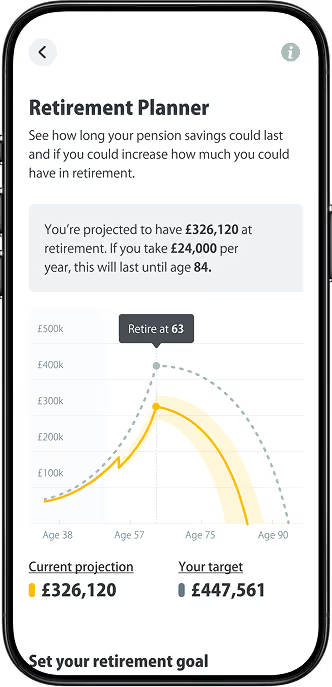
Be pension confident!

Be pension confident!

Combine your old pension pots into one new online plan. It takes just a few minutes to sign up.

Combine your old pensions into one simple plan
Invest with one of the world’s largest money managers
Make paper-free online withdrawals from the age of 55
Pay just one simple annual fee
  • Sign up in minutes
  • Transfer your old pensions into one new online plan
  • Invest with one of the world’s largest money managers
  • Pay just one simple annual fee
Capital at risk
Button with Google Play logo and text 'Get it on Google Play' on a black background.