







Bonus episode: “I switched my pension so it complies with my faith”



.avif)
PHILIPPA: Hi, welcome to another listener story bonus episode. I’m Philippa Lamb, and if you’re new here, or maybe you haven’t subscribed to the podcast yet, why not do it right now so you never miss an episode? Recently, we’ve been really enjoying hearing listeners tell us about their savings and retirement stories.
This time we’ve got Sanna’s story. Like so many of us, she’s doing a balancing act. She’s looking after her family finances, she’s buying her first home, and she’s trying to save for her retirement. As usual in these bonus episodes, we’re going to see if we can pull out some useful money lessons for the rest of us.
Rachael Oku’s back with us. She’s going to help with that. She’s VP Brand and Communications at PensionBee. Hi, Rachael, welcome back.
RACHAEL: Hi, thank you.
PHILIPPA: Just before we get into it, here’s the usual disclaimer. Please remember, anything discussed on the podcast shouldn’t be regarded as financial advice or legal advice. And when investing your capital is at risk.
So let’s start by hearing Sanna. She’s going to tell us about the arrival of her daughter and the dream of owning a home and how they shifted her financial priorities in the past few years.
Homebuying vs. saving for retirement
SANNA: My name’s Sanna. I’m married with a 2-year-old daughter and I currently work part-time. My current approach to saving for retirement has taken a bit of a back seat, so especially since I fell pregnant.
Our focus has really shifted towards trying to buy a home, which has been quite difficult in the current economic climate. But I’ve been trying to save quite diligently for a deposit trying to cut back where we can. But that means I haven’t contributed much to my pension pot, unfortunately.
We’ve had to make some major life decisions, especially during maternity leave and returning to move back with family to try and save of course, we’re still paying towards our living costs, but probably a lot less than what we would be if we were living and renting somewhere quite close to our offices - which are quite high rental areas.
PHILIPPA: This is such a familiar story, isn’t it, Rachael, having to trade off one financial priority against another, buying a home vs. saving for your retirement. You really feel for Sanna, don’t you? It feels like it’s just getting harder and harder to get on the property ladder. The average age is really high now, isn’t it? Is it nearly 34 now for first-time buyers?
RACHAEL: Yes, it’s close to 34 [years old]. Yeah, you really feel for people like Sanna because it’s very different to my parents’ generation. So I’m almost 40 and parents were having children younger, they were buying property younger, things were a lot more affordable.
I mean, at the time they were still expensive, of course, but they weren’t as out of reach. So now the average age of a first-time buyer in England is close to 34, and the average age that a woman has her first child has gone up to just under 31. So we’re a generation that are doing things later, which does make it challenging.
PHILIPPA: Yeah, so it means these young families, they’re navigating the property ladder at the same time as they’re dealing with childcare costs. So the potential for income disruption is just enormous.
RACHAEL: It’s huge, yeah, definitely.
Rising costs and financial impact
PHILIPPA: So Sanna’s strategy, they’ve moved back in with family to try and save money. It’s something we see a lot of because, as we said, rents are so high, it’s also difficult to save for a deposit. We’ve spoken about this a lot on the podcast. I think most recently in episode 41, we did hear from lots of guests that are doing the same thing. And I know, I think I saw a recent report that said 98% of adults living at home, they can’t afford to leave. So it’s not even just about saving for a deposit, they literally can’t leave.
RACHAEL: Yeah, that’s a really sobering statistic. So yeah, I mean, everything you’ve said, it’s cost of living, it’s rising rents, the availability of affordable housing, and these life pressures mean that sometimes pension contributions can take a back seat. For huge periods of time, but particularly when you’re in this kind of age bracket, let’s say kind of mid-20s to mid-30s, these are quite crucial pension contribution years.
PHILIPPA: This can be particularly bad news for women, right?
RACHAEL: Yeah, because when they’re taking parental leave and having career breaks to raise young children, they can have long-term impacts on their savings. We know that there’s a gender pension gap. Our latest data shows that it’s 37%, so that means that men typically have 37% more money in their pensions than women. The gap only increases the closer they come to retirement.
PHILIPPA: And this is largely because women take time out to raise kids and they stop contributing to their pensions.
RACHAEL: Yeah.
PHILIPPA: OK, let’s hear a bit more from Sanna. In this clip, she’s talking about the financial pressures of having a family, but also about how central her faith is to all her financial choices.
Faith-driven investing options
SANNA: I think the biggest challenge when it comes to saving [into] a pension, or for retirement, is probably the immediate need to secure a roof over our heads, especially with a child in the picture. I’m relying solely on our own savings. We have no external financial help, so we really are trying to stretch every penny.
Obviously, the cost of living has skyrocketed and that’s utilities, everyday expenses, and of course, nursery fees. I’m hoping the new childcare scheme that’s coming into play will ease things a little bit.
Another factor is our faith influences the type of financial product we can use, so we’re unable to take out a conventional mortgage, so the alternatives that do align with our values tend to be much more expensive and the options are quite limited.
That was actually the deciding factor in me switching my pension to PensionBee because it’s compliant, Shariah-compliant, so it complies with my faith and my values, and I actually take a lot of comfort in knowing that my investments are going to the right place. So when I do eventually start paying in, I can do that with peace of mind.
PHILIPPA: Let’s talk about the cost of living and specifically children first. Just remind us, because we saw changes, didn’t we, quite recently to childcare arrangements?
RACHAEL: Yes, so the expansion has been a real game changer for working parents. So since September [2025], eligible working parents can get 30 hours free childcare a week from when their child is nine months and over.
PHILIPPA: That’s a big change, isn’t it?
RACHAEL: Yeah, so it used to start age three and now it has gone down to nine months. So that’s typically within the realm of time that parents start to begin thinking about going back to work.
PHILIPPA: Yeah, so that’s potentially a huge boost for family finances.
RACHAEL: Yeah.
PHILIPPA: So Sanna also talked about her faith and how it shaped her financial decisions. And of course, millions of people do need to factor that into their finances one way or another. For her, she’s Muslim, so it’s about her investments being Shariah-compliant, so in line with Islamic principles. We have talked about this on the podcast before, actually way back at the beginning, back in episode 6. So just remind me, Rachael, how does that requirement change her financial options?
RACHAEL: Well, there aren’t that many options on the market in the UK, unfortunately. So I think savers like Sanna, they’re quite limited on lots of the financial products that they can choose, including pensions. So our Shariah Plan is only one of a handful on the market, and all of the investments are vetted by an independent Shariah committee. So savers like Sanna can feel really confident [about] their money and the choices they’re making with their money are aligned with their values.
But what I’d say is that the Shariah Plan, any Shariah investments, aren’t just for Muslim people. Anybody can invest in these plans. There are ethical exclusions and they focus on things like tech companies like Apple and Microsoft, for example. These are considered Shariah-compliant. So it isn’t just for people from certain communities or faiths. It’s an investing strategy that could potentially benefit everybody.
PHILIPPA: OK, well, finally, let’s hear from Sanna on her long-term view and where she thinks she might be money-wise, when she does come to retire.
Exploring multiple income streams
SANNA: I’m not sure what my pension income will be when I retire. I do know what it’s currently at. However, because I haven’t obviously paid into that, it’s not - it’s not moved up. Also hasn’t budged since. I probably don’t foresee it being enough, however, especially considering how living costs are only going up.
So that’s why the priority has shifted in terms of getting on the property ladder, because owning a home can eventually lead to opening up other opportunities like equity release or other investments. As it really does feel like we’ll need to start looking at multiple income streams, which will probably be becoming - will become a necessity for a lot of people just to get by, especially in the future, when we do edge closer to retirement age. So I don’t see that changing anytime soon.
PHILIPPA: OK, so two key points there as far as I can see. Sanna wasn’t exactly sure where her pension income potentially is right now, and she talked about this need for multiple income streams going forward. Pension calculators are great for this, right?
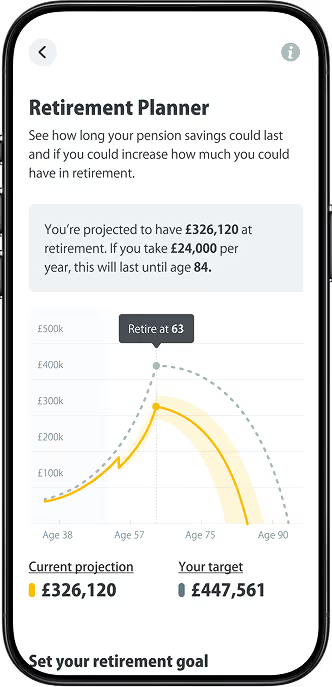
RACHAEL: They are, yeah. There are lots of calculators on the market, but the PensionBee one is particularly handy because it helps you to forecast what your savings might be worth when you come to retire, and you can adjust things like how much you’re paying in, how much your employer is paying in, the age you want to retire. And how much you want to retire with as an annual income. And you can adjust these and see how much you should really be saving now to potentially get you there in future.
PHILIPPA: It’s nice, isn’t it, because you can play with numbers and see how if you were able to put a bit more in, what a difference it would make in 10, 20, 30 years. And equally, if you’re thinking, “I don’t want to pay in this much”, what that’ll mean to you. So it makes it really real, doesn’t it?
RACHAEL: Yeah, yeah. Being able to sort of see what you could end up with, I think, is quite motivating. And I think it’s important to do that research and to start thinking about it sooner rather than later, so you can see what you need to achieve.
PHILIPPA: And she talks about these multiple income streams. I mean, what sort of thing might you think about?
RACHAEL: It could be money that she might make from self-employment. It could be a rental property. She might be talking about savings, so investment accounts, ISAs, Stocks and Shares ISAs. Some of these ideas you’re paying money [for] and you’re watching it potentially grow.
RACHAEL: Yeah, yeah. Something that can just sit in the background and make you money while you focus on your day-to-day life. So for Sanna, that’s saving, that’s raising her child and working.
PHILIPPA: Thank you, Rachael.
RACHAEL: Pleasure.
PHILIPPA: Thanks too to Sanna for sharing her story with us. It’s always so fascinating to hear what drives people’s financial choices and where their real lives are at that intersection of money and values. Choosing financial products can be a lot more complex, I think, than just looking at predicted returns.
If you’d like to find out more about pensions and retirement planning generally, head to the show notes on this episode. We have shared a tonne of resources there for you to explore and use.
And here’s a final reminder just before we go: anything discussed on the podcast shouldn’t be regarded as financial advice or as legal advice, and when investing, your capital is at risk. Thanks for being with us.
Risk warning
As always with investments, your capital is at risk. The value of your investment can go down as well as up, and you may get back less than you invest. This information should not be regarded as financial advice.
Period | Market Event | FTSE World TR GBP (%) | 4Plus Plan (%) |
|---|---|---|---|
4Plus Plan’s inception – 6 Sept 2013 | QE Tapering, China Interbank Crisis and its aftermath | -5.44 | -2.41 |
3 Oct 2014 – 15 May 2015 | Oil price drop, Eurozone deflation fears & Greek election outcome | -5.87 | -1.77 |
7 Jan 2016 – 14 Mar 2016 | China’s currency policy turmoil, collapse in oil prices and weak US activity | -7.26 | -1.54 |
15 June 2016 – 30 June 2016 | BREXIT referendum | -2.05 | -1.07 |












%201.png)