The Buzz.

Read the latest pension news and retirement planning tips, from our team of personal finance journalists, investment professionals and money bloggers.

I started my pension at 48 years old and have over £580,000 - this is how I did it
A few months ago I joined PensionBee’s Pension Confident Podcast to talk about starting a pension in your 50s. Heres's my story and how I built a pension of over £580,000 later in life.

A few months ago I joined PensionBee’s Pension Confident Podcast to talk about starting a pension in your 50s. I thought it might help to share more of my story, and how I built a pension of over £580,000 later in life.

I wasn't always financially savvy. In my 20s I spoke to a financial adviser who recommended I start a pension. I remember him showing me a graph explaining how the earlier you start investing, the less you may need to contribute over time.

To my regret, I didn't take his advice.

At the time I was earning little, and had lots of outgoings. I also wanted to save for a deposit to buy my own property, so any spare money went towards that.

In my 30s I worked for various advertising agencies that all offered workplace pension schemes. They'd match my contributions - where employers pay more into your pension if you agree to increase your contributions too. Sadly, I also failed to take this up, until a few months before I quit to become self-employed.

By my late 40s, I had around £1,000 in a pension. I remember seeing an estimate that it’d give me about £15 a year in retirement income. That wouldn't buy a prosecco lifestyle, let alone a champagne one!

But when I was 48, the business I'd started at 40 was finally making a decent profit. My accountant explained that pension contributions from my limited company could help reduce its Corporation Tax bill.

This time, I was wise enough to take the advice. I started a new pension and paid into it from my business. At the time, the standard annual allowance was £40,000 - this is the gross amount that can be saved into a pension each year, without incurring tax. 

Depending on your circumstances, you could also carry forward any unused annual allowance from the previous three tax years.

Over the past six years I've made significant contributions to my pension, to make the most of the available tax benefits. The standard annual allowance increased to £60,000 a year in April 2023 which meant I could add even more without incurring tax charges. I also hired an Independent Financial Adviser (IFA) to help me review my pension and investments.

Today my pension is worth over £580,000. More than £110,000 of this is investment growth, and I estimate my company has saved over £90,000 in Corporation Tax. Starting to pay into my pension six years ago has made a huge difference to my finances.

I know I'm rather an extreme case study. I've been fortunate to be able to pay so much money from my business into my pension each year. But I've also worked extremely hard. I worked seven days a week for years before my business turned a profit, and I've been frugal with my spending.

Today I'm passionate about helping other people plan for their retirement too, especially women. 

Research shows that nearly seven million people aged over 50 in the UK have no private pension savings, and it's estimated that 4.4 million of these are women. Women are also less likely to invest than men - we're thought to have just £450 billion invested, compared to £1.01 trillion for men.

As a result, women aren't just likely to have a smaller (if any) private pension than men. Their overall investments may be much lower too.

{{dark-cta}}

How to build a pension pot later in life

I came to financial education later in life, but even so, you can see how much I've been able to turn things around. You may not have £60,000 a year to invest in a pension. But there may still be a lot you can do to prepare for the future.

Here are some of the things I've learnt, as someone who found themselves under-pensioned over the age of 45.

Save something every month

If you can, start saving something every month into your pension, even if it's a modest amount. Regular sums have the potential to benefit from compound growth over time, and can be working away for you while you get on with life.

One thing that helped me was looking carefully at my spending. Tracking what you spend may help you spot things you're happy to cut down on or cut out.

For example, if you put £30 a month into your pension for 20 years and investments grew by an average of 5% a year, it could be worth around £10,000*. This is only an illustration and actual investment returns will vary. 

You can use PensionBee’s Pension Calculator to see your own projection based on how much you can afford to contribute and what your desired retirement age is. 

*This is only an illustration and actual investment returns will vary. Figures assume starting with no pension savings and contributing £30 per month for 20 years, inflation of 2.5% and an annual management fee of 0.7%.

Make the most of the tax benefits

One thing I wish I'd understood earlier is that pensions come with valuable tax benefits.

Most UK taxpayers benefit from tax relief which is essentially free money from the government. Usually, basic rate taxpayers get a 25% tax top up from HMRC on eligible personal contributions, so if you pay in £100, £25 is added, bringing the total to £125.

And if, like me, you run a limited company, your company may be able to make employer pension contributions. The tax treatment is different from personal contributions, so it's worth checking the rules, or getting professional advice if you're unsure.

If you’re employed, you’ll likely be paying into a workplace pension. Under Auto-Enrolment rules, eligible employees must pay 5% of their relevant earnings into their workplace pension. Your employer has to pay a minimum of 3% - but they could be willing to pay more. Ask your workplace about employer matched contributions

Keep in mind that employer contributions aren't eligible for tax relief. Tax relief is only applied to personal and third party contributions (from anyone but your employer) up to 100% of your earnings, capped at £60,000 per year (2026/27).

Tax relief and potential investment growth over time can make a huge difference to your overall savings. For example, if you put £250 a month into your pension for 20 years, and investments grew by an average of 5% a year, it could grow to around £85,000*. 

*This is only an illustration and actual investment returns will vary. Figures assume starting with no pension savings and contributing £250 per month for 20 years, inflation of 2.5% and an annual management fee of 0.7%.

Don't be afraid of market volatility

One thing that can put people off investing is market volatility. But markets will always rise and fall, and pensions are usually invested with the long term in mind.

When markets fall, your regular contributions may buy more units of an investment for the same amount of money. While there's no guarantee that markets will recover within a particular period, historically markets have grown over time.

For me, the important thing has been learning not to focus too much on short-term movements. I'm investing for my retirement, so I try to keep that longer-term goal in mind.

Don't compare your pension

Finally, I don't recommend comparing your finances to others. It doesn't matter if someone else has more in their pension than you. It may only dishearten you, if you feel you can never catch up.

The only retirement numbers that matter are your own. If you budget, you can get a better idea of how much you may need to live on, and what you might want in retirement, both the basics and the luxuries you value.

And the good news is that, whatever your numbers are, like me you may still have the chance to make a difference to your retirement, by starting to build your pension now.

Learn more about starting a pension from 50 in Episode 50 of The Pension Confident Podcast. Watch the full episode on YouTube or read the transcript.

Hannah Martin is the Founder of Rich Retiree, an online resource aimed at helping women over the age of 45 prepare for a more rewarding retirement.

Risk warning 

As always with investments, your capital is at risk. The value of your investment can go down as well as up, and you may get back less than you invest. Tax rules can change and benefits depend on individual circumstances. This information shouldn't be regarded as financial advice.

Image: Charlotte Rebecca Photography

What does your side hustle say about your money personality?
How you earn and spend your side hustle income could say a lot about your money personality. Find out which type sounds most like you.

With the cost of living still squeezing budgets, more people are looking for ways to bring in extra money. Selling clothes online, teaching a skill you already have, or taking on freelance work outside your day job have all become common ways to top up income. 

According to PensionBee research, 49% of UK adults have a side hustle. Another 12% have had one within the past two years.

Most people aren’t trying to  build a big business with half of side hustlers earning less than £100 a month. While everyone spends their earnings differently, only 5% put any of it towards a pension. 

That might have something to do with our different money personalities. Financial psychologists have long studied how personality traits shape our financial behaviour. Research into money personality types shows that the way we think about money can influence everything from spending habits to saving discipline. 

The same is likely true of side hustles: our money personality can shape everything from why we start one to what we do with the extra cash. 

Here are some of the most common money personalities.

The ‘Money Maker’

‘Money Makers’ are often looking for ways to earn a little more. They may work longer hours or pick up overtime. So it’s perhaps no surprise that they feel at home in the side hustle economy.

A side hustle can offer something a salary often can’t - a clearer link between the work you put in and the money you make. But earning more today doesn’t always mean having more for the future.

When just 5% of side hustlers put their extra income into a pension, that raises an important question: what do you want that additional work to add up to?

If you’re already putting time and energy into earning more,  consider putting some of that money to work for your future. Even small pension contributions could have more time to compound and benefit from potential investment growth.

{{main-cta}}

The ‘Spender’

When you’ve put hours into your side hustle, it’s understandable to want to enjoy your extra income.

That may sound familiar if you’re ‘The Spender’.

PensionBee research found that 31% of people use their side hustle money to treat themselves, including on holidays, clothes and eating out. Another 17% spend it as it comes in, without a particular plan. And there’s nothing wrong with enjoying money you’ve worked hard to earn.

But consider how the extra income might help with your longer-term goals.

One approach could be to decide how you’d like to split the money before it arrives. You might enjoy some now, while putting a little towards savings, investments or your pension.

That way, your side hustle could give you something to enjoy today, while also helping you save for the future.

The ‘Saver’

For ‘The Saver’, watching a bank balance grow can feel just as rewarding as spending the money. And plenty of side hustlers seem to share that. Almost a quarter use their extra earnings to build up savings. Another 14% are saving towards a specific goal, like a house deposit.

Putting some side hustle income aside can make sense, particularly when that income changes from month-to-month. Cash savings can help you build an emergency fund so that if your side hustle has a quiet month, you'll know there's something there to fall back on.

But once your emergency savings and nearer-term goals are covered, it's worth asking a different question - what about your future self?

The ‘Saver-Splurger’

If you’re a ‘Saver-Splurger’, money from a side hustle might feel a little different from your regular salary.

Your salary may already be set aside for things like your mortgage or rent, bills, groceries and pension contributions. Money from a weekend project or selling something online can feel more like disposable income, giving you a bit more choice over what to do with it.

That's where The Saver-Splurger can emerge.

You might diligently save your side hustle income for several months, only to spend the whole pot when something catches your eye.

If that sounds familiar, a sinking fund could be worth considering. 

Rather than relying on whatever you feel like doing that month, you could decide in advance that a proportion goes towards spending, another towards shorter-term savings and another towards your longer-term future.

You still get to enjoy the extra money without every month becoming a negotiation with yourself.

The ‘Worrier’

Not everyone starts a side hustle because they want more spending money. For some, earning extra is about security.

The most common use of side hustle income was covering day-to-day living costs, cited by 39% of respondents. Another 19% use it to pay down debt.

And when asked why they weren't paying their side hustle income into a pension, 22% said they couldn't afford to because the money was needed for essentials. For `The Worrier`, a side hustle might provide something more valuable than luxuries.

The ‘Gambler’

‘Gamblers’ tend to be drawn to big risks and bigger rewards. They're comfortable with uncertainty, and that same appetite can fuel a side hustle. 

But unpredictable income can make planning harder. And one-in-five side hustlers who don't pay into a pension say their earnings feel too unpredictable to commit to.

Setting aside a small amount before you spend the rest can help. And with PensionBee, you can pay in as much or as little as you like, whenever suits you. There's no fixed schedule to stick to. 

Could £1,000 of side-hustle income become £154,000?

Whatever your money personality, one of the most powerful ingredients for retirement saving is time.

The UK trading allowance means eligible individuals can receive up to £1,000 of qualifying gross trading income each tax year without paying Income Tax on it. Different rules apply depending on your circumstances, and if gross trading income exceeds £1,000 you may need to register for Self-Assessment.

Imagine you put £1,000 of side-hustle earnings into a personal pension each year, Instead of saving it in a regular bank account.

Someone starting at age 25 and continuing with £1,000 per year until age 67 could build around £154,000 in today's money.

Starting at 35 could produce around £91,000, while starting at 45 could still produce around £49,000.

Pension Projection Table
Age starting Annual contribution (excl. tax relief) Projected extra pension at age 67 (in today's money)
25 £1,000 £154,000
35 £1,000 £91,000
45 £1,000 £49,000
55 £1,000 £22,000
65 £1,000 £4,000

Note: These projections assume a 5% net annual investment return, a 0.7% annual management charge, 25% basic rate tax relief on contributions and 2% annual inflation, with retirement at age 67. Figures are rounded and stated in today's money. Investment returns aren't guaranteed and your pension can fall as well as rise in value.

The takeaway

There's no single way to use side hustle income, and it’ll vary depending on your circumstances.

If it's helping you pay the bills, that's an important job. If you're paying off debt, building emergency savings or saving for a house, those are important goals too. And sometimes, spending money you've worked hard to earn is exactly what you want to do.

Once you recognise those habits, you can decide whether they're still working for you. And if your side hustle is already helping you earn more today, perhaps a little of it could help pay for tomorrow too.

Risk warning

As always with investments, your capital is at risk. The value of your investment can go down as well as up, and you may get back less than you invest. This information should not be regarded as financial advice. 

Please note that tax rules change regularly, and the actual tax benefits you receive will depend on your individual circumstances. If you’re not sure, please seek professional advice. 

5 financial checkpoints after a major life change
As you progress through life, it's important to make sure your finances keep up with you. Here are five things to check after a major life event or change.

Major life changes can affect your finances in ways you might not expect. Starting a new job, moving home, getting married, or welcoming a child or grandchild can all change how you earn, spend, and save. 

There are other less positive but common things that can happen too, like divorce or bereavement. These can also affect your financial behaviours.

Yet it's easy for important financial tasks to slip down the priority list during busy times. 

Taking a little time to review your finances can help make sure your money still reflects your current circumstances. Here are five financial checkpoints to consider after a major life change. 

1. Review your budget and savings

A major life change can affect both your income and your spending. You might be earning more in a new job, paying higher household bills after moving, or adjusting to the costs of raising a family. Taking a fresh look at your budget can help you understand where your money’s going and whether your savings plan still feels realistic. 

  • Review your monthly income and spending - that way, you can see how your finances have changed. 
  • Check whether you're still able to save regularly - even small amounts each month add up. 
  • Look at your emergency fund - think about whether it still reflects your current circumstances. Many people aim to build enough savings to cover three-to-six months of essential living costs. If you’re in retirement, it can be sensible to save six-to-12 months expenses. That gives you income that you can draw on if market volatility sees your pension value temporarily fall.
  • Consider adjusting your monthly budget - apps like Snoop and HyperJar can help you track your spending. 

2. Check your pension

Milestones like starting a new job or becoming a parent could have a knock-on effect on your pension. Taking a few minutes to review your pension can help you understand where your retirement savings stand. 

  • Check that pension contributions have started - find out whether you're eligible for Auto-Enrolment, where your employer must enrol you into their workplace pension. If you earn below the eligibility threshold, you can still ask your employer to join the scheme. It's also worth asking whether your employer’ll match any extra contributions you make
  • Consider paying into a personal pension - this is especially important if you've become self-employed, as you won’t have an employer who enrols you into a pension or makes contributions on your behalf. 
  • Review any pensions from previous employers - if you've built up several small pension pots over the years, you could combine them so they’re easier to manage. 
  • Review your pension contributions - if your income’s changed, it’s worth checking that what you’re paying into your pension still fits your long-term goals. Tools like PensionBee's Pension Calculator can help you understand the impact of your contributions over time. Even increasing contributions by 1% can make a real difference by retirement.

{{main-cta}}

3. Review your insurance and protection

When your life changes, so can the level of financial protection you need. If you’ve recently bought a home, got married or divorced, or started a family, now’s a good time to check your cover and see if it needs adjusting. 

  • Review your life insurance - check whether the level of cover still suits your circumstances and any dependants you have.
  • Check your income protection - this type of insurance may provide an income if you're unable to work because of illness or injury.
  • Look at your home and contents insurance - if you've recently moved house or bought valuable new items, your cover may need updating.
  • Consider whether you need critical illness cover - this can pay out a tax-free lump sum if you're diagnosed with certain serious illnesses.

4. Update your financial records

You may need to update key financial records, such as who you've nominated to receive your pension, your contact details, or your will, after a major life event. Keeping these records up to date can help avoid confusion later on.

  • Check your pension beneficiaries - these are the people you've nominated to receive your pension if you die before taking it. You could review them after getting married, divorced, or welcoming a child. PensionBee customers can do this quickly and easily via the app.
  • Review your will - if your family or financial circumstances have changed, it may be worth checking that it still reflects your wishes.
  • Update your contact details - if you've recently moved home or changed your name, let your pension provider and bank know so your records stay up to date. 
  • Keep your records together - storing important financial documents in one place can make it easier to find what you need.

5. Check your priorities 

When you reach a milestone, it can be a good time to think about what matters most to you. A new job, home, or having kids might change what you're saving for or how you want to manage your money. Taking a step back can help make sure your financial plans match your long-term goals.

  • Think about your short and long-term goals - your priorities may have changed since your life event, whether that's buying a home, paying off debt, or planning for retirement.
  • Look at your monthly budget - if your priorities have changed, you could move more money towards the goals that matter most. 
  • Consider reviewing your financial plan each year - a regular check-in can help keep your finances aligned with any changes in your life.
  • Take things one step at a time - you don't need to update everything at once. Small changes can build up over time.

Keep your finances on track

Major life changes often bring new priorities. Taking the time to review your finances can help you spot anything that needs updating and give you a clearer picture of where you stand. 

You don't need to tackle every checkpoint at once. Even a few small reviews after a milestone event can help keep you on track towards your long-term financial goals.

Katie Sims is a Freelance Journalist and has been writing since 2021. She has a keen interest in financial wellness for women, and hopes to make money topics simple and accessible. Holding an MA in Media and Journalism, her work has been featured in Marie Claire, Woman & Home, Liz Earle Wellbeing, Tom’s Guide, and many more. 

Risk warning

As always with investments, your capital is at risk. The value of your investment can go down as well as up, and you may get back less than you invest. Past performance isn't a guide to future performance. This information should not be regarded as financial advice.

What is ‘friendflation’ and is it eating into your savings?
When other people’s celebrations start stretching your own budget, you could be feeling the effects of 'friendflation.' Find out how to plan ahead.

Summer spending has a way of creeping up on you. Most of the time, you’re saying yes to people you care about and enjoying yourself. It’s only when you look at your bank balance afterwards that you realise how much it all cost.

And it’s rarely just the event itself. A wedding might mean somewhere to stay and a gift, while getting home from a night out can cost almost as much as the evening itself. These extra expenses are easy to overlook at the time, but over a whole summer they can really add up.

Individually, they might not have felt like huge expenses. But put them all together, and having fun with friends and celebrating can get expensive fast.

There’s a name for this, and it’s ‘friendflation’ - the rising cost of having a social life.

The end of summer is a good time to look back at what you spent, to get an idea of what you might do differently next year.

So, what did this summer actually cost you?

The real cost of wedding season

Research from the Money and Pensions Service (MAPS) found that UK adults spent an average of £692 attending a single wedding. Most people go to three a year, adding up to more than £2,000. If you're 25 to 34, you probably went to six, taking the total closer to £4,500.

And the day itself is only part of the cost. There's also:

  • travel and accommodation, averaging £147;
  • an outfit, averaging £136; and
  • a present, averaging £117.

Separate research from Experian found that nearly one-in-five guests had declined a wedding invitation because of the cost.

Then there are the celebrations around the big day. The same Experian research found that three-in-four hen or stag attendees think pre-wedding celebrations are too expensive, and 11% said they'd gone into debt over one. 

But weddings aren't the only expense. Festivals, birthdays and spontaneous weekends away can all add up too.

Credit card provider Aqua found that 38% of UK adults don't have a budget for social spending at all. More than a quarter said fear of missing out had led them to overspend. Friends were named more often than any other group as the source of that pressure.

{{main-cta}}

When something else has to give 

According to Mastercard's Experience Economy Report, 71% of UK respondents say lived experiences matter more to them than ever. But you might not always get to choose which experiences you have. Someone else’s big life moment can become a big expense in your own budget.

When the invites keep coming, something often has to give. 27% of wedding guests cut back on things, like going out for meals, to keep up.

Sometimes the trade-offs are harder to spot. Maybe you paused your regular savings and told yourself you'd start again next month. Or perhaps you put off making that extra contribution to your pension and topped up your holiday pot to fund a wedding abroad instead. 

That doesn't mean the experiences weren't worth it. The wedding might have brought lifelong memories that you can’t put a price on. Spending money on the people and experiences you care about is part of what money is for - to enjoy doing the things you love.

But if keeping up with social events is regularly pushing your own plans further away, or leaving you stressed about money, it might be time to ask whether every invitation needs to be a yes.

Why saying no feels so hard

If you know all of this and still find yourself saying yes, you're not alone. 

Psychologists use the term ‘sociotropy' to describe a strong desire to keep other people happy and maintain harmony in relationships. It can help explain why turning down an invitation can feel so difficult.

Social spending involves people you care about, so there's often more to the decision than the numbers. You might know that you'd rather put £300 towards your pension but saying no can also mean worrying that you'll disappoint a friend or miss out on time together. 

These are understandable feelings, and there isn’t always a clear-cut answer about when to say yes and when to put your own finances first.

It's tempting to assume "Sorry, I can't afford it" is the easy option - a clear reason that most friends would understand. In practice, it rarely feels that simple, because money is one of the most difficult things for us to talk about.

Research from Barclays found that half of UK adults consider money a taboo subject, and almost 3-in-10 avoid money conversations even when they know talking could help. 

It can feel even harder when you could technically afford it, but would rather put the money towards something else. That can be difficult to explain without making it feel personal. 

Spending with friends rarely feels purely financial. Sometimes saying yes can feel like part of being a good friend. There’s often an emotional side to social spending too. Saying yes can feel like showing up for someone, which makes it easier to sacrifice something in your own budget instead. 

Here are a few things that might help:

  • Buy yourself some time - you don't have to answer the group chat straight away. "Let me check a few things and come back to you" gives you time to assess your budget before agreeing.
  • Keep your answer simple - you might feel you need to explain exactly why you're saying no, but a short, polite answer is often enough. You don't need to defend your spending choices. 
  • Suggest something else - offer an alternative that costs less but still gives you the chance to celebrate or spend time together.
  • Remember why you said no - if you start to feel guilty, remind yourself what you chose to prioritise instead. 
  • Think about the whole year - one expensive weekend might feel manageable on its own. Looking at everything coming up can help you decide what you genuinely want to prioritise. 

Consider a sinking fund

If you ended the summer with less in your bank account than you'd hoped, worried about upcoming bills or having put your own savings goals on hold, it might be worth rethinking how you approach next summer.

Simply deciding you'll ‘be better with money’ next year might not be enough. It can help to make some decisions before the invitations arrive.

One option is to create a social sinking fund - a separate pot of money you gradually build up for things like weddings, birthdays, trips and nights out. Look at roughly what you spent on social plans this year, then decide what you'd feel comfortable spending next year.

Give that money a new job

One more thing worth doing while summer's fresh in your mind is looking at the plans you wouldn't repeat.

Say you turn down one wedding or weekend away and save £300 over the year. Instead of letting that money get absorbed into everyday spending, you could give it a purpose by putting it into your pension.

Do the same each year for 30 years, and those £300 contributions could grow to more than £17,000.* That’s the benefit of giving your money time to compound - you’re not just keeping the £300 you didn’t spend, you’re giving it the opportunity to grow.

That doesn’t mean the plans you say yes to are a waste of money. Some will be completely worth it.

When the money you save has somewhere to go, saying no can feel less like missing out and more like making a conscious choice. 

*Calculations assume a £300 personal contribution every year for 30 years, 5% annual investment growth, 2.5% annual inflation, 0.7% annual management charges.

The takeaway

Seeing everything you spent over the summer in one place can feel like a lot. But it can also give you a clearer idea of what was worth the money. The point isn’t to regret the weddings and other celebrations, but to work out which costs felt worthwhile and which didn’t.

You could try thinking about:

  • which plans you’d happily spend the same amount on again;
  • the events you agreed to mainly because everyone else was going; and
  • what you spent less on, or put off, to make room for them.

You can use what you’ve learned to make next summer a little easier. Having some money already set aside for social plans means you’re less likely to find yourself choosing between them and something else you care about. 

Risk warning

As always with investments, your capital is at risk. The value of your investment can go down as well as up, and you may get back less than you invest. This information should not be regarded as financial advice.

Bonus episode: The best from our Series 5 guests (so far) with Philippa Lamb and Lucy Greenwell
The Pension Confident Podcast’s Host, Philippa Lamb, and Series Producer, Lucy Greenwell, look back over some of their best moments from our Series 5 guests (so far).

The following is a transcript of a bonus podcast episode of The Pension Confident Podcast. Listen to the episode, watch on YouTube or scroll on to read the conversation.

PHILIPPA: Welcome back. We have something special for you this time, a best bits bonus episode. Now, I love these because I get to look back at everything we’ve covered so far [in] this series. And even though we’re only halfway through the year, we’ve already covered so much: Is it worth getting married? What to do if you’re staring down 50 [years old] with absolutely nothing saved in a pension pot? How to resist lifestyle creep eating up all your pay? And a bunch of other topics all about making the most of your money.

Now, long [time] listeners already know our Series Producer, the super talented Lucy Greenwell. For today’s bonus episode, I’ve winkled her out of the gallery where she usually oversees recordings, and she’s here with me in the studio so we can argue over our favourite picks. Lucy, welcome to this side of the glass.

LUCY: It’s very lovely to be here, Philippa. We argue all the time after every episode. We go through the debrief, and there’s often quite contentious issues in that -

PHILIPPA: that’s true, we do a lot of arguing. But obviously, in the spirit of positivity, now we’ve been working really hard this year, haven’t we?

LUCY: Yeah.

PHILIPPA: We’ve done - it’s more episodes than we’ve ever done before, right?

LUCY: Yes, because we’ve launched, on top of our main monthly episode, we’ve launched two new mini-series. We’ve got Customer Episodes, which is [about] real people with their money stories, and we’ve got our Explainer Episodes where we demystify all that financial jargon.

PHILIPPA: Do you know how many guests we’ve had on this series so far?

LUCY: I do. I’ve counted up -

PHILIPPA: of course you have -

LUCY: all told, we’ve had 33 different voices on Series 5 of the podcast. And I’m the 34th, so that’s a big breadth of expertise and experience.

PHILIPPA: It’s a lot, isn’t it? Now look, the other day Lucy and I were mulling over the best way to choose our best bits, and we had a bit of a brainwave, which was to divide them up into categories.

Best episode for first-time listeners

PHILIPPA: And so, the first category we came up with is: best episode for first-time listeners. So, this is like if you wanted to introduce the series to a friend who’d never listened, which would you recommend?

LUCY: So, you and I agreed on this quite quickly. Episode 50 was all about starting that pension pot from nothing, standing start at 50 [years old], and I loved it because it’s so the opposite of, “Oh, we’ve got it all sorted on this podcast, and we all know what we’re talking about”. This is like, you’ve got nothing and you’re 50 [years old], what are you going to do about it? So, it’s just brilliant.

PHILIPPA: It is, you know, seven million people aged over 50 in the UK right now have no private pension savings at all.

LUCY: And you might think, why is it so many? How did that happen? But the episode was full of all the reasons why that happens. [A] massive one is Auto-Enrolment. That didn’t exist until 2012. So if, like me, you were working before that, there was no one to nudge you to get going. I didn’t get going until I was in my early 30s -

PHILIPPA: yeah, people just never talk about pensions before -

LUCY: no one mentioned it to me. I keep telling my Dad, “Why didn’t he make me do it?”. But he’s got no answer. Then there are career breaks, [a] big one as well. Caring responsibilities, huge one. Opting out of your pension when money is tight, and that just adds up.

PHILIPPA: Yeah, we had some really specific numbers on what that opting out can cost you, didn’t we, in that episode - even for a short period.

LUCY: Yeah, let’s hear a bit of that.

SARAH: This is based on a starting salary of £25,000 at 21 [years old]. The average annual salary increases of 2% [each year]. 8% pension contributions when contributing, and 3% annual investment growth [after fees and inflation]. If you have zero periods of opting out of your pension, by the time you’re 68 [years old], your pot size will be £194,185. But if you opted out from age 30 to 33, it’d be £176,740. Which is actually a difference in pot size of £17,445. So those three years make a really big difference there.

LUCY: So that’s over £17,000 difference, and it’s not because you’d have necessarily put £17,000 worth of cash into your pension, it’s the compounding that you’ve lost out.

PHILIPPA: Yeah, that’s the point, isn’t it? Hannah Martin talked about that, didn’t she? About the fact that compounding - we always go on about compounding on the podcast, but it’s so important. Every pound you put in, at whatever age, it still has that chance to grow, right? And it’s so - it’s not all doom and gloom, even if you’re starting late. And I started late, you started late-ish, I started late-ish too.

LUCY: Yes.

Most surprising number

PHILIPPA: Now, this obviously is a financial podcast, which means there are always going to be statistics. Every series, there’s one I think -

LUCY: yes -

PHILIPPA: at least one, but maybe a big one that just stops the conversation dead. I’m going to say for me, it was Episode 46, which was redundancy. Because when our guest, Eleanor Mills, talked about her own experience of being made redundant after 23 years at the Sunday Times, and just how devastating that was for her; 10,000 people wrote back to her to say they felt exactly the same.

LUCY: Yeah, it was really, really shocking, that moment. And one of those moments where all of us in the gallery just fall quiet as well. Just, she described it so beautifully. We’ll hear a bit in a second.

But the point is, about redundancy, is that everyone, almost everyone at some point, is either going to face it themselves or they know someone who is, or they’re worried about it given what’s happening in the job market. It’s timely. We recorded that episode in January of this year and that conversation about job security has just got ever noisier since then.

PHILIPPA: That’s the thing, it’s so common, it can happen more than once, and the sad thing is there’s still so much stigma around it even now, even though it’s a really common thing, people don’t talk about it.

LUCY: Yeah, it’s true. Let’s hear a bit of Eleanor Mills telling her story.

ELEANOR: It was horrible. It was really, really grim. I’d been at my old newspaper for 23 years. I was the Editorial Director, I was the Editor of the Sunday Times magazine. I got a call asking me to go up and see the new Editor. I went up with all my stuff for the six months, all my jolly things.

PHILIPPA: The things you were going to be talking about.

ELEANOR: I just interviewed Sheryl Sandberg. It was all good, world exclusive. [I] walked in, the tissues were on the table, the Head of [Human Resources] (HR) was there with the new boss, and I was out.

PHILIPPA: Wow.

ELEANOR: It was a truly horrible, surreal moment. A bit like being in a car crash. When you get that real dissociation. I was sitting in that office and watching the tugboats chug up the Thames and the seagulls flying around the Southwark Cathedral. Just knowing in that moment that my life was never going to be the same again. It’d been my life from when I was 21 to when I was 50 [years old], and I suddenly realised that I was going to have to start again.

LUCY: The way she described seeing the tugboats and the seagulls, that clearly, she went into complete shock at that moment, and those images are just frozen and kind of replayed -

PHILIPPA: just burned into her brain, aren’t they? -

LUCY: so horrendous. And we actually, on that episode, we had Jimmy McLoughlin OBE. He was with us, and he was once a Number 10 Advisor -

PHILIPPA: oh yeah -

LUCY: to Theresa May and Boris Johnson, wasn’t it? And he described redundancy of a different sort when there’s a change of government. So, as we all watch on the TV, the new PM walking into that black door with Number 10 on it, in Downing Street, all the advisors literally at the same moment are just filing out of the back door unseen. It’s the end of it. So, it’s pretty topical given what we’ve seen in recent weeks.

PHILIPPA: I was just thinking that. I remember him saying about that, and then now here it is playing out in real time now that we’ve got a change of Prime Minister. And of course, everyone always says, you go and see a career coach if you’ve been made redundant, but it all costs money, doesn’t it? And Jimmy, I remember he had this great tip about how to get some fresh career ideas for free.

LUCY: He did. He said, “Use AI”. So just go on, tell it everything about yourself. I was talking to a friend about this yesterday. She said she’d just uploaded her CV onto AI and just gone through the motions of pressing it for suggestions about what company she could approach for freelance work. And so, you ask it to act as a career coach, you ask it a few questions about yourself, and he said it’s a really good way. I haven’t tried it yet, but working out what you’re actually good at, your skills. And it’s quite hard to do that on yourself without a bit of external help. So, it’s a free tool worth a go.

PHILIPPA: Yeah, do you know, I’m tempted. I think it’s a really interesting idea because even if you ask friends or family, I mean, there’s only so much stuff they’re going to say to you -

LUCY: yeah -

PHILIPPA: and AI is completely objective about you. It doesn’t care. So, you know, sounds good.

LUCY: Yeah.

Funniest episode

PHILIPPA: Now look, we’re a serious money podcast, obviously. But we do laugh a lot in the studio. We do have some very funny guests. I’ve got a standout favourite in the series so far. Do you want to guess who it is?

LUCY: I know who it is because we’ve talked about him. Bobby Seagull -

PHILIPPA: yes -

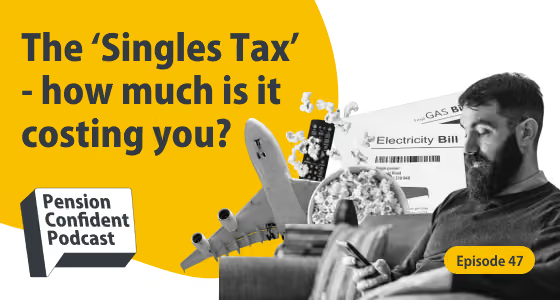
LUCY: Episode 47, on the ‘Singles Tax’, the financial penalty for single people.

PHILIPPA: The spreadsheet. He has a spreadsheet.

LUCY: Yeah, so Bobby, for anyone who doesn’t know him, he’s a Mathematician, he writes for the [Financial Times] (FT), and quite surprisingly he appeared on a Netflix show called Indian Matchmaking, also been on University Challenge. So, he’s a sort of star in his own right. And he was single, sort of. And Philippa, you asked him about the cost of dating -

PHILIPPA: I did -

LUCY: and he just revealed, just casually dropped it into conversation, that he has kept a spreadsheet of every first date he’s ever been on.

PHILIPPA: And that’s 158 first dates.

LUCY: That’s not a small number. And he’s got a graph, so the average spend per date tracked over time. Let’s hear a bit of that.

BOBBY: Being the mathematical nerd I am, I have - for my own eyes only - I have a spreadsheet of all my first dates.

EMMA: No!

BOBBY: Yes. And after like 10 first dates, I’m like, “I’m a Mathematician, there’s great data here”. I know it’s not very sexy.

PHILIPPA: Are you ranking these women?

BOBBY: Well, if you’ve got data there, you can choose to rank them if you want. It sounds like a lot, but over 14 years, 158 first dates.

VALENTINA: Did you pay for all of them?

BOBBY: So, pretty much 99% of first dates. One pro tip is that a lot of London museums have London Lates, so National Gallery, Tate Modern, Tate Britain, and they’re free to enter and you can buy drinks, but that’s a cheap, great date.

PHILIPPA: That’s an excellent idea.

BOBBY: It’s my number one choice [out] of my 158. A lot of them, a sizable minority of them, would’ve had that.

LUCY: It was eye-opening though to hear how much our world is financially geared for couples. So, couples pay less per head than singles for pretty much everything: streaming services, rent, holidays. This cumulative cost of living alone, it’s really unfair.

PHILIPPA: I know, I remember that conversation really well, and it’s so unfair, isn’t it? Because single people are this growing army. I remember Bobby saying there’s 8.4 million single-person households in the UK, all ages obviously. And all those companies offering products and services, I’m kind of thinking they should think harder about that.

LUCY: I totally agree.

Best money tip

LUCY: Right, next award: best money tip.

PHILIPPA: Yeah, you know, I always love this part. This is the episode where people get into the really practical detail, the things you could actually go do right now, today. Did anything from this series land as a proper, you know, “Right, I’m gonna do that” moment for you?

LUCY: Well, almost every episode has a bit of a “Right, I’m gonna do that” -

PHILIPPA: that’s true -

LUCY: for me, but this one that I’ve chosen comes from our recent lifestyle creep episode, [Episode 51]. So, lifestyle creep [is] that silent consumer of all of our pay rises, where the more you earn, the more you spend. Your spending rises just to match that income, leaving you absolutely no better off. You never feel any richer.

PHILIPPA: Yeah, I think we all know how that is, that phenomenon as you earn more, you go for more expensive stuff, don’t you? Because you can, better restaurants, better cars, better holidays, better clothes. But you get used to it.

LUCY: Yes.

PHILIPPA: Really fast.

LUCY: Yes.

PHILIPPA: So, it all feels like it was before, even though you’re earning more.

LUCY: Yeah, it doesn’t make you feel any better off. So, there’s a reformed lifestyle creeper came on the show, financial expert Clare Seal, and she had this really good tip - which is simple, but just strangely effective sounding.

CLARE: If you can make it really tangible, so doing direct swaps. And so, this is how I incrementally started paying more into my pension. I literally took the thing and cancelled the thing and immediately set up the Direct Debit straight into my pension. So, a direct swap of -

PHILIPPA: interesting -

CLARE: this thing that I’m not getting value out of versus this thing that I’m gonna get so much value out of. As you walk past the coffee shop, pop the £4.50 straight into your savings or your investments or your pensions. Honestly.

PHILIPPA: She’s so right about that -

LUCY: I know -

PHILIPPA: and it’s so simple -

LUCY: I know -

PHILIPPA: but such a good thing to do. I’ve got a surprising one too. It’s a bit niche - LUCY: yeah -

PHILIPPA: but it’s from Episode 49 -

LUCY: oh yeah, what was that?

PHILIPPA: Well, that was about whether having a Buy-to-Let property, if you’re fortunate enough to have one, is it worth keeping it anymore? And it was Anna Pearce. She was a Buy-to-Let Landlord. She was a Content Creator as well. ‘Property Empress’ is her handle -

LUCY: yeah -

PHILIPPA: and Michael Annis, he was a Mortgage Advisor, and it was - it was - this doesn’t sound great, but stay with it, because it’s really interesting. It was about conveyancing.

PHILIPPA: Can you do your own conveyancing? Is it a bad idea? It’s a bad, bad idea -

ANNA: you know -

PHILIPPA: you should see your face!

ANNA: I actually looked into this not too long ago. You can technically.

PHILIPPA: You can?

ANNA: Highly wouldn’t recommend it.

MICHAEL: I think if a client said that, I’d start crying.

PHILIPPA: The general suggestion here is that -

MICHAEL: unless you’re a conveyancer yourself -

ANNA: a tip I’d also say is look [into] finding a solicitor in the North, because they’re cheaper.

LUCY: There we go. She says you don’t have to be local, shop around, shop nationally to find a better price for a conveyancer. And she’s talking about Buy-to-Lets there, but obviously that applies to any property you buy, your main home included.

PHILIPPA: Yeah, and it’s the great thing, isn’t it? We’re still kind of hung up on pre-digital days, aren’t we? That you need to go to some solicitor who’s around the corner -

LUCY: high street -

PHILIPPA: you really don’t.

LUCY: No, you don’t.

Most shocking moment

PHILIPPA: OK, time for our last category: the most shocking moment. What was the one thing a guest said that genuinely stopped you in your tracks, behind the glass there in the gallery?

LUCY: There were a few things I was toying with here. But the thing in the end that we all thought was, “We just haven’t considered it.” Episode 48, ‘The Great Wealth Transfer’, which by the way, if you haven’t heard it, please do - it’s packed with really fascinating information.

PHILIPPA: It really was. 

LUCY: It was. We had this solicitor called Annaliese Barber. She’s a specialist in wills and estates, and she told us about the Inheritance Tax threshold. Sounds boring, [it] really isn’t.

PHILIPPA: So, this was about the fact that it’s been frozen for so long.

LUCY: Yeah, so long. Let’s hear that clip. We’ve clipped it up for you.

ANNALIESE: It’s been frozen since the 2009/10 tax year at £325,000, and it’ll stay at that level until 2030/31. So it’s like 22 years, which -

PHILIPPA: 22 years with all the inflation that we’ll see in 22 years.

ANNALIESE: Mm-hmm.

PHILIPPA: That’s amazing, isn’t it? Something that’s so far, far more people are going to be caught by -

ANNALIESE: oh, absolutely -

PHILIPPA: Inheritance Tax than they ever used to be -

ANNALIESE: yes.

PHILIPPA: What should the number be?

ANNALIESE: So it should be more like £535,000 [if adjusted for inflation], which is a huge difference.

PHILIPPA: It is, isn’t it? Because if we’re saying that the average house price is under £300,000, then that gives you quite a lot of wriggle room with your estate, doesn’t it, for other investments and savings and belongings and all the rest of it to be part of your estate before you’d have to pay any Inheritance Tax.

ANNALIESE: And I think it’s something that sneaks up on people as well. They don’t appreciate how much their property’s worth.

PHILIPPA: Startling, huh?

LUCY: Yeah, shocking. Really shocking.

PHILIPPA: That’s a wrap on our favourite bit so far. Lucy, thank you as always for coming out of the gallery.

LUCY: Such a pleasure. I’m going to creep back to the gallery where I belong.

PHILIPPA: If you’ve missed any of the episodes that we’ve talked about today. They’re all there for you wherever you get your podcasts. We’re on YouTube and in the PensionBee app too.

Now, in September, we’ll be back with an episode on ‘What’s missing from your investments?’. You don’t want to miss it. And if you’re enjoying the show, please do subscribe, leave us a review. It genuinely helps us find more people like you.

Just a reminder, anything discussed on the podcast shouldn’t be regarded as financial advice or, of course, as legal advice. And when investing, your capital is at risk. Thanks for joining us, and we’ll see you next time.

Risk warning

As always with investments, your capital is at risk. The value of your investment can go down as well as up, and you may get back less than you invest. This information should not be regarded as financial advice.

Will new Prime Minister Andy Burnham be bad for the stock market?
Investors are worried that Andy Burnham could be bad for the stock market. But historic performance suggests it might not matter. Here's what the data says.

Andy Burnham has now been in office as Prime Minister for around a month.

In that time, he’s made a few small policy announcements. That includes a VAT cut on electricity bills from October, a £2 fare cap on most bus routes, and a business rates cut for pubs, clubs, and live music venues. 

Outside of these relatively modest changes, we haven’t seen grand policy reforms. It’s likely that we’ll learn more from his new Chancellor, John Healey, at their first Budget on 28 October.

However, that hasn’t stopped many people speculating about what Burnham’s premiership will mean for their money.

A recent Boring Money survey found that, while many people are broadly neutral about his policies, 50% think he’ll be bad for their personal finances.

That’s particularly true for very confident investors. Of those polled, none said they felt positively towards what his leadership would mean for their finances.

Often, a change in Prime Minister can lead to a shift in policy. 

Former Prime Minister Keir Starmer’s politics are widely considered to be centrist, appealing to a broad range of people. 

Meanwhile, Burnham’s promoting his “business-friendly socialism” mandate. A more left-leaning position might lead you to think that his tenure could be bad for markets.

However, in the long term, markets don’t actually react that much to who’s in the hot seat.

Markets don’t really react to Prime Ministers in the long term

To think about market performance and Prime Ministers, we need to take a long-term view. So, let’s go back to May 1997 when Tony Blair was elected, giving us almost 30 years of data. 

Between then and now, before Burnham took power in July, the UK had eight Prime Ministers. 

Of those, three were from the Labour Party - that’s Blair, Gordon Brown, and Keir Starmer. The other five - David Cameron, Theresa May, Boris Johnson, Liz Truss, and Rishi Sunak - were all Conservatives.

The graph below shows how the FTSE 350 - an index of the 350 largest companies in the UK - performed between May 1997 and July 2026. The data points are monthly, rather than daily.

It’s split out by each Prime Minister’s tenure, with the dots marking the start and end of their premierships. In line with the parties’ colours, red is Labour, blue is Conservative.

The first and most obvious point we can see from this data is that, despite the different leaders, the line trends upwards.

You might look at Gordon Brown and Boris Johnson’s segments and conclude that their leadership led to dramatic falls in value.

However, we need to take into account the unique circumstances they faced. Brown took over at almost the very start of the 2007/08 financial crisis. For Johnson, it was the 2020 Covid-19 pandemic.

Both these periods led to market falls that were independent of any government decisions.

Likewise, it’s also important to look at the context of Tony Blair’s rises and falls.

Blair presided over the dot-com bubble in 2000. In this well-known market event, valuations for new internet companies grew massively. When the bubble ‘popped’, the market fell significantly. 

That’s why we see a drop from there to 2003, followed by a recovery and return to growth after.

Again, this wasn’t a fault of poor governance. Rather, surrounding circumstances outside of the government’s control led to a dip. It wasn’t necessarily Blair’s excellent leadership that led to the recovery, either.

Even when we zoom in on bad government decision-making, the impact is barely noticeable. 

For example, Liz Truss’s disastrous Mini-Budget briefly caused both the pound to fall and a crisis in the UK bond markets. But stock investors barely reacted to those circumstances.

This effect isn’t isolated to the UK

We don’t just see this trend in the UK’s political divide, either. The same is true for the S&P 500, an index of the 500 largest companies in the US.

This chart shows the index’s performance over the same time frame. It spans six terms and five Presidents, with Donald Trump’s two tenures interrupted by Joe Biden’s presidency.

Of these Presidents, three are Democrats: Bill Clinton, Barack Obama, and Biden. The other two - George Bush and Trump - are Republicans.

The colours match their parties again, with red for Republicans and blue for Democrats. It isn’t an exact equivalent but Democrats are broadly more politically aligned with the UK’s Labour Party. Republicans would be closer to the Conservatives.

Just as we saw with the UK data, the market trends upwards over time. 

Again, there are a few outliers to note where the market dips outside the President’s control.

In this case, we see it similarly with the Covid-19 pandemic under Trump. Likewise, it’s the same for Biden in 2022, with the fall coinciding with Russia’s invasion of Ukraine.

We can say this for the market’s immense success under Biden and Trump post-2022, too. This can largely be attributed to the incredible run from the US’s big tech stocks (the ‘Magnificent Seven’).

Staying invested can be the right course of action

All this goes to show that staying invested and riding out market volatility would’ve left you better off in the long term.

It’s true that there would’ve been better and worse days individually in the market. In fact, if we examine the data on a granular level, we’d likely see investors reacting when a new Prime Minister or President stepped into office. 

They might’ve moved their money for fear of what the new leader might mean for the market. Or they could’ve invested heavily with the election of a pro-business candidate.

Yet, over this period, the trend is clear for these two markets: long-term growth, no matter who’s been in charge.

Past performance doesn’t necessarily tell us what’ll happen in future. But history suggests that staying invested can help you grow your wealth in the long term, even if markets move up and down over time.

So, if you’re feeling worried about what the new Prime Minister’s policies could mean for your investments, take a beat and remind yourself what the long-term data shows.

Risk warning

As always with investments, your capital is at risk. Past performance is not an indicator of future performance. The value of your investment can go down as well as up, and you may get back less than you invest. This information should not be regarded as financial advice.

Is it worth getting married?
Married or unmarried, your relationship status can affect your finances. Here’s what it could mean for pensions, tax and inheritance.

Not everyone dreams of getting married. And choosing not to marry doesn’t mean you’re any less committed.

Some couples have seen marriages around them break down and decided a certificate wouldn’t have changed anything.

Others grew up at a time, or in a place, where marriage wasn’t an option for them. And some simply don’t feel they need a ceremony to prove their commitment - or the big expense that can come with it.

Both are reasonable ways to build a life together. But they don’t have the same legal or financial consequences and pensions are one of the clearest examples.

You can share a home, split the bills and build a life together. But if you’re not married or in a civil partnership, your partner doesn’t automatically have rights to a part of your pension if you separate. And if one of you dies, there are important legal and tax differences that many couples may not know about.

As more couples choose to live together without getting married, it’s worth knowing what this could mean for your retirement plans. It also helps to understand where marriage does, and doesn’t, make a financial difference.

Fewer couples are tying the knot

Fewer than half of UK adults are now married or in a civil partnership, while the number of couples living together has grown by around 140% since 1996. It’s a sign of how much relationships have changed over the past few decades. Living together without getting married is now a normal part of modern life, but the law hasn’t always moved at the same pace.

That gap between everyday life and the law can cause confusion. Around 46% of people in the UK still believe that ‘common law marriage’ exists, when it doesn’t.

The term generally describes the idea that couples can gain legal rights by living together for a certain amount of time. While some countries recognise common law relationships or marriages in certain circumstances, there’s no such legal status in the UK. You can live with someone for 60 years, raise children together, and split every bill, but none of that gives you the legal rights of a spouse.

{{main-cta}}

Legal and tax benefits

There are certain financial advantages to being married, and pensions are one of the clearest examples.

If a married couple divorces, there are a few ways their pensions can be split. One option is a Pension Sharing Order (PSO), splitting pension assets fairly between both people. Unmarried couples don't have this option. If one partner has built a large pension pot and the other hasn't, perhaps because one of them stepped back from work to raise children, there's no legal mechanism to rebalance that after a break-up.

The same gap shows up if someone dies. Married couples can pass assets to each other free of Inheritance Tax (IHT). Unmarried couples don't get this benefit automatically, no matter how long they've lived together.

Marriage also brings a couple of tax perks that unmarried couples miss out on. Property and shares can be transferred between spouses without triggering Capital Gains Tax (CGT), meaning each partner can use their own tax-free allowance when they come to sell.

There's also the Marriage Allowance, which lets one spouse transfer up to £1,260 of their unused Personal Allowance to the other. Your Personal Allowance is the amount you can earn before you start paying Income Tax, and it's currently £12,570 (2026/27). This could be worth exploring if one of you isn't working or earning below the threshold. It's a modest saving, but it only applies with a marriage certificate or civil partnership. 

But is a ring really necessary?

None of this means marriage is the only route to financial security as a couple, or that it's right for everyone.

Many of the gaps between married and unmarried couples can be closed with a bit of planning. This can include various measures.

  • A will - this ensures your partner is looked after if you die, even though it won't solve the IHT difference.
  • Cohabitation Agreements - these can work like a version of a prenup, covering property, savings and other shared assets, without requiring marriage.
  • Nominating a beneficiary on your pension - this tells your provider who you'd like your pension savings to go to if you die, since pensions usually sit outside your *will and the rules of intestacy.
  • A declaration of trust - this sets out how a jointly owned property should be split if you separate, in whatever proportions reflect what each of you put in, rather than defaulting to a 50/50 split.

*Currently, pensions are considered to sit outside your estate, which means that when you die your beneficiaries can access your retirement savings without having to pay IHT. However, this position is set to change from April 2027. 

These measures can offer some of the financial protections associated with marriage, without couples having to marry. Some couples also point out that marriage doesn't guarantee fairness either. Around 42% of marriages in the UK end in divorce, and going through a divorce can be just as complicated, and costly, as untangling finances as an unmarried couple. 

There's also a wider legal shift underway. A government consultation is currently looking at giving unmarried couples clearer rights when they split up, and at making prenups and post-nups more reliable so they're upheld rather than left entirely to a judge's discretion. Nothing has changed yet, but it's a sign that the gap between married and unmarried couples may eventually narrow.

What’s worth knowing

Whichever path a couple chooses, a few practical issues tend to catch people off guard.

Around 47% of people in the UK still don't have a will. Without one, an unmarried partner has no automatic right to anything left behind, however long the relationship lasted.

Pets are treated as objects in the eyes of the law, in the same way as a sofa or a fridge, and this doesn't change whether or not a couple is married. A court deciding who keeps a pet after a split could look at who paid for it, who covers the vet bills, and who takes it for walks most often.

And for couples who haven't formalised anything, whether married or not, pensions are often the asset that get the least attention day-to-day, right up until a split or bereavement forces the issue.

One option couples may not be aware of is contributing to each other's pensions. Contributions from a partner, sometimes called third party contributions, can still benefit from tax relief. Most UK taxpayers get tax relief on eligible pension contributions, which means that the government effectively adds money to your pension pot. Usually basic rate taxpayers get a 25% tax top up; meaning HMRC adds £25 for every £100 you pay into your pension making it £125. 

Tax relief can be received on personal and third-party contributions up to 100% of your relevant UK earnings, capped at £60,000 per year (2026/27). Tax relief isn’t applied to employer contributions. 

So if you earn £25,000 a year, personal and third party contributions that benefit from tax relief can total up to £25,000.

No single right answer

There’s no simple financial case for getting married - or staying unmarried. Both come with different protections, trade-offs and paperwork.

What matters is knowing where you stand. Love might bring two lives together, but it doesn’t automatically bring pensions, property and inheritance with it.

Whatever a couple decides, it’s worth having these conversations. Who owns what, what happens if you split up, and where your money would go if one of you died aren’t particularly romantic questions, but they need to happen because being clear about your finances is part of building a life together. 

Want to know more about the financial side of saying “I do”? Listen to our Pension Confident Podcast episode, ‘Is it worth getting married?’, where our expert panel explores what marriage could mean for your money - and what unmarried couples may want to think about too. You can also read the transcript, or watch the episode on YouTube..

Risk warning

As always with investments, your capital is at risk. The value of your investment can go down as well as up, and you may get back less than you invest. This information should not be regarded as financial advice. 

Please note that tax rules change regularly, and the actual tax benefits you receive will depend on your individual circumstances. If you’re not sure, please seek professional advice. 

Bonus episode: “There’s no point being the richest person in the graveyard”
PensionBee customer Andy spent two decades working abroad before returning to the UK to focus on his pension. He talks about tax relief, tracking down old pensions, and why there’s no point being the richest person in the graveyard.

The following is a transcript of a bonus podcast episode of The Pension Confident Podcast. Listen to the episode or scroll on to read the conversation.

PHILIPPA: Hi, welcome to another ‘Behind the Pensions’ bonus episode. This time, Andy’s going to be telling us all about his pension journey.

ANDY: There’s no point being the richest person in the graveyard. Life is for living, but at the same time, I need to make sure I’ve got enough there to live.

PHILIPPA: This series is all about listeners like you telling us all about their pension hopes and plans. Andy, who you just heard there, he spent more than two decades living and working abroad. And when he came home to the UK, he really started focusing on his pension situation because he wants to retire and also because he’s lived with Multiple Sclerosis (MS) since 2008, so he needs to factor that into his retirement budget.

I’m Philippa Lamb, and if you haven’t subscribed to The Pension Confident Podcast yet, click that subscribe button right now and you’ll never miss an episode.

Meet Andy

PHILIPPA: Here’s Andy introducing himself properly.

ANDY: OK, I’m Andy Newman, [I’m] 58 years old, based in the South East of the UK. So, and my work, I’m actually an Independent Contractor, specialising in ethics. So, I’m a - for want of a better word, I’m an Ethics Officer. Yeah, I think with, I mentioned around my MS, so of course I’m always and I - you never really know what the future is going to hold. I want to just make sure I keep myself comfortable, that I’m provided for. At the moment, obviously, I’m still working.

My plan is to retire in the next year or so if I possibly can. So, I’ve got other kinds of irons in other fires, as far as property and investments as well. But really just trying to make sure that I’ve got the money there so I can - I wouldn’t say I’m an extensive holidaymaker now, because my accessible - or my mobility issues don’t make that quite so easy. Just so really, I can still live a comfortable life and have a happy life, then I’ll be quite happy.

I’m trying to diversify a little bit so at least I’m a bit covered if there’s a stock market crash or Donald Trump does something else crazy, then I’ll make sure I’m pretty covered. I think house prices are normally quite a stable, quite a safe way of investing. And then, but then there are other ways to actually grow your money a lot quicker. And I’ve been quite pleased with looking at my PensionBee [account], looking at it’s grown about 10% since I’ve had it, which is quite nice to see.

PHILIPPA: Now, pensions expert Veronica Morozova from PensionBee has been listening to that with me. Hi, Veronica.

VERONICA: Hi, Philippa.

PHILIPPA: Welcome back. An Ethics Officer, he’s planning to retire within the year, he’s watching his pension go up and down daily, he’s already thinking about diversification. So, he’s clearly someone who’s done the work. But he has this additional challenge of MS and that potential for really substantial care costs later on that he needs to factor in, right?

VERONICA: Yeah, I think we all at one point or another wonder about our future care costs. But if you know you have a diagnosis like this, you probably might want to plan for it a bit earlier. He only really seriously started thinking about his pension four or five years ago, so the position he’s in now, he’s built relatively quickly.

PHILIPPA: Yeah, so thinking about that question about care costs, I mean, how do you plan for that?

VERONICA: Yeah, it’s definitely one of those areas where state provision really doesn’t go as far as people might expect, unfortunately. In England, if your savings are above £23,250, you’re not entitled to help with the cost of care from your local council.

PHILIPPA: Wow.

VERONICA: So, if you plan to move into a care home, you won’t get help if you own a property, for example. So, someone like Andy with a known diagnosis, that makes early and deliberate planning really important -

PHILIPPA: yeah -

VERONICA: and care costs can be substantial and are often difficult to predict. So, building a meaningful buffer in your retirement plan is one of the best approaches.

Consolidating pensions and working abroad

PHILIPPA: One of the other troubles for Andy was locating his old pension pots. It’s a problem a lot of people run into. He spent more than 20 years working overseas, and that added a whole extra layer of complexity, didn’t it, to his pension picture?

ANDY: So, 2001, I went and I managed to find a job working in the Czech Republic. The idea was I was only going to go for a couple of years, get some experience, come back and continue my career [in the UK]. And it didn’t quite work out that way. So, I ended up spending 21 [to] 22 years overseas. But then, of course, I was diagnosed with MS back in 2008. The condition slowly got worse, so I made the decision to then move back to the UK, just over three years ago.

When I was living abroad, then realised there were some former pensions I had which were sitting pretty dormant, and then it was a case of trying to put it all together. Then I was in - I was overseas, but then repatriating, realising, “Oh, I need to start up a SIPP, I need to get something started”, and bringing in something which was called a ‘QROPS’. Like a Qualified Recognised Overseas Pension Scheme, so bringing that back inshore. So that was some of the challenges. So, a little bit, it felt a bit like starting from the very beginning because I hadn’t been in the UK system for quite a while.

PHILIPPA: So, Andy’s got a lot to deal with, hasn’t he? And he’s talking about consolidating old pensions, we hear about that a lot. Just remind us, why it matters [and] how it works.

VERONICA: Many people in the UK have multiple old workplace pensions that they might have lost track of, especially people that have frequently changed jobs, moved between employers, worked abroad - like Andy, or maybe they had a period of self-employment.

PHILIPPA: Uh-huh.

VERONICA: And so, the government’s Pension Tracing Service is really helpful with helping you locate lost or dormant pension pots, and it’s free to use as well.

PHILIPPA: And consolidating it all into one place, it can be advantageous, can’t it? It means, you know exactly what you’ve got, you can manage it more easily.

VERONICA: Exactly. And with PensionBee, you can combine your pensions online and see everything in one place. Consolidation might not be for everyone. You do need to check the terms of your pensions with existing providers and look out for exit fees and other things. So, it does require a little bit of research, but consolidation can be very helpful, yes.

PHILIPPA: Yeah, just depends [on] whether it suits you. Worth looking into.

VERONICA: Yeah.

PHILIPPA: Now, Andy also mentioned ‘QROPS’. Now, this isn't something that most listeners, I don’t think, will have come across. What is it? And why do people in his situation need to think about it?

VERONICA: Yeah, it sounds very jargony, doesn’t it? ‘QROPS’. So, it stands for Qualifying Recognised Overseas Pension Scheme. So essentially, it allows UK pension holders to transfer their pots into an approved overseas scheme when they move abroad.

PHILIPPA: OK.

VERONICA: So, for people like Andy who return back to the UK, those savings can be transferred back onshore, but the rules are quite complex, and it’s advisable to seek professional financial advice to figure out the logistics of it all.

PHILIPPA: OK, because State Pension, that’s also affected, isn’t it, when you live abroad?

VERONICA: Yes, exactly. So, State Pension is affected because you need 35 qualifying years of National Insurance Contributions to receive the full new State Pension. And you need at least 10 qualifying years to receive any State Pension at all.

PHILIPPA: And if you’re abroad, presumably your National Insurance Contributions can stop, but you can make voluntary contributions, right?

VERONICA: Yes, exactly. You can make voluntary contributions to protect your entitlement, so it’s worth checking your State Pension forecast through the government gateway at GOV.UK.

PHILIPPA: You can just go on the site and see where you’re at, can’t you?

VERONICA: Yes, exactly. So, it’s always worth checking and because you can always play catch-up with your NI contributions as well.

Tax relief and self-employment

PHILIPPA: So we asked Andy that horrible question we ask everyone in this series, “What does he wish he’d known earlier about pensions?”. And he did, he did have an immediate answer, didn’t he? He said it was tax relief, and it was a conversation with a friend that really brought it home to him.

ANDY: Generally, what I’ve been doing, I try to have one regular amount go in each month, but then that’s as a personal contribution. But then, of course, speaking with my accountant, being an independent contractor, like self-employed, it’s my own company, all of my earnings going to that company and then suddenly realising, “Well, if I don’t, if it just sits in the company, then I get stung for Corporation Tax”. So, then I suddenly realised, and also getting the advice, try and maximise from a tax perspective what I can put into my pension, to put it aside.

I think one of the main, main things is around the HMRC contributions. So of course, particularly for personal contributions, that it’s going to be like topped up. So probably if I’d realised a good few years ago - in fact, I was even talking with a friend and he was saying about his children, about doing it. If they start doing it now, if they’re in their 20s, how much they can actually build up even just by putting £50 or £100 a month. But of course, at that age, they’re thinking about mortgages and holidays and everything.

PHILIPPA: So, for anyone out there who’s self-employed and has their own company, there’s a tax incentive, isn’t there, to pay into their pension through the company, but how does that work?

VERONICA: So, if you operate through a limited company, employer pension contributions paid directly from the company are considered to be a legitimate business expense.

PHILIPPA:OK.

VERONICA: So, they reduce the company’s taxable profit and lower the Corporation Tax bill.

PHILIPPA:OK.

VERONICA: They’re also not subject to employer National Insurance Contributions and they’re also not subject to employee National Insurance Contributions either.

PHILIPPA: OK, so that would suggest that contributing through your company, it’s far more tax efficient usually than paying yourself a salary, paying the Income Tax and the National Insurance, and then just contributing from what’s left?

VERONICA: Yes. Yes, exactly. And I think, as Andy found, a good accountant is often the key to unlocking this. It’s also worth knowing about yourself so you can ask the right questions to a professional.

PHILIPPA: Now, even if you’re not self-employed or contributing through a company, that government top up that Andy talked about, it’s something so many people either don’t know about, or they don’t think about until it feels too late. Just lay it out for us.

VERONICA: Essentially, basic rate tax relief works like this: for every £80 that you contribute personally, the government automatically adds £20, making your total contribution £100.

PHILIPPA: OK, so simple as that. Tax relief isn't just a bonus, it’s essentially free money from the government. And then that grows. I mean, the key point here is that grows inside your pension too with compounding. So really, really helpful.

VERONICA: Yes, exactly. And Andy’s insight applies to everyone, essentially. The contributions you delay aren't just the payments you miss, they’re growth and top ups that you miss out on too.

PHILIPPA: Yeah.

Planning for an uncertain future

PHILIPPA: Now, Andy has done a lot of the right things, not least because he knows he might have even higher care costs at some stage than the rest of us. But when we asked him how he feels about his pension and retirement now, he said that thing that I think so many of us feel: he could always have done more. And then he put it in a way that really stopped us in our tracks.

ANDY: One time I was talking with my dad when I was seven [years old] or something like that, and almost like saying, “Well, so what are you going to do if you run out of money?”. And I think I just said, “I’ll just write a cheque”. If you haven’t put into your pension, you can’t draw down from a pension. Exactly the same as writing a cheque on a bank account that’s empty. I feel as though I’m in a good place as far as my pension planning is concerned. It probably could always be better, but you end up saying, well, there’s no point being the richest person in the graveyard. Life is for living, but at the same time, I need to make sure I’ve got enough there to live.

PHILIPPA: Yeah, “There’s no point being the richest person in the graveyard”. That really cuts the heart of what retirement planning is all about, I think, doesn’t it?

VERONICA: It’s quite a tricky one, isn’t it? For most people, calculating how much is enough is like just one of the hardest questions when it comes to retirement planning because you’re essentially trying to put a number on an unknown future lifespan and lifestyle that you might want. And the challenge gets significantly harder when you’re living with a progressive and unpredictable condition like Andy’s. So, you do have to plan for a range of retirement scenarios from relatively stable to significant care needs.

PHILIPPA: Yeah, so Andy’s diversified approach - this pension, property, ISAs, investments - this sounds really sensible, doesn’t it? No single income source is ever going to be a silver bullet.

VERONICA: Yes, exactly. And, PensionBee’s [Pension] Drawdown Calculator can actually really help model different retirement income scenarios and doing things like checking in on your pension regularly, as Andy does, is a healthy habit. Seeing it grow is genuinely motivating. And the most important first step is deciding what kind of retirement you want and then working backwards to understand what it costs.

PHILIPPA: Yeah, and if you need help doing that, you can always find yourself an [Independent Financial Advisor] (IFA), right?

VERONICA: Exactly, yes. It’s always advisable, especially in these unpredictable scenarios, to get professional advice.

PHILIPPA: So, our thanks to Veronica, and thanks of course to Andy for sharing his story with us. If you’d like to find out more about pensions and retirement planning, head to the show notes for this episode. We’ve shared a lot of resources for you there. You can explore them. You don’t need to be a PensionBee customer to use them, so take a look.

Here’s a last reminder that anything discussed on the podcast shouldn’t be regarded as financial advice or as legal advice, and when investing, your capital is at risk. Thanks for being with us for this customer story. We’ll see you next time.

Risk warning

As always with investments, your capital is at risk. The value of your investment can go down as well as up, and you may get back less than you invest. This information should not be regarded as financial advice.

£50,000 or a coin flip for £1 million? What your choice tells you about your attitude to risk
Your answer to the viral question of whether you'd take £50,000 or a coin flip for £1 million contains a valuable lesson about your attitude to risk. Find out why.

Would you take £50,000 or flip a coin for a chance to win £1 million?

That’s the question that exploded on social media in July, with BBC News even picking it up.

You’ll probably never be given this opportunity. But if you were, the data suggests that you’d choose the £50,000.

In a YouGov poll of just over 4,500 adults in Great Britain: 

  • 73% said they’d take the £50,000 instantly;
  • 21% said they’d take the 50/50 shot on the £1 million; and
  • 6% said they didn’t know either way.

There’s no right or wrong answer - it completely depends on your preferences and circumstances.

But your answer can offer a valuable insight into yourself, and how you feel about risk.

Here’s why.

Risk can equal reward, but also loss

Your answer to this question speaks to how you think and feel about risk.

Generally, the more risk you take, the higher the potential reward. But of course, the higher the chance of losing, too.

In this case, that’s true. There’s no risk to taking the £50,000. But you take on 50/50 odds - and risk as a result - if you opt for the coin flip.

So, it’s a question of how risk-averse you are as an individual. 

If you’re not very risk-averse and willing to accept a chance of loss, you’re more likely to go for the £1 million.

But if you’re highly risk-averse, you’ll probably pick the certainty of the £50,000.

The YouGov survey results therefore suggest that, as a nation, Brits are highly risk-averse. And that translates into the decisions we make with our money. 

That’s exactly what a Financial Conduct Authority (FCA) survey shows. It found that we much prefer holding money in cash, where there’s no chance of losses, than investments, where there’s greater growth potential but also risk of losing value.

The most recent data shows that nine in 10 adults held cash savings, yet just 35% had investments.

This risk aversion could stem from a psychological bias called ‘loss aversion’. A theory developed in 1979, loss aversion means that we feel the sting of a loss twice as much as the pleasure of a win.

It’s an evolutionary mechanism that helped ensure our survival as a species. For our ancestors, going for an extra piece of fruit in the tree when they’d already gathered enough could’ve led them to fall and hurt themselves unnecessarily. 

Being loss-averse meant being risk-averse, keeping us safe from danger. 

{{main-cta}}

Taking risk can give you opportunities to grow your wealth

Avoiding risk and loss sounds sensible, and in many respects, it is.

However, there’s also a possible downside: you could miss out on opportunities by not taking risk.

In this hypothetical case, the opportunity cost of not taking the coin flip is quite stark. You could be leaving £950,000 on the table. Of course, to go for it, you’ll have to be comfortable with the chance that you’ll walk away with nothing.

Investments carry a similar opportunity cost. As we saw above, far more people save than invest in the UK. Yet, investing gives them a greater potential for growing their wealth.

Barclays produces an annual study comparing cash with investments in equities (that’s stocks and shares) and gilts (that’s UK government bonds).

The latest data shows that, between 2004 and 2024, cash declined in real-terms value by 40.5%. 

That’s because inflation - that’s the rising cost of living - reduces your money’s spending power. Over time, you can’t afford to buy as much because prices have risen faster than the value of your money.

Whereas an investment portfolio made of 60% equities and 40% gilts returned 21.6% in real terms. 

Of course, there’ll have been ups and downs along the way. All investments involve an element of risk, and there’s always the chance that you’d get back less than you invest. 

Past performance doesn’t necessarily tell us what’ll happen in future, but, over long periods, investments tend to outperform cash. Not taking on risk could reduce your wealth’s growth potential - or even see it lose its spending power over time.

Working out your personal risk tolerance can help you make the right decisions for you

This goes to show that it’s important to develop a healthy, manageable relationship with risk. That way, you can take on an appropriate amount that’s right for you, without either taking on too much, or missing out on opportunities to grow your wealth. 

To do this, it’s worth thinking about your personal risk tolerance in the full context of you and your money. Here are three things to consider.

  • Capacity for risk - that’s how much you could realistically afford to lose when taking risk. In the specific decision of whether to flip the coin, capacity’s less important as you aren’t staking any of your own money. But it applies in the sense that if you couldn’t afford to live without the £50,000, it wouldn’t be sensible to go for the £1 million.
  • Need for risk - in other words, what return would you need to achieve your financial goals? If you wanted to retire imminently and £50,000 would top up your fund to provide the lifestyle you want, there’d be no need to flip the coin. 
  • Attitude towards risk - this covers your individual feelings. Simply, can you handle taking risk? Would the stress of the coin flip be worth it when you could walk away with £50,000 now?

Your pension’s invested for your future

When you save into a pension, that money's invested for the long term - often for decades.

Your pension will usually invest in a range of assets (like stocks, bonds and cash) collectively known as a ‘fund’ or ‘plan’.

PensionBee offers a range of curated pension plans for different saving needs. You can stick with one of our default plans - that’s the Global Leaders Plan for under 50s, or the 4Plus Plan for customers aged 50 and over.

Or, choose one of our specialist plans, such as the Climate Plan or the Shariah Plan.

As each plan holds different investments, their risk/reward profiles vary. Scroll down on the plan page for more information on the risk level of your plan.

Remember, the younger you are, the more time you have to ride out market volatility over time before you can access your pot (from 55, rising to 57 from 2028). 

That’s why our default plan for under 50s has a higher risk/reward profile. Meanwhile, the default over 50s plan’s a medium profile.

Armed with this knowledge, you can pick a plan that’s suitable for you and your circumstances.

In the meantime, now that you’ve thought about your risk tolerance, are you flipping the coin?

Risk warning

As always with investments, your capital is at risk. The value of your investment can go down as well as up, and you may get back less than you invest. Past performance isn't a guide to future performance. This information should not be regarded as financial advice.

Should you aim to ‘Die With Zero'?
Entrepreneur Bill Perkins argues that, rather than just saving for the future, you should be aiming to die with zero. Find out why, and some questions worth asking first.

For decades, the financial advice most of us have heard has been fairly consistent. Work hard, save diligently, aim to pay off your mortgage as soon as possible, build a decent pension and leave something behind for your loved ones.

But what if this isn’t actually the best way to live?

That's the question asked by entrepreneur Bill Perkins in his best-selling book Die With Zero

A challenge to traditional retirement planning

Perkins’ argument is simple. If you die with a large pile of money sitting untouched, you've effectively spent years working for wealth you never used. 

Perkins says that instead of focusing on building wealth for the future, we should aim to spend it while we're alive. The idea is to invest in memorable experiences rather than accumulating enough to leave some behind.

The ideas behind the philosophy

In his book, Perkins offers several frameworks to help readers think about when to save and when to spend. 

  • Time-bucketing - planning experiences for different stages of life, recognising that some adventures are best enjoyed while you're young and healthy. 
  • Memory dividends - the idea that experiences continue to pay emotional rewards long after they've happened, as you relive and share those memories. 
  • The net worth curve - the idea that wealth should rise during working years before gradually being spent in retirement, rather than endlessly accumulating. 
  • The fulfilment curve - weighing up whether spending money on an experience now will bring more happiness than delaying it until later, when your health, energy or interests may have changed.

A tempting idea - or a terrifying one?

The idea of dying with nothing left in the bank might sound either liberating or terrifying. 

Either way, Perkins’ philosophy has found plenty of supporters. Particularly among people reassessing their priorities after the COVID-19 pandemic. 

For those in their 50s, 60s and beyond, it also raises some challenging questions. 

  • How do you balance enjoying life now with making sure you don't outlive your savings? 
  • Is leaving an inheritance still important? 
  • Can anyone really know how much money they'll need in later life?

It’s not about spending recklessly

The idea behind Die With Zero isn't about reckless spending or running up debt. Perkins argues that money’s simply a tool for creating fulfilling experiences. Once your essential needs are covered, the purpose of wealth should be to improve your life.

I found myself nodding along to much of Perkins' argument. Without realising it, I've often made decisions that fit his philosophy. 

In my early forties, I moved to Australia to live with a man I'd met on holiday. It wasn't the most sensible financial option. Sydney is even more expensive than London and I was paying for a home in each. I ended up staying for two years before returning to the UK single, with no regrets.

More recently, I spent six weeks walking 1,000km on the Camino Via de la Plata, from Seville to Santiago. Right now, at 52, I’m still fit and healthy enough for a self-supported 1,000km walk. But will that still be the case in 20 years’ time? 

Thinking about healthspan, not just lifespan

Die with Zero also encourages people to think about time in a different way. Many of us spend our working lives assuming retirement will provide unlimited freedom. But good health is never guaranteed. According to Perkins, people should think about their ‘healthspan’ as well as their lifespan. By that, he means making the most of the years when they have both financial resources and physical ability.

Adventurous holidays, physical hobbies or long-haul travel might be doable in your 50s, 60s and 70s, but not so practical in your 80s. 

All this prompts a difficult mental shift for a generation of savers.

What about leaving an inheritance?

Another issue raised in Die With Zero is attitudes towards leaving an inheritance. Perkins argues that if parents want to help their children financially, it's often more useful to do so while they're alive. As opposed to leaving them money decades later.

Many families are already adopting this approach and helping younger generations onto the property ladder or with education costs.

{{main-cta}}

The biggest danger: running out of money

The biggest risk of the Die With Zero philosophy is obvious.

None of us know how long we'll live - or what’s ahead. So spending our cash too soon could mean running out of money in retirement.

A healthy 65-year-old today could spend 30 years in retirement. Medical advances mean many people are living well into their 90s, while inflation continues to push up the cost of everyday living.

Planning to spend almost everything assumes you'll accurately predict both your lifespan and future spending needs - which is impossible.

Unexpected events can change financial circumstances. Markets fluctuate, pensions may not stretch as far as expected and care costs can be substantial. If you've spent too much in your 60s, rebuilding your finances in your 80s may not be an option.

Questions worth asking

Whether or not you embrace the philosophy of dying with zero, it raises useful questions for anyone approaching or enjoying retirement.

  • Are you postponing experiences because you're worried about spending, even though your finances are healthy?
  • Have you built up savings without a clear plan for using them?
  • Would your children benefit more from modest financial help now than an inheritance much later?
  • Are your financial decisions helping you live the life you want today as well as protecting tomorrow?

Getting the balance right

The title Die With Zero is intentionally provocative, but I don't think it should be taken literally. Few people should aim to spend every last penny, given the uncertainty over how long they'll live and what future care or living costs might arise. 

Yet Perkins makes a persuasive point when he says: "Most people don't run out of money. They run out of time to spend it on their lives." The real lesson isn't to die broke, but to strike a better balance between saving for tomorrow and making the most of today.

Emma Lunn is a multi-award winning Freelance Journalist. She’s written about personal finance for 20 years, with a career spanning several recessions and their consequences. Her work has appeared in The Guardian, The Telegraph and MoneyWeek. Emma enjoys helping people learn to manage their money well, in both the short and long term.

Trailer: The Pension Confident Podcast Series Five summer trailer
Redundancy, the ‘Singles Tax’, Britain’s £5.5 trillion inheritance pile: Philippa Lamb rounds up Series Five’s biggest questions so far. Plus, a first listen to what’s coming next.

The following is a transcript of a bonus podcast episode of The Pension Confident Podcast. Listen to the episode, watch on YouTube or scroll on to read the conversation.

PHILIPPA: Hi, welcome back to The Pension Confident Podcast. I’m Philippa Lamb, here’s your Series 5 rewind so far!

We’ve been asking big questions this year like “What happens when your job disappears overnight?

ELEANOR: I got a call, asking me to go up and see the new Editor. [I] walked in, the tissues were on the table -

PHILIPPA: [Gasps]

ELEANOR: The Head of [Human Resources] (HR) was there with the new boss, and I was out.

PHILIPPA: “Is being single costing you?

PHILIPPA: I know it’s a bit personal, but who’s single right now? 

VALENTINA: I am.

BOBBY: Mine is complicated, so in physics -

ALL: Ooooh!

PHILIPPA: “Who’s going to get Britain’s £5.5 trillion pound inheritance pile?

ANNALIESE: Do you have a will? I’m putting you on the spot there.

DAN: I don’t have a will -

ALL: [Gasps]

DAN: Yet!

PHILIPPA: “Are Buy-to-Lets still worth having?

MICHAEL: It’s down to how much rent the surveyor agrees it’s going to get. And surveyors are very prudent and very mean at times.

PHILIPPA: “Can you build a pension pot from scratch if you’re [aged] 50 plus?

HANNAH: Play around with the compound interest calculator. Trust me, it’s more fun than that sounds.

PHILIPPA: Yeah, it doesn’t sound like a great day, but it really is.

PHILIPPA: And, one for all of us, “How do you keep lifestyle creep at bay?

CLARE: Keeping lifestyle creep at bay is like playing whack-a-mole, because as you have more money, you sort of think, “Why not?”

PHILIPPA: This is news you can use and there’s more. The other day I sat down with Series Producer, Lucy Greenwell, to pull out our absolute favourite bits from Series 5 so far. That’ll drop into your feed later this month. For now, here’s a taster.

PHILIPPA: Do you know how many guests we’ve had on this series so far?

LUCY: I do, I’ve counted them up - 

PHILIPPA: of course you have -

LUCY: all told, in the last six months we’ve had 33 different voices on Series 5 of the podcast!

PHILIPPA: And come September, after our annual summer break, the podcast is back, to dig into “What might be missing from your investment portfolio?”

GABRIEL: No one ever says “Beware, your money is being eroded by inflation”. It’s always “Beware, capital at risk with investing”, which I think has turned us into a nation of savers. We love a rainy day, but we’re too good at it.

PHILIPPA: So lots coming up and of course, if you’ve missed an episode, you can always catch up wherever you get your podcasts, or on YouTube, or in the PensionBee app. Happy listening!

Risk warning

As always with investments, your capital is at risk. The value of your investment can go down as well as up, and you may get back less than you invest. This information should not be regarded as financial advice.

5 famous people who reinvented themselves in later life
Later life isn't an end, but a time to reinvent yourself and pursue your goals. Be inspired by these five famous people who achieved their success over age 50.

Retirement can often be seen as an ending. It usually comes after a lifetime of hard work, where you earned and saved to enjoy your lifestyle during your career and in later life.

But just because that’s the standard retirement, it doesn’t mean it has to be yours.

Instead, it can be an opportunity to try something new - perhaps things you always wanted to do but didn’t have time for while you were working.

That’s why we launched our new campaign, Born to Retire. We're changing the narrative around later life and reminding everyone that retirement’s not the ending of the story. Instead, it’s the start of a new chapter for you to make the most of. 

Your PensionBee pension could allow you to do exactly that. You can be who you’ve always wanted to be, reinventing yourself and reaching the goals you’ve always wanted to.

There’s a long history of people who’ve achieved their major life successes in their older age. 

Find out about five who might inspire you to take on something new once you stop working.

1. Charles Darwin 

The founding father of evolutionary biology, Charles Darwin is one of the most well-known and influential people in UK history.

Darwin posited the theory of natural selection via the survival of the fittest, and the idea of descent from common ancestors.

From a lifetime of research, Darwin introduced his idea in his groundbreaking book, On the Origin of Species. 

Many of Darwin’s observations in the book come from the famous second voyage of the HMS Beagle in the 1830s, when he visited the Galapagos Islands.

When the voyage departed, Darwin was 22 years old. Yet he didn’t publish his book until he was 50.

Instead, Darwin had spent a lifetime collating knowledge and understanding. That investment later became a paradigm-shifting theory which has influenced our view of how the world works.

Throughout your career, you’ll have learned valuable lessons, both in your line of work and about life.

Retirement could give you an opportunity to reflect on all the knowledge you’ve collected and turn it into something new. That might be a book, social media channel, or even a new business.

2. Bram Stoker 

Irish writer, barrister, and literary critic Bram Stoker is best known for writing the Gothic horror story, Dracula. But you might not’ve realised that Stoker’s legacy work wasn’t published until he was just shy of his 50th birthday.

Stoker had been managing a successful theatre tour, when he went to Whitby in Yorkshire for some downtime. 

While there, the Gothic atmosphere of the seaside town inspired him to write his now-famous story.  

Although the book wasn’t particularly popular in his lifetime, it’s become one of the most well-known works of fiction of all time. In fact, his titular villain is now the most portrayed literary character in cinematic history.

Stoker had travelled to Whitby for a break from the intensity of his theatre work. Yet, by resting his mind for that short period, his creativity sparked. That brought to life one of the most memorable characters in the history of fiction.

You never know what sort of creativity you might unlock - and where it might lead - when you stop working.

{{main-cta}}

3. Laura Ingalls Wilder 

Laura Ingalls Wilder had a long and varied career. Starting as a school teacher aged 15 in 1882, she became a newspaper journalist before later becoming an author.

That final chapter is what Wilder’s remembered fondly for. She penned the nine Little House books, a series that includes the beloved Little House on the Prairie. 

Wilder’s stories are semi-fictionalised. They’re closely based on her experience of living on the American frontier as a child and her first years of marriage. 

With this subject matter in mind, it’s no surprise that it took a lifetime for Wilder to chronicle her early experiences. Her first book, Little House in the Big Woods, was published in 1932 when she was 65 years old. 

When you reach 65, you’ll no doubt have some stories to tell. Even if it’s just for you and your family, later life could be an opportunity to reflect on the colour and fullness of your life and career.

4. Harland David Sanders 

You might not recognise the name Harland David Sanders at first. But you’ve almost certainly seen his picture before. And you might better know him by his moniker, the Colonel. 

Sanders was the genius behind KFC and its iconic 11 herbs and spices. 

You might imagine that the founder of a hugely successful franchised business like KFC would’ve been a millionaire since his early career.

But Sanders was a very late bloomer. It wasn’t until 1952 that he signed his first franchise deal, aged 62. 

The deal was a simple side hustle to complement his primary business: a roadside restaurant in Kentucky.

Incredibly, that was just the beginning of his story. Sanders famously went broke aged 65 in 1955 when his restaurant went bust as a result of declining traffic to the area.

Yet, he didn't give up. Instead, he headed out on the road with his recipe and pressure cooker, selling his franchise idea to restaurants across the country.

In 1964, aged 73, Sanders sold his company to a group of investors for $2 million - that’s roughly $20.8 million today. All that from a humble side hustle.

Retirement could be your chance to start a new venture. That might be a side hustle you already have, or something you’ve always thought could be a great idea but never had the time or space to explore.

5. Vera Wang

Becoming Fashion Editor at Vogue at age 23, Vera Wang was certainly successful early on.

But Wang isn’t best remembered for her editorial achievements. Rather, it’s her role as a designer in her own right - especially in bridalwear - that made her a household name.

Like many of the other people on this list, that’s a venture she could only pursue because of all the knowledge she built in the fashion world first.

Wang was 40 when she founded her bridalwear company. And it’d take at least another decade for her to become a globally-recognised name, which she did in her 50s.

Perhaps most interesting is Wang’s reason for her change in career direction. She didn’t set out simply to change the industry; she created the dress she wanted to wear at her own wedding, and the rest is history.

Wang’s story offers an inspiring lesson you can take with you into retirement: if you like it and it doesn’t exist, then make it.

Save for the later life you want

Your pension savings could be the ticket to achieving the life you want in retirement.

With PensionBee, combine old pots and contribute easily online. Then, when you come to access your pot (from 55, rising to 57 from 2028), choose from drawdown or buying an annuity.

You can also set up Automatic withdrawals, having your funds regularly delivered to your account when you choose.

Sign up today and find out who you could be with PensionBee.

Risk warning

As always with investments, your capital is at risk. The value of your investment can go down as well as up, and you may get back less than you invest. This information should not be regarded as financial advice.

Your July 2026 market update: tech stocks, Iran, and interest rates lead to flat performance across the world
Stock markets recorded flat and falling performance last month as big tech dragged and interest rate rises loomed. Find out what happened to markets in July.

This is part of our monthly series. Catch up on last month’s summary here: Your June 2026 market update: Keir Starmer resigns, big shifts in big tech, and key interest rate decisions

It’s said that history doesn’t repeat, but it rhymes. That feels relevant when looking at July market performance. 

The month’s news cycle was almost a ‘greatest hits’ of 2026 so far, as we saw: 

  • US tech companies dominating headlines;
  • questions about where interest rates might be headed;
  • political change in the UK;
  • tensions in the Middle East leading to restricted oil and gas supplies; and
  • the US imposing tariffs on its trading partners.

All these events created headwinds for the world’s major markets, leading to flat and falling performance this month.

As ever, a month is a snapshot. Zoom out, and markets have historically trended upwards over time. Take a look at what happened in July.

The headlines: tech stocks fall as investors move to defensive assets

Markets reacted to global uncertainty this month. That led some of the biggest companies to drop, taking markets with them. In response, more defensive assets such as banking and utilities performed well.

The S&P 500 lagged this month. Largely, that’s down to the Magnificent Seven, a group of tech stocks that comprise some of the biggest companies in the world. 

Investors are concerned about the true profitability of Artificial Intelligence (AI). And these businesses are racing to outcompete each other for dominance in the sector. 

While earnings reports were broadly positive, spending plans spooked investors. That led to a bit of a market correction (more on this below).

US markets were also impacted by geopolitical updates. 

Markets also struggled across Asia. Japan felt the effects of the drop in AI stocks, as did South Korea and China. 

These countries are home to companies which have benefited from the AI buildout. That includes semiconductor producers like SK Hynix in South Korea, and Tokyo Electron in Japan.

Before July, they’d carried the countries’ markets to some notable growth this year. For example, South Korea’s KOSPI index doubled in value in the first half of 2026.

So, investors’ nervousness about the future of the AI sector and the shift into defensive options harmed Asian markets.

The UK and Europe were the biggest beneficiaries of this shift in July. Both the FTSE 350 and MSCI Europe Ex-UK are mostly made up of ‘old economy’ companies like those in energy, banking, and mining.

Investors often seek shelter in such assets when uncertainty increases. So, as tech companies dragged, these stocks performed well.

This also explains the S&P 500’s flat performance. While its flagship tech giants have driven growth, it also contains a huge number of these more defensive stocks. That’s left it balanced out at a small increase in value.

All this is underpinned by concerns around inflation and interest rates - more on this later.

Mixed results in US tech stocks

Six of the Magnificent Seven reported earnings in July.

Investors tend to closely watch most companies during earnings seasons, as it gives a sense of the direction of specific stocks.

But these businesses’ earnings reports are even more key. They make up such a large percentage of the US market, and the world markets as a result. 

Plus, other businesses - particularly in Asia - rely on them for custom. So, when they move, it can take the world markets with them.

It was a mix of fortunes during this earnings season.

Amazon and Microsoft announced revenue increases and relative successes in the costs and efficacy of their AI infrastructure investments.

However, investors shunned Meta and Apple, with each seeing their shares fall after reporting their earnings.

Both companies reported increases in sales. But, for Meta, an eye-watering minimum of $130 billion to spend on its AI buildout had investors wondering when it would become profitable.

Apple hasn’t staked its future in the AI buildout. But it still needs the components to build its phones that the other tech giants are using on data centres and AI infrastructure. Investors were spooked by these supply constraint concerns.

As mentioned above, the S&P 500 increased slightly this month. Poor tech stock performance was offset by gains elsewhere.

But, when looking at the Nasdaq - an index made up primarily of tech stocks - it was down by 10% from its peak this year.

This puts it in the territory of a market ‘correction’, marked by a fall of 10-20%. Arguably, that means stocks are now priced relative to what they’re worth.

Investors moved into defensive assets amid challenges around the world

Of course, as is often the case for markets, this value didn’t just disappear. Instead, investors rotated into different, more defensive assets.

These are businesses that perform slowly and steadily - think sectors like banking, energy, and consumer goods. 

Such businesses might not have the same growth potential as something like a tech stock. But they can be placed to ride out periods of uncertainty as their customer bases are often constant, even when circumstances slow spending.

Right now, that includes things like:

  • the conflict between the US and Iran, and the possibility of energy prices staying higher for longer;
  • the newly announced tariffs in the US and what they might mean;
  • inflation and the rising cost of living; and
  • interest rates (more on this below).

For example, in the UK, Unilever - the owner of brands like Vaseline and Dove - delivered its best quarter for sales volumes in over a decade.

Similarly, in the US, the big winners were banks. Wall Street giants like Bank of America and JP Morgan reported strong earnings from trading and investment banking.

With uncertainty abound, investors preferred these more tangible investments.

Interest rates held across the board

All this month’s performance has been underpinned by central banks voting on interest rates. 

Interest rates are one of the main tools central banks have for controlling inflation. When inflation’s high, raising interest rates can slow spending and bring it down. Meanwhile, when it’s low, cutting rates can stimulate the economy.

Currently, inflation’s above the 2% target in most economies. So, we might expect rises to come. 

Yet, in the most recent reviews, the world’s major banks held their rates. That includes the:

Notably, the BOJ and ECB raised rates last month already. So, their holds seem less surprising. 

For the rest, it seems to be a matter of time before they follow suit. Three of nine BoE committee members voted for a rate rise this month, as did three of the Fed’s 12 members.

Inflation's still running above target in these economies. That means we might see some countries follow Japan and Europe in raising rates this year.

This could influence markets. Interest-paying assets, such as bonds, could become more attractive. 

Meanwhile, rising borrowing costs could be consequential in the UK, especially for the government. 

New Prime Minister Andy Burnham’s promised to focus on the cost of living. That's all while carrying out his “business-friendly socialism” strategy from his days as Mayor of Manchester. 

Bond markets responded negatively to the new Prime Minister, with concerns that he’ll increase borrowing to fund his spending plans. 

Increased interest rates could make that even more expensive. So, we could see a similar reaction later in 2026 if that were to happen.

Risk warning

As always with investments, your capital is at risk. Past performance is not an indicator of future performance. The value of your investment can go down as well as up, and you may get back less than you invest. This information should not be regarded as financial advice.

Inside the campaign that's reimagining retirement
Take a look behind the scenes of Born to Retire, PensionBee's campaign reimagining what retirement could look like.

For decades, traditional advertising sold retirement the same way.

Smiling couples on a beach, a round of golf, a cruise somewhere sunny. It's a picture of later life that feels familiar, comfortable and predictable. But for many people, it doesn't feel relatable.

If you ask most people to picture their own retirement, they tend to struggle. The image on screen rarely matches the life they actually live, or the one they hope for. That gap has been part of pension marketing for years, and it hasn't done much to make people feel closer to their own future.

The language around pensions hasn't changed much either. It's full of technical terms and product features, and rarely talks about the life people actually want. When retirement does come up, it's often framed around fear. 

That kind of messaging can sometimes prompt people to act, but it might not make them feel positive about the future they're building. Fear can grab attention, but it doesn't build confidence. 

PensionBee's new campaign, Born to Retire, offers a different perspective. Rather than an ending, retirement is a new opportunity - a chance to lean into your passions and shape your days around what you actually want to do.

Changing the conversation

It can be surprisingly difficult to picture yourself enjoying retirement. It can seem like something reserved for people who are better off or better prepared.

Born to Retire challenges that idea, treating retirement as something for everyone rather than a reward you earn by getting everything right.

Instead of talking about pensions as a chore, the campaign talks about possibility.

Across TV, radio, digital and outdoor ads, that’s why one statement  runs through it all: ‘Who could you be with PensionBee.’

The question is open on purpose, and the answer is different for everyone. For one person, retirement could mean:

  • waking up to a new view every morning in a campervan;
  • perfecting the instrument you learned at school;
  • finally turning that overgrown allotment into something you're proud of;
  • volunteering at your local community centre and;
  • teaching your grandkids to fish, cook, or ride a bike.

From products to people

This is also a shift in how PensionBee talks about itself.

Earlier campaigns explained how our product worked and helped people understand the benefits of combining pensions. More recently we've moved towards feelings, like what it's like to have your pension sorted and your future under control. As PensionBee CMO, Jasper Martens, puts it, as a brand you have to earn the right to say more, and that right has been earned step-by-step.

Born to Retire goes further. The person comes first, and the pension is the tool that helps get them there.

That's a big change from most financial adverts, which tend to lead with fees and product features. When you pay attention and look at them you'll find numbers before names, and charts before characters.

This campaign leads with hope instead, trusting that people will care more about their pension once they can picture what it's actually for and what they want to do with it. It treats pensions as something that matters because of what they let you do later, not because of the admin involved in managing them.

A challenger mindset

10 years on, PensionBee is no longer the small startup it once was, with over 327,000 Invested Customers to date. But Born to Retire is rooted in the same challenger mindset that shaped the company from the beginning.

The creative process began by looking at how people experience pensions today. Too often, they still feel distant and intimidating. The team wanted to create something that felt more human and more optimistic.

That thinking runs through the campaign. Instead of focusing on products or retirement milestones, it explores the conversations and emotions that shape the way people think about later life and get them excited for retirement.

It doesn't try to answer every question about retirement. But it encourages people to see it differently. That meant stepping away from the familiar language and imagery that has long defined pension advertising and representing the very people who are in the retired phase of their life.

Building a different visual world

Bringing this idea to life meant creating a look that felt different, without losing touch with real life.

The visuals use colour, movement and a touch of surrealism, making the world feel brighter than everyday life while staying recognisably human. The aim was for it to feel hyper-real, not fantasy.

Every choice worked towards the same goal: retirement should feel like something joyful to look forward to, not something out of reach. 

Every detail mattered

Big campaigns take months of planning. We worked with creative agency Wildish & Co. who kept the project on track from moodboards, casting and costume design to production meetings and location scouting, long before filming started. Every detail had to support the same idea.

  • wardrobe choices reflected personality rather than perfection;
  • sets were built to feel lived in, not staged; and
  • props hinted at each character's interests and ambitions, without spelling everything out.

That's why the finished films feel crafted rather than over-produced. Every detail is considered, but nothing feels forced or overly polished.

The aim was to create something that feels authentic. Rather than watching a traditional pension advert, the audience is invited to see a version of retirement that could one day be their own.

Looking beyond pensions

At its heart, Born to Retire is an invitation to think differently about retirement. Instead of asking people what they're saving for, it asks them who they might become.

The campaign is designed to leave people feeling hopeful about what's ahead. The pension is still there, but as an enabler rather than the story itself. That's what gives the campaign its optimistic tone and sets it apart from more traditional retirement advertising.

Rethinking retirement

Financial advertising has long relied on certainty and facts. Those things still matter. But on their own, they can only take the conversation so far. People don't just want confidence in their pension - they want something to feel confident about.

That's where Born to Retire differs. Rather than dwelling on the practicalities of retirement, it invites people to imagine the life that comes after work. The pension is still there, but it's no longer the headline.

In doing so, the campaign suggests that planning for later life isn't just about being prepared financially, it’s also about having something worth looking forward to.

How much should I have in my pension?
See how much you might need in your pension each decade from 30 to 60 to provide enough retirement income.

Knowing how much to save for later life is tricky. Retirement can feel like something to think about down the line, especially when you’re young and in the middle of your career.

But, the sooner you start putting a plan together and working out how much you’ll need, the easier it can be to set money aside.

Having an end goal to work towards can give you purpose and direction with your saving.

Plus, you can regularly check in at different life stages to monitor your progress.

So how much do you need to save for retirement?

What you need in your pension each decade

In truth, what you need for retirement depends on your personal circumstances - we’ll come back to this idea at the end.

First, let’s look at what retirement could cost on average. For that, we’ll use Pensions UK’s Retirement Living Standards.

These are an estimate of the average annual cost of retirement, updated each year. It breaks the cost of retirement down into three lifestyles: minimum, moderate, and comfortable.

We’ll base our calculation on a moderate standard of living. That’s a retirement lifestyle which each year includes things like:

  • £500 for maintaining your property, and £300 in case of emergencies;
  • around £59 a week for groceries, plus £33 a week for food out of the home;
  • a three-year-old car, replaced every seven years;
  • a fortnight three-star all-inclusive holiday in the Med, plus a UK off-peak staycation; and
  • up to £1,500 for clothing and footwear.

They also assume you have no housing costs, such as rent or mortgage payments.

In 2026/27, the figures for how much you need each year for a moderate retirement are:

  • £32,700 for individuals; and
  • £45,400 for couples - that’s a combined household income between two people.

With these figures in mind, we can then work out that a single person would need total pension savings of £503,825. 

This assumes that you receive the full new State Pension, and retire at State Pension age. In 2026/27, the full new State Pension pays £12,547 a year once you reach State Pension age (66, rising to 67 by 2028).

It’s based on annual withdrawals of 4%, increased by inflation each year. This withdrawal rate historically means your pot’ll last for at least 30 years. However, it’s not a perfect science, and that rate might not be appropriate for everyone.

These calculations also assume no tax, but pension income - including from the State Pension - is potentially taxable. So, you might need more in your pension to achieve this income when taking tax into account.

How much should I have in my pension throughout my career?

With this figure in mind, you can then work backwards. Using the PensionBee Pension Calculator, you can work out what you’d need to have saved throughout your life to reach those targets.

The table below shows you what you’d need to build a pot of that size at 30, 40, 50, and 60 as an individual.

The figures make the following assumptions:

  • £350 personal monthly contribution, including tax relief;
  • £250 employer monthly contribution;
  • 5% annual investment growth;
  • 2.5% annual inflation;
  • 0.7% in pension fees;
  • a retirement age of 67; and
  • you don’t take your 25% tax-free lump sum (from 55, rising to 57 from 2028).
Age Total pension savings
30 £55,000
40 £145,000
50 £255,000
60 £390,000

Note: total pension savings figures are rounded.

These figures show the power of starting early. If you begin contributing at 30 and keep doing so, you have enough time to set money aside and give it the chance to grow so you can enjoy later life.

They don’t show the impact of increasing contributions, either. As you progress through your career, your earnings might rise. That could allow you to increase how much you pay into your pension too.

Doing so could help you hit your goal sooner. That might allow you to retire earlier, or with more saved than you thought you might have.

{{main-cta}}

Save for your future with PensionBee

The Retirement Living Standards are a good guide for what you’ll need for later life.

But they’re just that - a guide.

What you’ll need for retirement is actually completely personal to you. It’ll depend on things like:

  • when you want to retire;
  • what you want to do with your time;
  • what sort of lifestyle you’re aiming for; and
  • whether you’re single or in a couple.

Putting these elements together, you can work out your own personal number to aim for. Then, you can use tools like the PensionBee Pension Calculator to give you an idea of how much you’d need to save to achieve it.

You can see what impact increasing your contributions would have. You can also add or remove the full new State Pension. So, if you won’t make enough National Insurance contributions, you can take that off your calculation. You need 35 years on your record to receive the full amount.

By working out what you need and what it’d take to get there, you can have the confidence that you’re on track for the retirement you want.

Risk warning

As always with investments, your capital is at risk. Past performance is not an indicator of future performance. The value of your investment can go down as well as up, and you may get back less than you invest. This information should not be regarded as financial advice.

BeeHive 2026 - refreshing your experience
Over the past few months, we’ve been refreshing your PensionBee account ('BeeHive') across the apps and our website. Read our round-up of what's changed so far, including some new features.

Over the past few months, we’ve been refreshing your PensionBee account (your ‘BeeHive’) to give you clearer access to your pension information and make managing your retirement savings easier.

Android users may have noticed these changes being progressively rolled out since our February launch. If you're an iOS user, changes will be rolled out shortly, or you can download the latest version of the app. We've rounded up some of the changes so far that have made their way into your BeeHive.

What’s new:

Plan information

You can now more easily see where and how your pension is invested. Head to ‘My pension’ and tap ‘View plan information’. Here you’ll get a quick look at your plan’s top 10 holdings - the companies that your pension has the largest investments in - as well as the type of assets and the countries your pension invests in.

Discover tab

Our blog, video and podcast content can be found under the new ‘Discover’ tab, which you’ll find on your main navigation bar. Here you’ll be able to keep up to date with all of our latest and weekly featured blogs, the Pension Confident Podcast and our Pensions 101 videos. There’s always something new to read, watch or listen to, so be sure to check back regularly.

Automatic withdrawals

Our newest way of taking money from your pension lets eligible* customers schedule automatic withdrawals. It saves time and the hassle of making monthly manual withdrawals by having them automatically deposited to your chosen bank account.

*you can withdraw from age 55, rising to 57 in 2028.

Dark mode

If you like to use dark mode with your other apps, we’ve now added it as an option within the PensionBee app. If you're not familiar, dark mode is a display setting that uses light-coloured text on a dark background. It’s easier on the eyes in low light, reduces screen glare, and can even help save a little battery life. To enable dark mode, tap the 'Account' icon in the top right corner of your app and then select 'Settings'.

Live chat

We've expanded the ways you can access support through our new live chat feature. Live chat lets you get quick answers to your questions without leaving the app. Just tap the icon in the bottom right corner to open it, then type your question and our AI assistant, BeeBot, will respond right away. If BeeBot can't help, simply ask to speak with one of our account managers (BeeKeepers) instead. Past conversations are saved in the 'Messages' tab within the Live chat feature, and you can download transcripts anytime you need them for your records.

Personal rate of return 

Personal rate of return is a new performance metric we’ve added to the 'My pension' tab of your BeeHive. The current simple return compares your current pension balance to the total net amount of money you’ve paid in. However, if you regularly contribute, transfer a pension or withdraw from it, the personal rate of return provides a more accurate picture of pension performance by factoring in the size and timing of those transactions. So you’ll always see a figure that genuinely reflects how your money has grown. This feature is being gradually rolled out, so you may not see it initially.

Read more on our dedicated blog.

Account

You can manage your personal information and find account support under the new ‘Account’ tab in the top right corner of your BeeHive. Here you’ll be able to edit your personal details, manage beneficiaries, find your BeeKeeper’s contact information and access our FAQs.

A refreshed look and feel

Whether you manage your pension through our app or online, you’ll get a more consistent experience, including the names of features and menu items. Those menu items are outlined below:

Summary (previously, the ‘Balance’ tab).

This is now split into two parts: ‘Transactions’ and ‘Overview’.

Transactions 

We’ve simplified your pension’s transaction history, showing only the two most recent, with access to your full history available through ‘See all’. Your pension’s transaction history includes contributions, transfers and HMRC and tax top ups made into your pension and any withdrawals from it.

Overview

Your pension’s overview makes it clearer to see how much money has been added to your pension whilst excluding any investment growth.


My pension (previously, the ‘Analytics’ tab)

See your plan’s performance up front with the performance chart. See simple pounds and percentage figures, making performance over time easy to understand.

Find your plan information, Retirement Planner and switch to a different plan, if preferred, all from here.

Actions (previously, the ‘Funds’ tab)

This is where you can contribute to your pension, transfer old ones and track their progress. You can also find your unique PensionBee referral link here. So, you can refer a friend and receive a £100 pension contribution for every friend who opens an account and adds £100 or more to their pension.

More to come

Although we’ve completed the rollout of your refreshed BeeHive, we’re continuing to enhance your PensionBee experience with new and improved features coming in the not-too-distant future. You can look forward to enhanced tools, including a new version of your Retirement Planner to help you better plan for and manage life in retirement.

Let us know what you think

We’re always looking for ways to improve your experience as a PensionBee customer. If you have feedback about the changes or any other part of your PensionBee experience, email us at feedback@pensionbee.com.

Could cohabiting couples finally get legal rights?
The government's considering major reforms to give cohabiting couples in England and Wales greater financial rights. Learn more about the proposed changes.

For years, millions of couples have lived together. Some of them believe they have the same legal protections as married people. Yet when a relationship ends or a partner dies, many find out the hard way that the so-called ‘common law marriage’ doesn’t exist in the UK.

But this could be about to change.

The government's considering major reforms that would give cohabiting couples in England and Wales greater financial rights. These changes will potentially benefit more than three million unmarried couples. Scotland already has protections for cohabiting couples, albeit limited, under the Family Law (Scotland) Act 2006.

The proposals have been described as the biggest shake-up of family law in a generation. If they become legislation, the rules could transform the legal position of people who’ve built lives, homes and families together without getting married or entering a civil partnership.

For older couples in particular, the changes could be significant. Many people over 50 choose to cohabit, but not marry, after divorce or bereavement. But not everyone understands the impact their relationship status could have on their finances.

The end of the common law marriage myth?

Surveys repeatedly show that many mistakenly think couples have legal rights through long-term cohabitation. This is the case in some other countries - such as Australia and New Zealand - where cohabitees are recognised as being in a “de facto” marriage.

But this doesn’t exist in England and Wales, regardless of how long a couple have lived together.

The legal gap between being married and unmarried is significant. Married couples and civil partners have established rights when it comes to:

  • inheritance;
  • pensions;
  • property; and 
  • financial support. 

Whereas cohabiting couples are left to rely on whatever arrangements they’ve put in place themselves.

This reality often comes as a shock when a relationship ends. One person may have spent years raising children, sacrificing career progression, earnings and pension contributions. Despite these contributions, they may find they have little legal claim to financial assets built up during the relationship. In heterosexual relationships, this is more commonly the woman

The situation can be even more difficult following a death. Married couples and civil partners can pass unlimited assets to each other tax-free and share their tax allowances. But unmarried couples don’t benefit from this spousal Inheritance Tax (IHT) exemption. Meaning they may face a 40% tax bill on anything over the standard £325,000 IHT allowance (2026/27).

Also, under current ‘intestacy rules’ - which apply when someone passes away without a will - an unmarried partner won’t automatically inherit if their partner dies. Instead assets will be passed on according to the rules of intestacy. This usually means to the closest living relative.

What are the proposed changes?

The reforms would create a new legal framework for qualifying cohabiting couples.

Under proposals put forward by the Law Commission, couples who’ve lived together for three years or more, or who have a child together, could gain the right to apply for ‘financial remedies’ when a relationship ends.

The proposals wouldn’t treat cohabiting couples in the same way as married couples. Instead, they’d provide a more limited system designed to address any financial disadvantage arising from the relationship.

For example, someone who gave up work to care for children, supported a partner's career, or invested money and time into improving a home they didn’t own, could potentially have legal grounds to claim some money. 

The consultation will also explore whether courts should give greater weight to the impact of domestic abuse. That includes controlling or coercive behaviour or economic abuse, when assessing finances for cohabitants.  

Qualifying couples would also gain automatic inheritance rights if their partner died without a will. 

Can couples opt out of automatic inclusion?

Under the proposed rules, couples would be eligible if they’d lived together for at least three years, or had a child together. 

However, those who didn’t want the new rights could opt out.

This could appeal to older couples with children from previous relationships, who may’ve already arranged their finances and inheritance plans.

To ensure both partners are making an informed decision before opting out, the government is considering safeguards. For example, a written agreement, full financial disclosure and independent legal advice. 

Why do the new rules matter to over 50s?

The topic of cohabiting is increasingly relevant to older generations. It’s older people who tend to have built up more wealth over their lifetime.

Some middle-aged couples deliberately choose not to remarry, many because of:

  • concerns about inheritance;
  • family dynamics;
  • pensions; or 
  • protecting assets for children from previous relationships.

However, if a home is in one partner’s name, and that person dies without a will, the surviving partner has no rights. This includes being able to inherit the property or to continue to live in it. Instead, the estate usually passes to children or other relatives, potentially making the surviving partner homeless.

{{main-cta}}

What should cohabiting couples do now?

Any legislation is unlikely to become law until 2028 at the earliest. Until then, if you’re cohabiting, consider taking your own steps to protect your financial future.

  • Make a will - this is the most important step. Writing a will gives you the opportunity to set out who your estate should be left to or divided between.
  • Keep pension beneficiaries up to date - pension benefits don’t always automatically pass to an unmarried partner. Check that your chosen beneficiary details are up to date. PensionBee customers can do this in their online account (‘BeeHive’).
  • Consider a cohabitation agreement - this legal document sets out what happens to property, savings and other assets if the relationship ends. It could help you avoid disputes later on. 
  • Review how your home is owned - the way a property is registered can affect what happens if one partner dies. If you're unsure whether you own as joint tenants or tenants in common, seek legal advice. 
  • Seek advice if a relationship breaks down - even under the current rules, some financial protections may be available. In particular, where children are involved.

What happens next?

No final decisions have been made yet. And any changes would require legislation to pass through parliament before becoming law.

If you want to have your say, visit the Ministry of Justice website and take part in the consultation before 14 August 2026.

Want to find out more about whether getting married is financially worthwhile? Listen to episode 52 of The Pension Confident Podcast, where our expert guests discuss the benefits and downsides of getting married for your purse strings.

You can also read the full transcript of the conversation.

Emma Lunn is a multi-award winning Freelance Journalist. She’s written about personal finance for 20 years, with a career spanning several recessions and their consequences. Her work has appeared in The Guardian, The Telegraph and MoneyWeek. Emma enjoys helping people learn to manage their money well, in both the short and long term.

Risk warning

As always with investments, your capital is at risk. The value of your investment can go down as well as up, and you may get back less than you invest. This information should not be regarded as financial advice. 

Please note that tax rules change regularly, and the actual tax benefits you receive will depend on your individual circumstances. If you’re not sure, please seek professional advice. 

E52: Is it worth getting married? With Mike Donkor, Philippa Dolan and Jasper Martens
For the first time ever, fewer than half of UK adults are married. So is tying the knot still worth it, legally and financially? In this episode our panel unpack the real legal and financial gap between marriage and cohabiting, covering Inheritance Tax, pensions, wills, and more.

The following is a transcript of a bonus podcast episode of The Pension Confident Podcast. Listen to the episode or scroll to read the conversation.

Takeaways from this episode

  • Fewer couples are choosing to get married - fewer than half of all UK adults are married or in a civil partnership, while the number of cohabiting couples has increased by about 140% between 1996 and 2021.
  • The ‘common law marriage’ myth - around 46% of people in the UK mistakenly believe common law marriage exists.
  • Marriage still carries real tax advantages - assets, including property, can pass between spouses free of Inheritance Tax.
  • Adults aren’t preparing for the worst - around 47% of people in the UK don’t have a will, leaving unmarried partners especially exposed.

PHILIPPA LAMB: Hi! Will you marry me? It’s a question most people answer with their heart, not their head. But should they? For the first time ever, fewer than half of all UK adults are married or in a civil partnership. Cohabiting is a completely normal part of modern life. The problem is the law hasn’t kept pace with it, and the financial and legal gap between married and unmarried couples is way bigger than most people realise. So, the question we’re asking is: legally and financially, is it worth getting married?

With me today, another Philippa! Philippa Dolan, a Solicitor and Partner at Collyer Bristow. She’s also Co-Host of their legal podcast, LawTorn. Philippa has spent decades advising clients about prenups, divorce, and custody cases. Mike Donkor’s here with us too. He’s a former Stockbroker turned Financial Planner. He provides regulated advice to help individuals and couples simplify complex financial decisions around issues like Employee Share Schemes [and] Inheritance Tax (IHT). And from PensionBee this time, we’re joined by Chief Marketing Officer, Jasper Martens. He’s been with PensionBee since, what, almost the very beginning?

JASPER: The beginning, yeah.

PHILIPPA LAMB: And it’s not your first time on the podcast.

JASPER: It isn’t.

PHILIPPA LAMB: Welcome everyone.

MIKE: Welcome, welcome.

PHILIPPA LAMB: Thanks for coming in.

MIKE: Thanks for having us.

JASPER: Thank you.

Why marriage rates are falling

PHILIPPA LAMB: Now look, I’ve got a question for all of you. Assuming you find someone that you want to spend the rest of your life with, do you personally think marriage is the way to go? Philippa? 

PHILIPPA DOLAN: It’s hard to generalise. Sorry, I’m a lawyer.

PHILIPPA LAMB: She’s equivocating right out of the gate.

PHILIPPA DOLAN: I am, yes.

PHILIPPA LAMB: For you then?

PHILIPPA DOLAN: I got married to someone I’m still very friendly with. We had two children. We got divorced after a few years. I did the divorce. It was all fine.

PHILIPPA LAMB: DIY divorce.

PHILIPPA DOLAN: I totally trusted my then husband.

PHILIPPA LAMB: Did you marry again?

PHILIPPA DOLAN: I did marry again.

PHILIPPA LAMB: How did you two meet?

PHILIPPA DOLAN: He came to see me as a client, because he was getting divorced and we fell in love.

PHILIPPA LAMB: OK.

JASPER: Sounds like a rom-com.

MIKE: Sounds like an episode of Suits.

PHILIPPA LAMB: I don’t know if that’s romantic or not. But it’s handy -

PHILIPPA DOLAN: yeah, yeah -

PHILIPPA LAMB: wow -

PHILIPPA DOLAN: who I’ve been married to for many years.

PHILIPPA LAMB: Mike, how about you?

MIKE: I’ve been married about 11 years now.

PHILIPPA LAMB: And was it always going to be marriage?

MIKE: So yeah, I never really over-thought about it. It was just, “OK, we’re together, we’re gonna have kids, and then we’re gonna get married”. And that was the process with me. Yeah.

PHILIPPA LAMB: And that’s what happened.

MIKE: Yeah.

PHILIPPA LAMB: For the record, I’m married, second marriage, like Philippa. So, fair to say I’m quite positive about it myself. Which brings me to Jasper.

JASPER: Well, I’m not married myself, but I’ve been together with my partner for 18 years, so you can consider that to be quite a long-term engagement - 

PHILIPPA LAMB: yeah, long relationship -

JASPER: yes, long relationship, and I think I’ve never been too keen on it.

PHILIPPA LAMB: Tell me why.

JASPER: A couple of reasons. First of all, quite a lot of people around me got divorced, quite early on in the process. And second, I’m gay, and in not many countries marriage was an option on the table. And my age hopefully doesn’t show too much, but from the Netherlands it was always possible, where I’m from originally. But I’d say in other countries it wasn’t always an option. Here in the UK only, I don’t know when it was actually legalised or when it was possible.

PHILIPPA LAMB: I think that came in 2014.

JASPER: So, there were two reasons for it really. I see a lot of marriages fail.

PHILIPPA LAMB: Yeah.

JASPER: And I just want to keep it nice and clean if the time ever comes that me and my partner are no longer together. But we’ve been going for 18 years and we’re quite happy.

PHILIPPA LAMB: What you say is right. Not all marriages go well. Mike, marriage is declining anyway, isn’t it?

MIKE: Yeah. 42% of marriages end in divorce. Naturally, we’re seeing an increase of cohabitants in the UK as well. It’s about 3.5 million people. It’s increased by about 140% [from 1996 to 2021]. And we’re seeing a lot more kids being born from unmarried couples as well.

PHILIPPA LAMB: Philippa, there’s this term, isn’t there, that people throw around a lot, ‘common law marriage’.

PHILIPPA DOLAN: Yes.

PHILIPPA LAMB: So, is that a thing?

PHILIPPA DOLAN: No.

PHILIPPA LAMB: So -

PHILIPPA DOLAN: absolutely not.

PHILIPPA LAMB: And it doesn’t matter how long you’ve been together?

PHILIPPA DOLAN: Doesn’t matter. None of that counts. You can be together for 60 years.

PHILIPPA LAMB: Doesn’t matter if you’ve got kids? Doesn’t matter if you own property together?

PHILIPPA DOLAN: They make a difference, clearly, because you’ve got a claim if you’ve got property with someone and children are separate. Children do have claims, but they’re -

PHILIPPA LAMB: but if you’re not married, in any way -

PHILIPPA DOLAN: the children’s claims. They’re not the parents’ claims, and the parents have no rights.

PHILIPPA LAMB: I do wonder how many people actually know that.

MIKE: I don’t think a lot of people know. I think it’s quite low. In the UK, around 46% of people believe that common law marriages exist, and it doesn’t. So, people are cohabiting together and assuming that the government or the law is protecting them in one way, shape, or form when it actually isn’t.

PHILIPPA LAMB: That’s a big problem, isn’t it? We’ll get into the why of that in due course, but it’s fascinating to hear. Essentially, should we just nail down civil partnership as well, Philippa? Because obviously, not everyone marries, but people do have civil partnerships. Are your rights the same?

PHILIPPA DOLAN: Exactly.

PHILIPPA LAMB: OK.

PHILIPPA DOLAN: Absolutely the same.

PHILIPPA LAMB: But, Jasper, you haven’t done either?

JASPER: No, we haven’t done either. So, we’re together, we’re cohabiting, I’d say, and we’ll probably get later into it, but certain things that are common, like our house, we’ve got that sorted. You have to make sure that those things - what happens if we’re separating, or even one of us passes away? What happens to the house? I think you need to take care of those things. But there are other ways to do it rather than going into either a civil partnership or getting married.

The financial perks of marriage

PHILIPPA LAMB: OK, well, I don’t want to persuade you to [do] anything different, but I’m going to ask Mike -

MIKE: yeah -

PHILIPPA LAMB: to talk about actual financial benefits -

JASPER: yes -

PHILIPPA LAMB: of being married. Are there any?

MIKE: Well, yeah, there’s loads.

PHILIPPA LAMB: Go on then, tell us.

MIKE: There’s loads. Ultimately, I always say to clients when I’m speaking to them about this stuff, “What’s important for you, and the people that you care about, if you weren’t here?” And I think when you start to answer that question, then the question of marriage starts to become a bit more attractive in some circumstances.

The idea of marriage is essentially, I guess, from a legal, financial perspective, is more of an automatic framework of what could happen in the event of something later on. And that can save a lot of time, a lot of hassle, maybe a lot of cost as well. So, if I was to touch on one thing, for example, Inheritance Tax (IHT) - Jasper was talking about property - if you’re married and something [were] to happen to one of the spouses, your property could automatically be transferred to your surviving spouse -

PHILIPPA LAMB: without Inheritance Tax? -

MIKE: without Inheritance Tax.

PHILIPPA LAMB: That’s a key difference, isn’t it?

MIKE: It’s quite powerful.

PHILIPPA LAMB: That could be a lot of money.

MIKE: Yeah, definitely. If you think about London, the average house price is around £550,000, probably upwards of that. We start thinking about Inheritance Tax, those numbers can just keep going up and up and up without you even doing anything, just by sitting in the property.

PHILIPPA LAMB: It’s quite a compelling thought, isn’t it, Jasper?

JASPER: Mm-hmm. Mm-hmm. Yes.

PHILIPPA LAMB: Just got to lay that out there.

MIKE: Jasper’s intrigued!

JASPER: I think the Inheritance Tax isn’t something I would’ve thought about per se. For me, it was more about - and this sounds awful to say because we’re very happy together - but it was more from a point of view, I meant, what if we decide to move, split up? Like, what would happen? We just take each other’s share of the house. And that’s it really. But what if one [of you] passes away and if you’re not married or in a civil partnership, Inheritance Tax might be on the table versus not on the table. So, I think that’s definitely a consideration.

PHILIPPA LAMB: We’re going to talk more about what happens if someone unfortunately dies a bit later on, but are there other tax benefits we should be thinking about?

MIKE: Well, yeah, Capital Gains Tax (CGT).

PHILIPPA LAMB: Right. So how does that work? 

MIKE: So, if you’re an owner of property or shares, [or] some investment, you could effectively transfer some of those assets, or that equity, to your spouse at no Capital Gains Tax. I guess one of the key benefits there is you’re now in a position where it’s not just one allowance that you can maximise, because everyone has a Capital Gains [tax-free] allowance of £3,000 a year (2026/2027). So effectively you could split that share, provide it to your partner, and they can also use their allowance if they were to sell those shares as well.

PHILIPPA LAMB: Am I right, maybe there used to be something around Income Tax as well for married couples?

MIKE: So, if one of the spouses isn’t earning and the other one’s a basic taxpayer, then they could still transfer the Marriage Allowance, about £1,260 [of your Personal Allowance] (2026/2027), something along those lines.

PHILIPPA LAMB: OK, so there’s a marginal gain there. That’s worth thinking about.

MIKE: You can save [in tax up to £252] or so (2026/2027). Obviously [it’s] dependent on the circumstances, but there’s something there.

When unmarried couples split

PHILIPPA LAMB: It would be useful, Philippa, to talk about what happens to an unmarried couple’s finances when they split. If you’re just living together, cohabiting, no agreement, no nothing, what happens to all the stuff? However long you’ve been together, what happens to all the things you’ve built?

PHILIPPA DOLAN: Well, it’s like two people living together, that’s all it is. They could be flatmates, so whoever owns what, they own it. And you might have an argument over the sofa if you went out and bought it together, but probably you own half each.

PHILIPPA LAMB: OK, so here’s a common scenario. It certainly was in the past, I think still is. Girlfriend moves into boyfriend’s flat or house. They end up staying together for years. She’s paying other bills, maybe he’s paying the mortgage, maybe she’s contributing, but it’s off the books. They’re sharing their household finances, but he still owns the house. So, they’re together 20 years. At the end, the house is his outright, is it?

PHILIPPA DOLAN: It really depends [on] what she’s been contributing.

PHILIPPA LAMB: Would she have to prove it?

PHILIPPA DOLAN: If he doesn’t agree, yes. The messiest of litigation.

JASPER: That’s very messy.

PHILIPPA LAMB: That’s the thing, isn’t it? In those relationships, you don’t keep notes, do you? You just pay bills.

MIKE: No one’s tracking who bought the vacuum, who paid for the cooker, unless you’ve got a spreadsheet like me, you know.

PHILIPPA DOLAN: So certainly, if the property’s the main asset, then if it’s in one person’s name, you’re a bit stuffed if you’re the other person. You can run arguments about, “Well, I did pay the mortgage, say”, which would give you some claim -

PHILIPPA LAMB: or some other household bill in lieu of the mortgage?

PHILIPPA DOLAN: Depends on the bill, really. It needs to be tied to the house.

PHILIPPA LAMB: So, say you were paying utility bills, maybe you’re paying for a cleaner, would that do it?

PHILIPPA DOLAN: No.

MIKE: No.

PHILIPPA LAMB: Or the Council Tax?

PHILIPPA DOLAN: No, a cleaner wouldn’t do it.

PHILIPPA LAMB: No. So that’s really worth thinking about for people living in someone - in a property which isn’t in their name.

PHILIPPA DOLAN: Yeah, yeah.

PHILIPPA LAMB: A very significant issue. Does it matter if you have children together in that situation?

PHILIPPA DOLAN: Completely different in that the children have claims. That - so the parent who’s the one who’s lost out on the deal, she (as it probably is) can make claims on behalf of the children - 

PHILIPPA LAMB: for maintenance? -

PHILIPPA DOLAN: for maintenance, but also for things like, “Oh, he’s great at the piano, I want him to go and spend three weeks in Germany this summer”. And if the money’s there in the relationship or in the - with the other person, then you can claim lump sums. You can also claim to stay in the house on behalf of the children until they’re adults, because of their accommodation needs. But it’s very complicated and not straightforward at all.

PHILIPPA LAMB: OK, so Jasper, have [you] and your partner talked about that sort of thing?

JASPER: Yeah, for me it was always explained. So, when we moved to London, he owned the apartment outright. He was basically my landlord. I think that’s probably the best way to describe it, and that’s how you need to see it. We sold that apartment two and a half years later and bought a property together. And then from that moment onwards, of course, things will have changed. I think it’s - you should never consider, even if you contribute like, how are you going to prove that? It’s going to be incredibly messy -

MIKE: really, really hard -

JASPER: and you just need to consider it like you’re paying your partner rent. Yeah, I think that’s the best way to describe it.

MIKE: You say that, but people aren’t always thinking about it from that perspective because, back in the day there used to be one breadwinner of the household. And if that person - maybe it was the man of the house that was “bringing in the bacon”, as they say, and the income - and maybe the wife was taking care of the children, then she may not -

PHILIPPA LAMB: or the girlfriend -

MIKE: or the girlfriend in this case - then she may not have all of the financials to feel like she’s contributing to justify the beneficial interest of the household, effectively.

Avoiding the money conversation

PHILIPPA LAMB: As we all know, if there’s kids, someone certainly initially is staying at home to look after them and maybe cutting down their work or not working altogether, possibly for very long periods of time. So, then you do get that financial inequality, and it is, yes, mostly even now still women, isn’t it? So, this is definitely something to think about. Do you often see, Mike, people with whom they’ve shared a home for years and they don’t have anything in writing?

MIKE: Yeah.

PHILIPPA LAMB: You do?

MIKE: Yeah. It happens a lot.

PHILIPPA LAMB: Wow.

MIKE: Even if you think about wills in general, I think about 47% of people don’t have wills, still.

PHILIPPA LAMB: Yeah.

JASPER: It all comes down to it’s one of those things that a lot of people just don’t understand well.

MIKE: Yeah.

JASPER: And they’re putting it off.

MIKE: Yes.

JASPER: And time goes really fast and it’s the same with other financial things. And being a marketeer in pensions, I can feel the pain, because it’s one of those things you’ll put off.

MIKE: Yeah.

JASPER: You do that on a Sunday afternoon when it’s raining. “Let’s just look at that will. Let’s look at our situation. Let’s have that conversation”. But you’ll be watching Netflix instead, I think. And that’s the problem. That you need to fight that inertia kicking in and take control and talk to you (Mike) and you (Philippa) about what are my circumstances like? Because time flies.

PHILIPPA LAMB: And with marriage, of course, we’re here we’re talking about legalities and money. This is a romantic relationship. There’s trust there, right? So, Philippa, tell me, but I’m guessing that that’s the thing that stops otherwise perfectly rational people thinking about this in a way that they might otherwise do - if it was a business relationship, for example.

PHILIPPA DOLAN: You mean they don’t want to suggest that there may come a time when the other person’s going to behave badly?

PHILIPPA LAMB: Yeah, well, it doesn’t occur to them, they’re in love. We’ve all been there.

PHILIPPA DOLAN: Jasper, you were saying you didn’t want things to go wrong if you split up from your partner, but of course it doesn’t have to go wrong.

JASPER: Yeah.

PHILIPPA DOLAN: For a lot of people, they’re really decent.

JASPER: Yeah.

PHILIPPA DOLAN: And they’re fair. And actually, whether you’re married or unmarried, we tend to know about the minority of people who behave badly for whatever reason - rage, jealousy, mental health, whatever it is. But a lot of people don’t behave badly. So, the benefits, I suppose, of getting married, other than the fact that I think it’s a lovely romantic gesture, it’s going to be tax isn’t it really?

MIKE: Yeah, it’s going to be tax. Jasper, you mentioned it earlier, a lot of people just don’t know. A lot of people are not looking into this. A lot of people are delaying [their] actions. It’s very easy to just kick the can down the road.

JASPER: You talked about marriage being almost like a template.

MIKE: Yeah.

JASPER: If you get married, you get a set of circumstances and rule sets. Even if you’re not very much in the know, it gives you a framework, safety net.

MIKE: Yeah.

JASPER: But I still believe that beyond that framework or the template -

MIKE: yes -

JASPER: you’ve got to switch your mind on when it comes to these things. Sometimes marriage might not be adequate if there’s wealth involved on both sides, for example. So, I do think people need to keep thinking and don’t rely on it too much.

PHILIPPA LAMB: And also, it’s that nice feeling you get, and I really, this is what drives me to get financial stuff done. It feels so good when you’ve done it.

MIKE: Yeah.

PHILIPPA LAMB: Doesn’t it? It feels so, “OK, job done”.

How pensions are shared

PHILIPPA LAMB: I want to ask about pensions because we’ve talked about property, we’ve talked about kids. Pensions are often a huge asset in a relationship, aren’t they?

JASPER: Yeah.

PHILIPPA LAMB: And if the relationship ends, how the pensions are divided. Do you have any arrangement?

JASPER: Yes, we do.

PHILIPPA LAMB: Impressive.

JASPER: And he’s not getting everything, and I’m not getting anything from his side either -

PHILIPPA LAMB: OK -

JASPER: If one of us passes away, we’ve looked at our retirement planning. I work for a pension firm -

PHILIPPA LAMB: of course -

JASPER: If I [hadn’t] have done that, then it would’ve been a huge scandal. Yeah. So, we’ve looked at our retirement planning, so we know our number, and it means that in my circumstances, some of it’ll go to my nephews, going past my sister, but to the nephews -

PHILIPPA LAMB: that’s for another podcast -

MIKE: we’ll talk about it later -

JASPER: that’s for another podcast -

MIKE: we’ll talk about it later -

JASPER: no, no, no -

MIKE: what did she do?

JASPER: We talked about it and we talked about it. For me, the most important thing was if anything happened to us, “Can I stay in my house? Can he stay in the house?”. Second is, are you financially - [have] you got your number to sustain yourself well and comfortably until the end of your life? The answer is yes. Then other than the romantic reasons, we couldn’t come up with reasons to get married.

PHILIPPA LAMB: I want to ask Philippa about this though, because pensions, as I’ve said, it’s often a huge asset in a relationship. And much like paying a mortgage, paying into a pension can be leveraged and enabled by another partner paying for other stuff. So, it’s not quite as simple as, “Yeah, well, I paid into it, so it’s mine”. If you’re unmarried and you split up, what happens if there’s a big pension pot in the relationship?

PHILIPPA DOLAN: You have no claim.

PHILIPPA LAMB: You’ve got no claim on it.

PHILIPPA DOLAN: You have no claim. And also, if it’s a pension that’s not a private pension, but it’s a -

PHILIPPA LAMB: a workplace pension -

PHILIPPA DOLAN: I think they’ve changed the rules to some extent for unmarried couples. There were cases in the last few years, but as a general rule, you’ll just lose the pension completely.

PHILIPPA LAMB: Really?

PHILIPPA DOLAN: Yeah.

PHILIPPA LAMB: So, Philippa, you can put arrangements, legal arrangements, in place in advance of all this, can’t you, against that possibility happening?

PHILIPPA DOLAN: Pension Sharing Order (PSO), you can, but only if you’re getting divorced and that’s something the court has to approve.

PHILIPPA LAMB: You can’t have that if you’re not married in the first place?

PHILIPPA DOLAN: No. 

MIKE: OK, that’s on the other side.

PHILIPPA LAMB: That’s another point well worth thinking about, particularly I’d say for later life couples or high income couples who’ve got these pension pots can be very substantial. That’s a big asset to walk away from.

JASPER: And I think it’s a really important thing to bear in mind, especially if one partner has a much smaller pension than the other, then I think it becomes a really unfair situation if the person that passes away or you’re getting a divorce has the bigger pot, then the other is literally left with nothing. And we see that quite often at PensionBee.

PHILIPPA DOLAN: But if you’re getting divorced, you’ll have an equality, probably, what the pensions are worth. So, it’s a reason for getting married, a financial reason.

PHILIPPA LAMB: So, I think what we’re saying here is this is something that definitely needs thinking about. Married, unmarried, whatever. If you’re in a relationship, there are pensions involved, have a think about that. It’s not unromantic, it’s just rational.

Who gets the pets?

PHILIPPA LAMB: Talking of sharing assets, and it’s very different to pensions, but I want to ask about pets. Because…

MIKE: I was thinking about that.

JASPER: Don’t split those in half.

PHILIPPA LAMB: This is a thing, isn’t it, that’s cropping up in legal disputes quite a lot at the moment. Is there, Philippa, firstly, a difference if you’re married or unmarried on the ownership of your communal pets?

PHILIPPA DOLAN: No, but I can say there’s no difference if you’re married or unmarried.

PHILIPPA LAMB: OK.

PHILIPPA DOLAN: And they’re still, I think, treated as ‘chattel’, so they’re still treated as objects.

PHILIPPA LAMB: So how do the pets -

JASPER: Like a sofa.

PHILIPPA LAMB: How do they get divvied up?

MIKE: You put the pet in the middle, and the parents stand on both sides, and you wait to see which -

JASPER: So, you literally have to have a bickering around who’s getting the sofa, who’s getting the dog.

PHILIPPA DOLAN: Yeah, and obviously if you’re a vengeful, angry person and you know the other person really loves the dog -

PHILIPPA LAMB: wants the dog -

PHILIPPA DOLAN: then it’s quite a good weapon to employ.

JASPER: Wow.

PHILIPPA LAMB: Have you seen people go to court for their -

PHILIPPA DOLAN: Yes, they do. Yeah.

PHILIPPA LAMB: And how does the court decide who the dog should go to?

PHILIPPA DOLAN: I think it’s complicated. It’s not really a - it’s not a family case, it’s a civil case. But I think that the judge will use their common sense, look at the people in front of them, work out who paid for the dog, who pays for the vet bills, who takes them for walks the most, who’s at home with them the most -

PHILIPPA LAMB: well, these things are worth thinking about. I’m wondering whether there shouldn’t be some arrangements -

MIKE: keep your receipts -

PHILIPPA LAMB: put in place -

JASPER: keep the receipts -

PHILIPPA LAMB: Can you have shared custody of your pet?

PHILIPPA DOLAN: Yes, you can have shared, but I don’t - I haven’t seen it written into an order, but certainly a lot of people do have shared arrangements.

Protecting your partner with a will

PHILIPPA LAMB: So now we have talked about this sad situation where one partner dies and protecting yourself in that situation, because as you said Mike, I think it’s not even half of adults in this country have a will now. So, there are big implications there. But I’m wondering, Philippa, if setting aside the question of married, not married, does a will - obviously this doesn’t cope with the end of a relationship if you decide to split, but if you stay together, someone dies, and you have wills, are you covered whether you’re married or you’re not?

PHILIPPA DOLAN: Yes, yes, not for tax, but certainly for who you’re leaving your estate to. Yes, it’d be a very sensible thing to do if you didn’t want to get married, but you love the person you live with and you wouldn’t want to see them on the streets if you died. Certainly, you should make them a beneficiary of your will.

PHILIPPA LAMB: But Mike, I’m guessing, lots of people you deal with don’t do that. And tax-wise, as you’ve said, it’s not as advantageous, right?

MIKE: If you’re not married. Yeah, definitely. I think you have to be very careful about the consequences of that. And this is where the planning comes into place because it’s only at that point that people start to really identify what’s important to them and what they actually want to hold onto. A lot of the time I’m speaking to people about property being passed on to their siblings, spouses from a previous relationship, stuff like that, and having to find out at the end that it’s not what they originally thought it was going to be, because they haven’t put those structures in place.

PHILIPPA LAMB: Philippa, if you hadn’t got married and you just decided you were going to cohabit with your partner, what legal arrangements would you have put in place to do that?

PHILIPPA DOLAN: None, I imagine.

PHILIPPA LAMB: Really? You’re a lawyer!

PHILIPPA DOLAN: I know. It’s a cobbler’s shoes, isn’t it? I haven’t got a pension. I’m the worst person.

MIKE: We’re going to have a chat, Philippa.

PHILIPPA LAMB: Yeah, I think that’s absolutely right. Everyone’s shocked, very, very shocked.

PHILIPPA DOLAN: But I probably wouldn’t. obviously, what you should do is make sure that they’re on the title, investigate pensions. Anything else, any other property you’ve got -

PHILIPPA LAMB: pets? -

PHILIPPA DOLAN: yeah.

JASPER: I think if you decide not to get married and you live together for a long time, I think for me, I always compare it to - it’s almost like a self-invested relationship instead of a Self-Invested Personal Pension (SIPP). Like it’s a ‘do-it-yourself’ arrangement. You really have to think about the details, like, “OK, so what do we do with the house? What do we do with the pensions?”. Like you’ve just mentioned, you’ve got to do the work though. If you’re not doing anything, you see many of those as your clients, you’ll be left in tears.

MIKE: Yeah.

JASPER: So, you’ll have to do the work. I think the argument for marriage, if you - aside from the romantic side of things, is it does give you that template, so things will get sorted. But if you’re not getting married, it’s like it’s a self-invested relationship.

Cohabitation Agreements and annual reviews

PHILIPPA LAMB: Can you have a prenup if you’re not married? A version of a prenup as it were.

PHILIPPA DOLAN: Well, yes, you can. You can have a Cohabitation Agreement.

PHILIPPA LAMB: So, is that what people should be doing then?

PHILIPPA DOLAN: The property and the pensions are probably the main issues, but some people do, and you can put all sorts of things in them.

PHILIPPA LAMB: Lay out proper rational -

PHILIPPA DOLAN: Yeah, who’s going to take out - who gets what, the rubbish, who’s going to take the dog for a walk whenever, who’s going to - you can put it in agreement. It probably does help. Personally, I couldn’t be arsed, but it probably would help if you had -

PHILIPPA LAMB: do you really want to use that phrase? -

MIKE: that’s exactly the problem -

JASPER: “I couldn’t be arsed” -

MIKE: “I couldn’t be arsed”. For most people.

PHILIPPA DOLAN: But maybe I can imagine, I know some people who probably would benefit from that, and they’d stick to the rules, and it’d make their relationship more relaxed.

PHILIPPA LAMB: But Jasper, you don’t have one of those, Jasper.

JASPER: No, we don’t. And I think the only thing I’d say is what we do on an annual basis, we made the agreement on an annual basis to just revisit some of the things we said we were going to do. I couldn’t - we bought the house in 2012. Give you an example. I’ve been building up my pension since I moved to London in 2009. Guess what? My nephews were born and they’re six and 11. So guess what? You got to, “Where does the money go when I pass away?”. You got to change. You got to tweak. Maybe not every year but make it a habit every year. Use that rainy Sunday afternoon and actually look at it again. Because if you’re not getting married, you’ve set up the rules yourself. So, you also make sure that you have to stick to those rules or you have to make changes.

PHILIPPA LAMB: So, do you do that with your partner?

JASPER: Every year we’ll have a conversation - “OK, what do you think?”. 

PHILIPPA LAMB: You do?

PHILIPPA DOLAN: Is he equally keen?

JASPER: Yeah.

PHILIPPA DOLAN: Is one of you more proactive than the other?

JASPER: He was always more keen than I was. But I’ve been on a journey. And I’ve seen the light. I think it’s really important that you love each other, so you also look after each other.

PHILIPPA LAMB: Yeah.

JASPER: And therefore, review it on a regular basis because things can change. Over time our incomes will have changed. We look at each other’s wealth. It’s like, “What does everybody - and are you OK? Are you comfortable?”. These -

PHILIPPA LAMB: who’s paying for what? -

JASPER: yeah. And this isn’t about - this isn’t romantic - this isn’t killing any romantic relationship. These are reasonable questions you need to ask yourself.

MIKE: I think the problem is people focus too much on the actual paperwork and not the intentions behind it.

JASPER: Yeah.

MIKE: What’s important to you? A financial plan isn’t a piece of paper, it’s an evolving plan. So, as your situation changes, so should your plan. I think sometimes people are worried too much [about] the contractual agreement as opposed to if somebody was to pass away, “What does that actually look like for your kids? What does that look like for your partner?”.

PHILIPPA LAMB: Or even just the relationship comes to an end.

JASPER: Yeah.

PHILIPPA LAMB: Because that’s what, that’s what thankfully normally happens in relationship breakup. It’s before, it’s earlier in life and people just go their separate ways. But you still got all this stuff to untangle, haven’t you? And Philippa and I know, both know about this from having gone through divorce. It’s complicated and we were married. If we hadn’t been, it would’ve been more complicated, wouldn’t it?

PHILIPPA DOLAN: Yes, I think that’s right. It’s more to talk about anyway.

PHILIPPA LAMB: Yeah, because I think we do hesitate. I think it feels unromantic. Maybe it feels a bit confronting, as you say. Maybe the guy’s not going to feel so great about you raising it. Maybe it’ll feel like an accusation. And all these things play into you don’t have the conversation. And if you’re unmarried -

PHILIPPA DOLAN: Your idea is a really good one, Jasper’s idea - 

PHILIPPA LAMB: the annual chat - 

PHILIPPA DOLAN: about having an annual chat, because [of] the trouble with talking about those issues out of the blue, it’s going to raise suspicions, never mind anything else.

PHILIPPA LAMB: Why is she asking? Yeah, why is he asking?

JASPER: It’s in our calendar.

MIKE: Like an annual review?

JASPER: Yeah, in December.

MIKE: With the Financial Advisor.

JASPER: I think it sounds very unromantic. It sounds almost like a business meeting. But I think if you’re living together without any arrangements in place, I think that’s the least you should expect, without raising any suspicions. But it’s like, “Has anything changed?”. I think that should be [a] staple in anybody’s cohabiting relationship.

A fairer end to relationships

PHILIPPA LAMB: I should say, Philippa, this is a particularly key time for us to be talking about this, because there’s been a consultation, hasn’t there, about how to end relationships in a fairer way [legally]. Tell us a bit about that.

PHILIPPA DOLAN: Well, it’s quite a bit of a mishmash, actually, because they put together cohabitation rights, which I think everyone, or nearly everyone, agrees is a good idea. They’ve also raised the idea that prenups and - prenuptial agreements and postnuptial agreements, called Qualifying Nuptial Agreements, are going to be - at the moment it’s quite discretionary - I say that, [but] if you tick certain boxes, chances are that the court will uphold the agreement, right? But the judge retains discretion even still.

So, I think the idea is they’re going to be set in stone so that if you again tick the boxes, then your prenup or post-nup will be recognised and upheld. And there’s also stuff about - the other one was having more codification of the financial rules, insofar as there are rules, governing divorce so that there’ll be more certainty because we have, in this country, we’re very - it’s a bit of a gamble quite often if you’re getting divorced. It’s not clear in the way that lots of countries have a more codified approach.

PHILIPPA LAMB: So, the plan is more clarity, more certainty around money in relationships. This is married or unmarried?

PHILIPPA DOLAN: This is both, actually. 

PHILIPPA LAMB: Really helpful.

PHILIPPA DOLAN: It’s to cover everything, and it sort of falls in and out of domestic abuse, but I’m not entirely sure why. And the one thing it doesn’t mention is how can you afford legal advice. And of course, because Legal Aid’s disappeared almost entirely, people can’t get legal advice any longer if they don’t have the money.

PHILIPPA LAMB: That’s a point well made -

MIKE: that’s a very good point -

PHILIPPA LAMB: if you end up legally wrangling with your partner who you’re not married to, the person with the deepest pockets is probably going to come out on top.

PHILIPPA DOLAN: Oh absolutely.

JASPER: Absolutely.

PHILIPPA LAMB: Yeah. Another thing to think about.

MIKE: Another reason to get married!

PHILIPPA LAMB: This is why we have this podcast, to chew over the pros and cons.

JASPER: Well, you’ve heard it here first.

MIKE: You’ve heard it here first.

PHILIPPA LAMB: I think it’s been very interesting. Thank you all very much indeed.

JASPER: Been a pleasure.

MIKE: Yes, it’s been great.

PHILIPPA LAMB: We’ll be taking a short break in August, but we’ll be releasing a special bonus episode with our Series Producer, Lucy Greenwell, looking back on the best bits from our Series 5 so far. Just a reminder, anything discussed on the podcast shouldn’t be regarded as financial advice or as legal advice, and when investing, your capital is at risk. Thanks for being with us. We’ll see you next time.

Risk warning

As always with investments, your capital is at risk. The value of your investment can go down as well as up, and you may get back less than you invest. This information should not be regarded as financial advice.

How bond markets reacted to new Prime Minister Andy Burnham, and what it might mean for you
New Prime Minister, Andy Burnham, took office on Monday 20 July. Find out how the bond markets reacted, and why it could matter for you and your pension.

With former Manchester Mayor, Andy Burnham, becoming Prime Minister, you might’ve heard about how the bond markets have reacted.

The government relies on borrowing through bonds. So, when those markets move, it can have implications for the wider economy, your money, and even your pension.

Find out what we know about the new Prime Minister so far, who’s in his cabinet, and why the bond markets could be important to both Burnham’s premiership and your finances.

Some small, early policy changes, but nothing too concrete - yet

So far, Burnham’s given little away in terms of policy. But we’ve seen a few early changes that suggest what sort of leader he intends to be. That includes:

The Prime Minister did also mention the frozen Personal Allowance for Income Tax, too. The threshold has been frozen at £12,570 since 2021, dragging more people into paying tax over time.

Burnham said he heard much frustration around the allowance during the Makerfield by-election. 

He’s since said that he’s not making any “immediate commitment” to changing the threshold. However, he did add that it could be considered at the next Budget this Autumn.

Beyond that, Burnham’s priorities are a little less defined and it’s yet to be seen where he’ll focus his attention. 

As Manchester Mayor, his ideology focused around a belief in business friendly socialism. In essence, he looked to support the UK’s free market while prioritising social programmes that improve peoples’ lives.

Meanwhile, it rejects the beliefs of neoliberalism, which focuses on free markets and reduced government spending. 

Burnham's been highly critical of this form of governance and its policies, such as trickle-down economics.

With those principles that he followed as Mayor of Manchester in mind, the Prime Minister looks set to explore these on a national level. To now, his priorities include:

  • helping with the cost of living; 
  • higher infrastructure investment; and 
  • increased defence spending.

However, the issue he faces is that Britain’s become increasingly reliant on borrowing via the bond markets to fund day-to-day spending and long-term investment. 

Debt levels are elevated and demands on the public finances continue to grow, from healthcare and pensions to defence and infrastructure.

That means he’ll need to raise the money somehow, and borrowing more in bonds might be the lever he chooses to pull - more on this in a moment.

Burnham’s cabinet includes a few familiar faces

While Burnham’s the man in the top job, it’s also important to consider his cabinet. The Prime Minister’s responsible for the government’s decisions at large. But it’s the Members of Parliament in his cabinet who’ll have to deliver the policy work.

That makes this group of high-ranking politicians just as important for you and for markets.

Burnham’s cabinet includes a number of people who played a key part in Keir Starmer’s government. That includes former Deputy Prime Minister and Housing Secretary, Angela Rayner. She returns to her role at the Ministry of Housing, Communities and Local Government, although not as Deputy leader.

Meanwhile, former Defence Secretary John Healey’s now Chancellor. Former Health Secretary Wes Streeting's stepping in at the Ministry of Defence. 

Others have also kept their previous roles. That includes:

  • Pat McFadden as Work and Pensions Secretary, with Torsten Bell as Pensions Minister;
  • Shabana Mahmood as Home Secretary; and
  • Sir Alan Campbell as Leader of the Commons.

Eyes will certainly be on Chancellor John Healey as he tries to balance the books while managing the government’s spending.

Similarly, Torsten Bell will be able to continue work on his plans of streamlining the pensions system and boosting UK investment.

View the whole of Burnham’s cabinet.

Bond markets have reacted negatively

This brings us to the bond markets.

Bonds are loans investors make to companies or governments. In the case of UK government bonds, they’re also known as ‘gilts’.

When bond interest rates rise, it means the cost of borrowing the money’s increased, making it more expensive. Think of it like a personal loan or mortgage - if the interest rate rises, so do your repayments.

Over time, that can make it even more difficult for the government to borrow money. As the government’s overall debt increases, lenders might view it as riskier to lend to. In turn, that can fuel higher interest rates and more expensive borrowing, and so on.

This can also happen in response to uncertainty in government, or changes that lenders perceive to be financially bad.

These changes may sound intangible, but they’re hugely important to the Prime Minister. In fact, it was a sudden rise in bond yields that forced the Bank of England to intervene after Liz Truss and Kwasi Kwarteng’s disastrous Mini-Budget in September 2022.

Before he became Prime Minister, Burnham and the bond markets already had somewhat of an adversarial relationship. 

Back in 2025 when he was Manchester Mayor, Burnham said that he thought the UK government shouldn’t be at the mercy of the bond markets.

At that time, the 10-year gilt yield - that’s the bond’s interest rate divided by the price - hovered around 4.73%.

Markets were relatively calm after Burnham initially announced he was throwing his hat in the ring for Prime Minister. But after taking office and naming his cabinet, they were less buoyant. 

Gilt yields rose above 5% on Monday 20 July, and stayed there overnight. That was largely in response to his statements that he’d look for “flexibility” within the government’s spending rules.

If the new Prime Minister and Chancellor intend to spend freely to achieve his goals, we could see yields stay higher for longer.

What higher gilt yields could mean for your money

A change in Prime Minister could be consequential for all of us. Policy changes could affect you directly, positively and negatively. Or it could be indirectly if they influence things like economic growth or inflation.

Likewise, bond yields don’t just matter to the government - they could also affect you and your individual finances. 

When gilt yields rise, it can filter through into other forms of borrowing, including mortgage rates.

Not only might that put a squeeze on your money as a whole, but it can also influence everything from housing market activity to consumer spending.

It could also affect your pension, depending on what type of scheme you have. 

  • Defined contribution - with these schemes, your savings are usually held in a range of different investments. So, it depends on the plan you have and how much of it is held in bonds, rather than stocks and shares. If your plan does include gilts, you could see shifts in the value of your savings.
  • Defined benefit - also known as ‘final salary’ pensions, this type pays a fixed income, usually for life. To do so, schemes often invest heavily in gilts, giving them certainty over the incomes so they’re able to pay out to their members. A rise in yields can reduce costs for schemes. However, it can also lower the value of your pot if you wanted to transfer it to a defined contribution scheme.

As we wait to see what’ll happen next with Burnham’s government, there might not be an immediate need to make changes to your money or pensions. 

It’s still very early days, and we don’t know exactly what the priorities will be. We’ll likely learn a lot more at the Autumn Budget later in the year.

In the meantime, it can be sensible to stick to your plan and keep following the fundamentals of saving for the future. That means:

Whatever direction Burnham’s government takes, it’ll be well worth staying across his premiership. Being informed can help you adapt as and where you need to.

Risk warning

As always with investments, your capital is at risk. The value of your investment can go down as well as up, and you may get back less than you invest. This information should not be regarded as financial advice.

Planning a golden gap year? Here's what to check before you go
More people in their 50s and 60s are taking an extended break with a 'golden gap year'. If you're thinking about doing the same, find out what to check first.

For years, the phrase ‘gap year’ brought to mind backpacks, hostels and young people setting off to ‘find themselves’ before starting work. Today, a different generation is embracing the same idea, but for different reasons.

More people in their 50s, 60s and beyond are taking what's become known as a ‘golden gap year’. It's an extended break later in life that could be used to rest, travel, volunteer or learn something new.

For some, the break is prompted by redundancy or burnout. For others, it's the moment children leave home, caring responsibilities ease, or retirement finally comes into view. And sometimes, it's simply a feeling that life is too short to keep putting dreams on hold.

A golden gap year doesn't have to mean luxury cruises or round-the-world adventures. It could also mean volunteering in your local community, taking an art course, learning a new language, or spending unhurried time with grandchildren.

It's often less about escaping life and more about asking what the next chapter could look like. But it pays to take a little time first, to make sure your finances can support the journey.

Why golden gap years are having a moment

The Covid-19 pandemic changed how many of us think about time. Instead of waiting for a traditional retirement date, some people are now asking whether they could enjoy a slice of that freedom a little sooner. 

Travel companies have noticed the same trend. Travelsphere reports that long-haul trips are now overtaking European favourites among newly-retired travellers.

After decades spent balancing careers, housing costs and family life, taking time for yourself can start to feel less like an indulgence and more like restoring some balance. UK government research backs this up: 55% of people aged 40 to 75 who hadn't yet retired said they'd consider a Midlife MOT - a chance to take stock of their work, finances and wellbeing before making the leap.

Planning for a midlife gap year

Taking a year out at 22 years old or later at 58 are very different decisions. At 22, the biggest worry might be delaying your first job. In midlife, stepping away from work can affect your income, your pension contributions, your National Insurance (NI) record and your retirement plans.

Your State Pension is based on your NI record. Most people need 35 ‘qualifying’ years to receive the full new State Pension, though the exact number depends on your own circumstances. A qualifying year is any tax year (6 April - 5 April) where you’re:

  • employed and earning over £242 a week (2026/27) from one employer and paying NI contributions;
  • employed and earning between £129 and £242 a week (2026/27) from one employer and are treated as having paid NI contributions;
  • self-employed and paying Class 2 NI contributions;
  • making voluntary NI contributions; or
  • receiving NI credits.

If you stop working for a while, you could miss a qualifying year. Some people keep building their record through NI credits, others don't. The good news is that a gap isn't necessarily permanent.

You can usually pay voluntary contributions to fill gaps from the past six tax years. But it’s worth knowing that the price has gone up. Class 3 contributions rose to £18.40 a week from April 2026, meaning a full missing year now costs £956.80 (2026/27).

The best starting point is checking your State Pension forecast and NI record, so you know where you stand before deciding anything.

{{main-cta}}

What happens to your pension while you're away?

Taking time away from work doesn't mean your pension stops. But it could affect how much is paid in while you're away, depending on your employment status and the type of leave you're taking.

Your workplace pension may pause

If you're employed, you may be paying into a workplace pension through Auto-Enrolment. Auto-Enrolment is a UK law that means most eligible full-time and part-time employees are automatically enrolled into a workplace pension. Both you and your employer usually make contributions, so if your pay stops, those contributions could pause too.

If you're planning unpaid leave or a sabbatical, ask your employer what will happen to your pension while you're away. Some employers continue making contributions during certain types of leave, while others don't.

Missing contributions for a short period isn't necessarily a problem. But it's worth understanding the impact beforehand, so there are no surprises and you can plan with confidence.

Self-employed contributions

If you're self-employed or freelancing, there's no employer paying into your pension for you. So a pause in contributions can leave a bigger gap than it might for someone in employment.

And when work goes quiet, pension contributions are often one of the first things to pause.
It helps to know that even if you earn less than £3,600 annually or don't earn anything, the maximum amount you can contribute to your pension whilst receiving tax relief is £2,880 net. This brings your total annual contribution to £3,600 gross once tax relief is added (2026/27).

Keeping up smaller contributions during a career break can help your retirement savings carry on growing, even while everything else is on pause.

Using your pension to fund the time off

If you're over 55, it might be tempting to dip into your pension to pay for a golden gap year. But the rules can be more complicated.

Most modern workplace and personal pensions are defined contribution pensions. You can usually start taking a flexible income from this type of pension from age 55 (rising to 57 from 2028). But once you begin flexibly drawing your pension, you trigger the money purchase annual allowance (MPAA).

This limits how much tax relief you can receive on contributions you make afterwards, cutting your allowance from £60,000 down to £10,000 a year (2026/27). The MPAA only applies to defined contribution pensions and doesn't affect defined benefit pensions.

If you're planning to return to work and rebuild your pension afterwards, understand this rule before you touch your savings. And if you're considering using your pension to fund a long break, regulated financial advice can help you see the full picture.

A full year isn't the only option

If a full year break feels too big a leap, financially or otherwise, there are smaller ways to get some of the same freedom.

You might try:

  • several longer holidays spread across a year;
  • a career sabbatical;
  • volunteering closer to home;
  • studying something you've always wanted to learn;
  • gradually reducing your working hours before retirement; or
  • combining part-time work with travel.

A shorter break can still give you that sense of space and possibility, just with less pressure on your finances and your career.

Your pre-departure checklist

Before you start packing, it’s important to take stock of your finances.

Check your retirement plans by:

  • reviewing your State Pension forecast 
  • checking your NI record for any missing years;
  • finding out whether filling any gaps would increase your entitlement;
  • reviewing your workplace and personal pensions;
  • estimating any pension contributions you'll miss while away;
  • considering whether you can keep contributing during your break; and
  • avoiding accessing pension savings (from age 55, rising to 57 from 2028) without understanding the tax implications first.

Review your work and income by:

  • working out exactly when your income will stop;
  • speaking to your employer about sabbaticals or flexible working, if that's an option;
  • confirming what happens to your workplace pension while you're away;
  • creating a realistic budget for the break; and
  • thinking about how you'll ease back into work afterwards. 

Don't forget the practical details such as:

  • arranging suitable travel insurance;
  • checking your home insurance if your property will sit empty;
  • reviewing any mortgage or rental commitments;
  • keeping an emergency fund separate from your travel budget; and
  • updating your financial providers if your contact details change while you're away. 

Summary

A golden gap year can be joyful, restorative and more achievable than you might think. Whatever you dream of doing, taking time out doesn't have to come at the cost of your future.

Planning ahead makes all the difference. Check your State Pension forecast, understand your NI record and review your pension savings so you can move forward with confidence.

And if you've built up pensions with different employers over the years, bringing them together into one place could make it easier to see exactly where you stand before you take your next big step.

A golden gap year doesn't have to come at the expense of your retirement. With a bit of planning, it's possible to enjoy time away today while keeping your long-term finances on track. 

Risk warning

Please note that tax rules change regularly, and the actual tax benefits you receive will depend on your individual circumstances. If you’re not sure, please seek professional advice.

As always with investments, your capital is at risk. The value of your investment can go down as well as up, and you may get back less than you invest. This information should not be regarded as financial advice.

Thank you! Your submission has been received!
Oops! Something went wrong while submitting the form.

Recent articles

Put your pension
in the palm of
your hand

Combine your old pension pots into one new online plan. It takes just a few minutes to sign up.
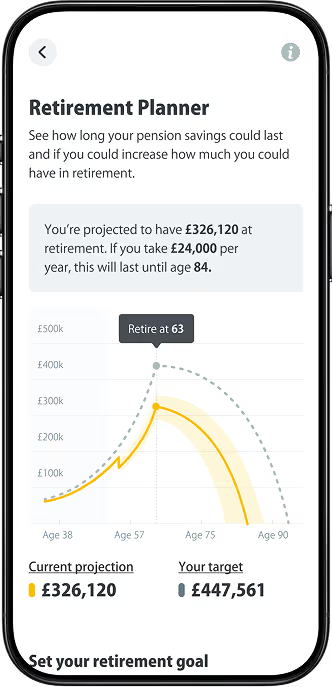
Who could you be with Pensionbee?

Combine your old pension pots into one new easy-to-manage online plan. It takes just a few minutes to sign up.

Get started
apple store bannerButton with Google Play logo and text 'Get it on Google Play' on a black background.