










The following is a transcript of a bonus podcast episode of The Pension Confident Podcast. Listen to the episode or scroll on to read the conversation.
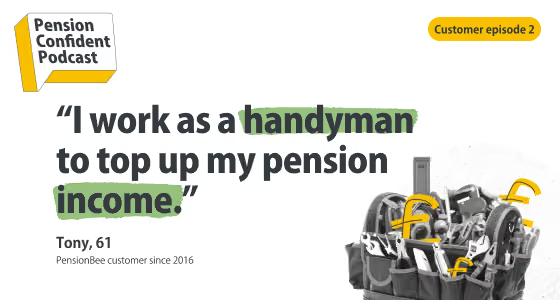
TONY: I work as a handyman, mostly to keep me active and engaged, but to also top up the pension monies being paid to me monthly.
PHILIPPA: Hi, welcome to another listener story. This time, we’re going to hear from Tony, as he tells us about how he’s making his finances add up now that he’s retired. He’s got a lot on his plate. He’s retired, but as he just said, he’s still working as a part-time handyman. It’s a nice mix, but he’s also juggling income from a bunch of places. Pensions, that part-time work, other accounts, too, all with different rules and tax implications. So it’s complicated. He’s going to tell us his own story in a moment.
And then Rachael Oku, who’s VP Brand and Communications at PensionBee, and quite the pension pro herself, she’s going to help me unpack his story and pull out some useful lessons and tips for the rest of us.
Hi, Rachael.
RACHAEL: Hi, Philippa.
PHILIPPA: Just before we get into it, here’s the usual disclaimer. Please do remember, anything discussed on the podcast shouldn’t be regarded as financial advice or legal advice, and when investing, your capital is at risk.
Now, let’s hear from Tony.
The rise of phased retirement
TONY: My approach to saving has always been to understand how much I need to be comfortable in full retirement, and I can turn the handyman job up and down depending on how much additional income I want to earn. The work cycle is a series of peaks and troughs, these representing times of the year to help subsidise holidays, family commitments, etc.
PHILIPPA: OK, so Rachael, Tony is drawing down (as the technical phrase goes) from various different pots, but he’s still earning some income to top it up. This sort of ‘phased retirement’, it’s getting more common, isn’t it?
RACHAEL: Yeah, absolutely. We’ve seen a rise in part-time work and people aged over 65 and not quite ready to fully retire yet. So there are a few things to be aware of. I think the main thing is that if you have a defined contribution pension and you’re drawing down, 25% is tax-free [subject to a cap of £268,275]. So you can either choose to withdraw this as a lump sum or you can take 25% off tax-free on every withdrawal that you make [from 55, rising to 57 in 2028].
PHILIPPA: But the rest?
RACHAEL: But the rest is going to be taxed at your marginal rate. So if perhaps you’re like Tony and you have a few different sources of income, maybe you’re drawing down from your pension, you have a part-time job, you need to be mindful of the tax brackets and maybe timing your withdrawals.
PHILIPPA: But the good thing here is he’s leaving money in his pension, and of course, that continues to grow.
RACHAEL: Yeah, that’s the beauty of drawdown. You’re not withdrawing it all in one go like you would if you were buying an annuity. You’re leaving whatever you don’t withdraw invested. And the longer you’re in the market, the more time or the more opportunity you have for that money to grow.
PHILIPPA: So that’s the advantage, isn’t it? Of continuing to work, even if it’s part-time, you can use that income to live.
RACHAEL: Yeah, pay for your everyday expenses. And then, as Tony said, use your pension for some of the bigger life things that you want to do.
PHILIPPA: Now, it sounds like Tony, like lots of us, wanted to understand how much he needed in cash terms to be comfortable in retirement. And this is always going to be different for everyone, but there are some benchmarks, aren’t there, to help us work out how much that might be?
RACHAEL: Yeah. So Pensions UK do a piece of work every year called the Retirement Living Standards, and they suggest what individuals or couples might need for a minimum, a moderate, and a comfortable lifestyle in retirement.
PHILIPPA: OK. What sort of numbers are they saying?
RACHAEL: So if you’re a single person, it’s around £44,000 for a comfortable retirement. If you’re in a couple, that’s about £60,000. So it’s a slight saving if you’re combining your income with somebody else.
PHILIPPA: Quite a big saving.
RACHAEL: Yeah, but it’s clear from these numbers that the State Pension isn’t going to be anywhere near enough.
PHILIPPA: And those numbers, they do assume you own your own home. Is that right?
RACHAEL: They do. They don’t include living costs, whether that’s rental payments or mortgage repayments.
PHILIPPA: So that’s definitely something to think about. Let’s hear from Tony.
Balancing mortgage payments and pension contributions
TONY: Saving has always been a focus in my life, contributing to a pension fund. Any additional monies earned through bonuses, etc., went to savings accounts to earn as much interest as possible. And having a family, pay for any educational needs, etc., that may come up in later life.
When I left the corporate world at the age of 55, the plan was always to pay off the mortgage and draw down on some of the pension monies. Both of my pension funds had small amounts withdrawn, but a monthly contribution is still being made to one fund to help top it up, and of course, get the government tax relief. But I’m also very fortunate to have received monies from my parents’ estate upon their death.
PHILIPPA: So Tony’s talking here about a very common situation: homeowners balancing their pension contributions with their mortgage payments. I mean, we have talked about it a lot of times on the podcast. Can you just run us through the pros and cons of allocating your money to each?
RACHAEL: So paying into your pension has lots of tax benefits, for example. So on the way in, when you’re contributing, you usually qualify for tax relief. And then on the way out, when you’re withdrawing your pension, you can get 25% tax-free [from 55, rising to 57 from 2028]. With property, though, I think there’s a lot to be said for owning your own home and paying off your mortgage and that sense of achievement you have once you’ve done that. But I suppose a pension is a lot easier in some ways to access in retirement. Whereas if you have a property, you’ll need to sell it to access the money or to downsize or take a lodger, do something that will help your property earn you that income.
PHILIPPA: Yes. And it might not be an ideal time for you to sell either.
RACHAEL: No, there’s no way of timing the market. The property market is up and down. And if you really need to sell and retire at a certain point in time, you’re going to have to sell regardless of what the market is doing. So you could potentially lose money.
PHILIPPA: OK. But if you’re loving this idea of paying off your mortgage - and who isn’t - to reduce your housing costs before you retire. If you can, it’s always good to keep on contributing to your pensions, isn’t it? Even through the tough times, even if it’s less than normal, don’t stop.
RACHAEL: Yeah, exactly. I think if you can, try and do both. If you do have to reduce your pension contributions, reduce them. But as you say, don’t stop.
PHILIPPA: You can pop them up again in a better time.
RACHAEL: Yeah, revisit when your finances are a bit more stable.
PHILIPPA: So he also talks about receiving an inheritance. Now, obviously, that’s a bittersweet experience, but great to have. What are the rules there for people to think about?
RACHAEL: Yes, Inheritance Tax can be quite complicated, but there are a few things to remember. So it’s typically only due after £325,000. That’s the current threshold as it stands today [2025/26].
PHILIPPA: So it’s quite a high ceiling.
RACHAEL: It’s quite a high ceiling. And if the estate is worth less than that, which is your property, your savings and investments, any cash that you have, altogether, if that’s less than £325,000, then it should be tax-free.
PHILIPPA: But if it isn’t?
RACHAEL: If it isn’t, then 40% Inheritance Tax applies.
PHILIPPA: OK, so it’s a steep tax rate.
RACHAEL: It’s a steep tax rate, and the rules are due to change in April 2027. It’s not 100% clear yet exactly how they’ll change, but it’s been earmarked for some changes.
PHILIPPA: So definitely dig into the details before you make any decisions on that.
RACHAEL: Yeah, absolutely. We’ve got a guide on the PensionBee website in our Pensions Explained section.
PHILIPPA: OK, and we’ll put a link to that in the show notes. There are other ways you can leave money to loved ones, aren’t there?
RACHAEL: So yes, there are other ways to leave money to loved ones. So you can leave money via a pension. If you pass on your pension before the age of 75 and haven’t started withdrawing, your beneficiaries can usually inherit that tax-free. There’s also property, but the rules can be quite complicated. So it’s definitely worth doing your research before you start planning.
PHILIPPA: OK. Now in the next bit, Tony highlights a challenge that I think many retirees face when they start drawing down from their pensions, while at the same time, they’re still trying to make new contributions.
Navigating different allowances for different accounts
TONY: The main thing I find challenging about my personal pension, now that I’ve drawn down some monies, is linked to the amount I can put back into my pension pot. I’ve always wanted to continue contributing to top up the pot and also benefit from the tax efficiencies this offers.
However, as the amount I’m now able to contribute is reduced, I only add a small sum each month. The focus has now been to look at, and set up, high interest bearing accounts such as an ISA and fixed rate options to allow saving fund growth. Also, monitoring the markets for best rates is key to getting the best return.
PHILIPPA: OK, so Tony’s referring there to pension rules changing once you start withdrawing. And this is something that can really easily trip people up, isn’t it?
RACHAEL: Yes, absolutely, especially if they have a defined contribution pension, which is the most common type. So once you start withdrawing and actually accessing your money [from 55, rising to 57 in 2028], the amount that you can continue saving or effectively put back in is restricted by what’s called the ‘money purchase annual allowance’ (MPAA). And that means that instead of having your allowance of 100% of your salary, up to £60,000, that is reduced down to £10,000 [in 2025/26].
PHILIPPA: So for higher earners, that could potentially be a huge drop in how much you can pay into your pension?
RACHAEL: Yeah, absolutely.
PHILIPPA: OK.
RACHAEL: So it’s not a bad idea to consider other savings options too, just like Tony is doing. He’s using his ISA allowance, and as it stands now, that’s £20,000 a year [2025/26], which you can use across a range of ISAs, from your Stocks and Shares ISA to a Cash ISA, and also a Lifetime ISA [LISA], depending on how old you are. Because I think that’s capped at 50. You can make contributions into that until you’re 50 years old. But because Tony is over 40, he could open just a Cash ISA or a Stocks and Shares ISA.
PHILIPPA: OK.
RACHAEL: And then if Tony’s earning interest on his fixed rate accounts, the ones that he mentioned, he might want to pay attention to his Personal Savings Allowance because that’s the amount of interest that you can earn on your savings before a tax charge is applied. And it depends on which Income Tax band you’re in. But if you’re in the basic tax bracket, you have £1,000 before you need to pay any tax. It’s £500 for higher rate taxpayers. And then there’s no allowance if you’re an additional rate taxpayer.
PHILIPPA: OK. This has been a bit of an issue, hasn’t it? Because we’ve had high interest rates, we’ve had more savers being at risk of exceeding that Personal Savings Allowance and having to pay tax. So it’s really one to watch, isn’t it?
RACHAEL: Yeah, definitely. It’s been a lot easier in recent years to come close to that Personal Savings Allowance of late or to exceed it. So for example, if you save £20,000 in one year at a 5% fixed rate, that could earn you £1,000 in interest, which would be just the allowance for a basic rate taxpayer.
PHILIPPA: Anything else you earned will be taxable?
RACHAEL: Yeah.
PHILIPPA: OK. Well, I hope we’re pulling some useful lessons out of this for everyone. We’ve got one final clip from Tony, and in this one, he looks ahead and he thinks about his options as he gets further into retirement and he gets older. Here he is.
Waiting on the State Pension to fully retire
TONY: My desire to stop work isn’t urgent as I really enjoy what I do. The challenge for me is the physical nature of some of the things I do, and I know as I get older, I’ll reduce some of the types of work undertaken. The plan is at least to continue till I’m 67. When at present, this will allow me to take my State Pension. This, combined with existing pensions, will allow me a minimum income of circa £36,000.
Health-wise, I may decide to continue doing some less physical work, as I’ll always need a daily stimulus. I can consider also increasing the drawdown on one of my pensions to increase my income, but understand that this impacts on the pot fund longevity. Also, my wife works in the education sector and is also considering her retirement options. This will also enable a larger joint pension pot to live off.
PHILIPPA: OK, so Tony is looking ahead to receiving the State Pension, and obviously, that’s going to be another source of income for him. We know it’s not a lot of money, so it’s obviously always going to be wise to try and build other savings, too. Just to remind us how the State Pension works right now.
RACHAEL: The State Pension is a regular payment that you receive from the government once you reach the State Pension age, and it’s designed to help support you in retirement. But you don’t automatically qualify for it, you have to make National Insurance contributions (NICs) through your working life. To qualify for the full [new] State Pension, which is approximately around £12,000 a year [2025/26], you have to pay in 35 years’ worth of National Insurance contributions, and to get the minimum amount, you have to pay in 10 years. Both men and women can currently claim this at age 65, but the age is increasing. So for those born after 5 April 1960, as Tony was, it’ll gradually rise until it reaches 67 in April 2028, and then it’ll move to age 68 for those who’re born after April 1977. So it’s something that is gradually increasing month by month.
PHILIPPA: Now, very handily, you can check what you’re going to be eligible for, can’t you?
RACHAEL: Yes, you can check on GOV.UK. There’s a State Pension checker.
PHILIPPA: Now, Tony highlights a really good point about expecting the unexpected, especially in later life. So you can’t take things like your health or your income for granted, can you? You never quite know what’s ahead as you get older. What could listeners do to better prepare their finances?
RACHAEL: Yeah, I think there’s a lot to be said about planning for the unexpected. You know, your life might look a certain way today, and sometimes it can be hard to think about the future and how you’re going to age and how you might be impacted by different things. So that could be changes in your health, your actual ability to work, which Tony does reference. He’s feeling fine now and fit and healthy, but he does expect that the types of jobs he’ll be able to do will change the closer he does get to that retirement. But also factoring in your partner’s retirement plans and having resilience to make any unexpected shocks less damaging. But there are two things that you can consider doing, which is, first of all, knowing how much money you have saved. Perhaps it’s in a few different pots, so it’s figuring out where that money is and how much you have.
PHILIPPA: This sounds really obvious, doesn’t it? But a lot of people don’t know.
RACHAEL: Yeah.
PHILIPPA: You’ve got fragmented pension pots or savings accounts here and there. Actually knowing how much you’ve got is not quite as straightforward as you might think, is it?
RACHAEL: No, I mean, totally. That’s why PensionBee was set up to help people to bring those pension pots together and to consolidate them. And it’ll get much easier once the Pensions Dashboards are introduced in the next year or two, where people can have a holistic view of all of the pots in their name and link to their National Insurance number. But for now, I think the challenge a lot of people face is remembering that they even had a pension and also who the provider is.
PHILIPPA: And the passwords and all the login details for all these financial products is fiddly, isn’t it?
RACHAEL: Yeah. If you’re Tony’s age and you’ve had a range of jobs through your life, I think the government predicts that the average is about 11 different pensions [throughout] your working life. So that’s quite a lot to keep track of if you haven’t consolidated them. So the first thing is knowing how much you have and where it is. And the second thing is, if you have a partner, to be open and honest with them about what your retirement goals are, how much you think you might need to live your life comfortably, and what your plans are in general for what you want to achieve with your money in retirement.
PHILIPPA: It can feel like a tricky conversation, can’t it? People don’t like talking about money.
RACHAEL: No, they don’t. But I guess the hope would be that when it’s your spouse and you’re planning for your last chapter in life, that it could actually be quite fun because you’re thinking about what you’re going to do when you have some freedom. You don’t have to work anymore. You’ve spent your whole life working and saving, and now this is the fun bit surely. You get to actually plan how to spend it.
PHILIPPA: Yeah, and that information sharing piece is really important, isn’t it? If you’ve both got savings, you’ve both got pensions. You need to be able to know where they are and how to get at them, don’t you?
RACHAEL: Yeah, absolutely. And to have that transparency with each other. The Retirement Living Standards talk about how much you need to live each year as a single person and as a couple. And it’s slightly less if you’re a couple. So I think pooling your finances and being transparent about how much you have as a combined unit can really help.
PHILIPPA: Absolutely. Thanks, Rachael.
RACHAEL: Thank you.
PHILIPPA: Thanks also to Tony, of course, for so generously sharing his story with us. Hopefully, you found some food for thought about your own pension journey there. We’ll be bringing you more of these stories all year.
If you’d like to find out more about pensions and retirement planning, head to the show notes for the episode. We’ve shared a tonne of resources there for you to have a little trawl through, to explore, and to use.
Now, here’s a final reminder before we go that anything discussed on the podcast shouldn’t be regarded as financial advice or as legal advice. When investing, your capital is at risk. Thanks for being with us.
Risk warning
As always with investments, your capital is at risk. The value of your investment can go down as well as up, and you may get back less than you invest. This information should not be regarded as financial advice.
Period | Market Event | FTSE World TR GBP (%) | 4Plus Plan (%) |
|---|---|---|---|
4Plus Plan’s inception – 6 Sept 2013 | QE Tapering, China Interbank Crisis and its aftermath | -5.44 | -2.41 |
3 Oct 2014 – 15 May 2015 | Oil price drop, Eurozone deflation fears & Greek election outcome | -5.87 | -1.77 |
7 Jan 2016 – 14 Mar 2016 | China’s currency policy turmoil, collapse in oil prices and weak US activity | -7.26 | -1.54 |
15 June 2016 – 30 June 2016 | BREXIT referendum | -2.05 | -1.07 |











%201.png)