











A workplace pension is a valuable employee benefit. It's also one of the most effective ways to save for retirement, because your employer contributes too.
If you're thinking about asking your employer to pay more into your pension, it's worth doing some research first. Understanding how Auto-Enrolment works, knowing what's typical in your industry, and preparing your case, can make the conversation easier.
Here's what to know before speaking to your employer, how to ask for an increase, and what to do if they say no.
How does Auto-Enrolment work?
Auto-Enrolment is a UK law. It means most employees - both full-time and part-time - are automatically signed up to a workplace pension by their employer.
To qualify, you need to be aged 22 to State Pension age (66, rising to 67 from 2028), earn at least £10,000 a year and work in the UK. You also can’t already be a member of a workplace pension scheme.
If you earn less than £10,000, but above £6,240, you won’t be automatically enrolled. However, if you ask to join, your employer can’t refuse you and must make contributions on your behalf.
If you’re eligible, your employer must pay in. The minimum contribution from your employer under Auto-Enrolment rules is 3% of your qualifying earnings. This is your annual earnings between £6,240 and £50,270 (2026/27). You can then pay in 5%. Together, that makes 8%. Your 5% includes basic rate tax relief, so your actual cost is usually 4%. Basic rate tax relief means part of your 5% comes from the government, not your own pay.
Some employers pay more than the legal minimum. Government figures show that employer pension contributions tend to be much higher in financial and insurance services (around 9%) than in construction (around 3%).
The legal minimum stays at 8%, no matter how long you've worked for your employer. Some employers do pay more the longer you stay, so it's worth checking your pension scheme rules.
Will my employer match my pension contributions?
An employer may also offer to match your contributions. This means they'll pay in more if you agree to pay in more too. For example, if you both pay in 5%, the total going into your pension would be 10% of your salary.
This all depends on your employer, your pension scheme, and your own role and seniority.
What difference will it make if my employer pays more?
A small increase in employer contributions could make a big difference over time. The more that's paid into your pension, the more you could have in retirement.
Extra contributions also give your pension more time to benefit from potential investment growth and compounding. Compounding is when any returns you earn go on to earn returns of their own.
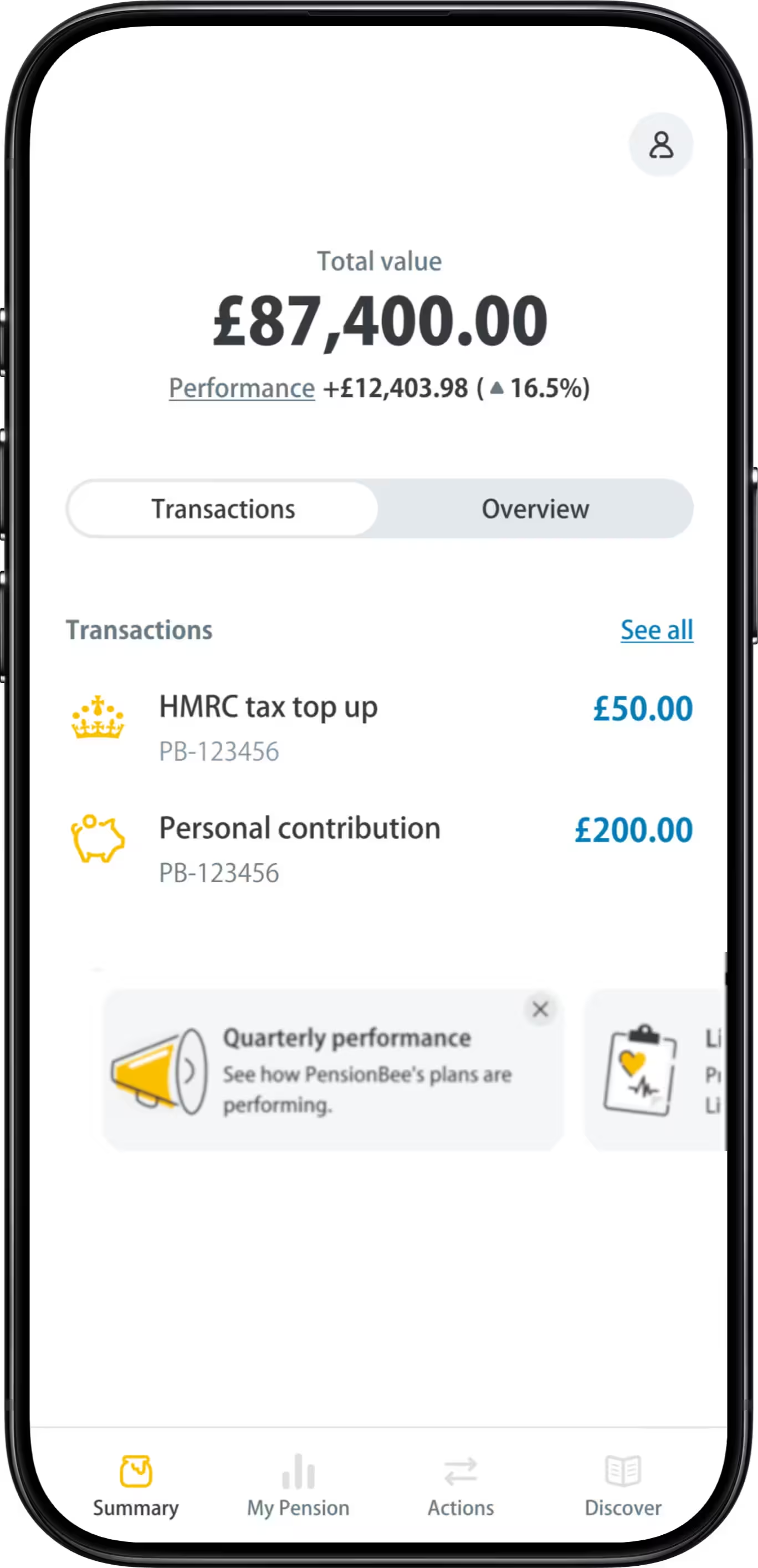
Plus, most UK taxpayers get tax relief on their personal pension contributions. This means the government effectively adds money to your pension pot. Basic rate taxpayers usually get a 25% tax top up. So if you pay in £100, HMRC usually adds £25, bringing your total to £125.
Even an extra 1% from your employer could make a noticeable difference. The exact amount depends on your salary and on investment returns, which aren't guaranteed.
How can I ask my employer to pay more towards my pension?
Asking your employer for more can feel daunting. But a little preparation can go a long way.
Here’s what you can do get ready:
- Check your contract - look at your pension details for any rules on employer contributions. Your HR team should be able to explain your options.
- Do some research - find out what's typical in your industry and for your level. Job adverts and trusted colleagues can be useful sources.
- Review your pension - check your latest statement so you know exactly how much you and your employer currently pay in.
Once you’ve done your due diligence, you can:
- Arrange a meeting - you can raise it during a one-to-one or performance review. Be clear about the contribution level you'd like.
- Follow up in writing - it can be a good idea to send a short email after the meeting, confirming what you discussed and any next steps. That gives you a record to refer back to.
If your employer agrees, they'll usually arrange the change through your workplace scheme.
If they say no, don't be discouraged. Ask whether a smaller increase is possible, or discuss salary sacrifice if it's available. Salary sacrifice means you give up some of your salary, and your employer pays that amount into your pension instead.
There may be budget reasons why your employer can't increase contributions right now, but they should be able to explain why and tell you when to ask again.
{{main-cta}}
What happens if I'm self-employed?
If you're self-employed, instead of a workplace pension you may have a Self-Invested Personal Pension (SIPP) or a personal pension.
The main difference between SIPP and personal pension is control. A personal pension invests your money for you, in a ready-made plan. A SIPP lets you choose your own investments, such as funds, shares, or commercial property. Both let you pay in what you can, when you can, which makes them appealing for self-employed people.
When you work for yourself, saving for retirement is entirely your responsibility. You don’t benefit from a workplace pension and employer contributions. Any boost in contributions has to come from you so it’s important to be aware of the annual limits and tax details.
The annual allowance is the limit on the gross amount that can be saved into a pension (whether that’s a personal pension or a SIPP) each tax year without incurring tax charges. The current standard annual allowance for pension contributions is £60,000 (2026/27), and this includes personal, employer and any third party contributions.
Can I ask my employer to pay into my SIPP or personal pension?
If you work full-time and already have a SIPP or a personal pension, your employer might be able to pay into it directly.
Most companies set up Auto-Enrolment with one pension provider for all their staff. But this isn't always the case. If you work for a small company, and your employer is happy for you to use your own pension, you may be able to ask them to pay into it instead.
Employer contributions work the same way whether they go through Auto-Enrolment, a SIPP, or a personal pension. They're free from Income Tax and National Insurance (NI), and they still count towards your annual allowance of £60,000 (2026/27).
There's a separate limit on tax relief. You can get tax relief on personal and third party contributions up to 100% of your salary or relevant earnings, capped at £60,000 a year (2026/27). Tax relief isn't applied to employer contributions.
Summary
Asking your employer to pay more into your pension starts with research. Check your contract, see what's typical in your industry, and review your latest statement. Then raise it in a meeting and follow up in writing.
If they say yes, the extra contributions could make a real difference over time, thanks to tax relief and investment growth. If they say no, ask about smaller increases or salary sacrifice, and try again later.
If you're self-employed, you can pay into your own personal pension instead. And if you want to help someone else save, you can make third party contributions to their pension too.
Rebecca Goodman is a freelance Personal Finance Journalist. She regularly writes for several national newspapers including the Independent, the Mail on Sunday, the Sun, and the Guardian along with a number of specialist publications.
Risk warning
As always with investments, your capital is at risk. The value of your investment can go down as well as up, and you may get back less than you invest. Tax rules can change and benefits depend on individual circumstances. This information should not be regarded as financial advice.
Period | Market Event | FTSE World TR GBP (%) | 4Plus Plan (%) |
|---|---|---|---|
4Plus Plan’s inception – 6 Sept 2013 | QE Tapering, China Interbank Crisis and its aftermath | -5.44 | -2.41 |
3 Oct 2014 – 15 May 2015 | Oil price drop, Eurozone deflation fears & Greek election outcome | -5.87 | -1.77 |
7 Jan 2016 – 14 Mar 2016 | China’s currency policy turmoil, collapse in oil prices and weak US activity | -7.26 | -1.54 |
15 June 2016 – 30 June 2016 | BREXIT referendum | -2.05 | -1.07 |











%201.png)