The Buzz.

Read the latest pension news and retirement planning tips, from our team of personal finance journalists, investment professionals and money bloggers.

The 6 most costly pension mistakes to make in your 30s
Are you making any of these common pension mistakes? Here's why they're costing you money and some tips for how to fix them.

Retirement may still feel like a long way off, but the sooner you get on top of your pension situation the better. The government is increasingly concerned that people aren’t saving enough for retirement, and this means that many of tomorrow’s pensioners could really struggle to make ends meet.

But the news isn’t all gloomy: it’s not too late to get to grips with your pension and start saving your way towards a more comfortable retirement. If you’re making any of these six common pension mistakes, here are some tips for how to fix them.

1. Delaying starting a pension

To give you the best chance of enjoying a decent pension pot at retirement, you need to start saving into a pension plan as soon as possible. The later you start, the bigger the contributions you’ll have to make to get a reasonable retirement income.

What it’s costing you

If you start saving at age 30 and you contribute _ni_rate of a £30,000 salary, you could expect to have a pension fund of £196,100 at retirement. If you made the same contributions but you only started saving at the age of 45, your pension pot would be around £109,500 at retirement.*

How to fix it

Although retirement may feel a long way off right now, it pays to start saving straight away.

2. Opting out of your company scheme

Recent changes to legislation mean that companies must automatically enrol their employees into a workplace pension scheme. As a result, you have to actively opt-out if you don’t want a workplace pension. However, making the decision to opt-out could be costly.

What it’s costing you

Opting out effectively means turning down free money from your employer.

The new Auto-Enrolment rules compel your workplace to contribute towards your pension, as long as you’re paying into the scheme. The employer minimum contribution is currently 2% of your annual salary (rising to 3% in 2019), but many workplaces offer ‘contribution matching’, which means they’ll increase their contributions if you increase yours.

Opting out of your workplace pension effectively means turning down free money from your employer.

How to fix it

If you’ve already opted out, contact HR about signing up.

3. Leaving your pensions languishing

We keep talking about your ‘pension pot’ as a single thing, but many people actually have several pension funds because they’ve moved jobs a few times. It’s easy to push this to the back of your mind, but the fact that your pension isn’t in one place can have a real impact on your retirement savings.

What it’s costing you

Well, the problem is, it’s actually hard to know this until you start tracking down your old pensions and sifting through the paperwork. You may be losing out because you’ve got money sitting in a poorly-performing fund, or because your pension provider is charging high fees.

How to fix it

Start by tracking down those old pensions. We know this can seem like a huge task, but PensionBee can help if you choose to join us. The more information you can give us about them the better as this can really speed your transfer up, but don’t worry if you don’t have your policy number to hand – we don’t necessarily need it and you can always add it later.

{{main-cta}}

4. Thinking property is your pension

It’s tempting to hope that your home or buy-to-let property will tide you over in retirement. This isn’t a good idea for a number of reasons: firstly, it puts all your financial eggs in one basket, meaning you’re at the mercy of the property market, which is often unstable.

Plus, homes are costly because they require constant upkeep and maintenance, and the capital can only be realised when you’re ready to sell.

What it’s costing you

A good pension plan will let you spread your assets across a range of funds, so that your money is invested in a combination of categories like shares, bonds, property and cash. Unlike relying solely on property, this means that your investments are diversified.

If you pay £8,000 into your pension, HMRC adds _tax_free_childcare of tax relief.

If you rely on property instead of a pension you’re also missing out on all the extra money that’s added to pension pots. Not only will your employer contribute to workplace schemes, but the government also adds money in the form of tax relief.

For example, if you pay £8,000 into your pension this year, HMRC adds another _tax_free_childcare in the form of tax relief, to give you a _money_purchase_annual_allowance total.

How to fix it

Property can still be a good investment, but make sure you start a pension plan too.

5. Letting fees eat your pension

You probably know that your pension provider charges a management fee, but did you know about the whole host of other fees that they may also be taking from your pension funds? Often hidden in the small print, sneaky pension provider fees may include a ‘contribution fee’, an ‘inactivity fee’ and an ‘exit fee’. According to a recent YouGov poll, 89% of people know little about the fees they’re paying.

What it’s costing you

These fees can have a big impact on your pension pot at retirement. For example, if you’re paying an annual fee of 2%, this could reduce your pension pot by 36% by the time you retire.**

How to fix it

If you sign up to PensionBee, once we’ve found your old pensions we’ll combine them in a new, good-value plan. We’re upfront about our fees: we only charge a single annual fee and there’s no hidden costs.

6. Ignoring your pension plan

When did you last check your bank balance? Chances are, more recently than you took a look at your pension balance. It’s important to keep checking your pension to make sure you’re on track to a reasonable retirement fund.

How much it’s costing you

It’s often hard to tell, as many pension providers send reams of paperwork through the post with the figures buried. To see whether you could be losing out when you retire, you need to know how your funds are performing and whether you need to make any adjustments. At the very least you should check your pension every year and each time your circumstances change.

How to fix it

If you pick a PensionBee plan, you will have 24/7 online access to your pension, so you can easily check how much money is in your pension pot, how your funds are performing, and how much you’re likely to receive on retirement.

Have you made any of these pension mistakes? Are there any you think we’ve missed? Let us know in the comments section at the bottom of the page!

* These figures are intended for illustration only. As with all investments, capital is at risk and the value can go down as well as up. We have assumed a retirement age of 65, that your plan earns a 5% return before the effects of inflation and have taken inflation of 2.5% into account.

** Standard assumptions apply. This calculation is based on a pension pot of _isa_allowance, and is an illustration of how much the fees may reduce your pension pot by, when you reach retirement age.

What to do with your savings when interest rates are low
Interest rates are dismally low for savers, so how can you make the most of your money?

NatWest recently suggested that they may introduce negative interest rates for business accounts, meaning that customers may actually be charged for making deposits. This has led to some wondering whether an ‘under the mattress’ approach to saving is better than having cash in the bank.

While there’s no suggestion that personal account holders will face negative interest rates, saving rates have been dismally low for a while, and the news has made some savers nervous.

If you’ve got money saved, here are some options for what to do with it while rates remain at rock-bottom.

Pay off any debts

Credit cards

If you have any outstanding debts like credit card or loan debt, then it’s usually smart to start by paying these off, as you’re likely to save more money on the loan interest than you’d earn on any savings interest.

You can also consider making mortgage overpayments, but check first that your mortgage provider won’t hit you with penalties. You can use Money Saving Expert’s mortgage overpayment calculator to get an idea of the impact mortgage overpayment could have.

Shop around for a better current account

Calculator

Some standard bank accounts are offering surprisingly good interest rates of as much as 5%, so switching could be a wise move.

Read the terms carefully though: you often need to pay in a minimum amount of money each month to qualify for these accounts, and the interest rate may drop after the first 12 months. Some accounts will also charge you a monthly fee.

Regular saver accounts

Piggy banks

Also make sure you’re getting the best deal possible on your regular savings account, as some are currently offering up to 6%.

Again, make sure you’re clear on the minimum amount you’ll need to save each month, and check if there’s cap on the amount of savings eligible for the advertised rate.

Help to Buy ISAs

Help to buy

If you’re hoping to buy your first home, you can open a Help to Buy ISA and the government will add money to your savings. The government adds 25%, so that for every £200 you save you’ll get a top-up of £50, up to a maximum of £3,000.

When you’re buying your property, your conveyancing solicitor applies for the government bonus and it’s paid towards the cost of your property.

{{main-cta}}

Stocks and shares ISAs

Stock market

An ISA is a smart way to save, as it’s designed to be tax efficient. For 2016/17 the ISA allowance is £15,240.

A cash ISA is just a tax-free savings account, but a stocks and shares ISA means that your money is invested in things like bonds, shares and funds.

If you receive dividends (regular payments from investment profits) then the first £5,000 is tax free, and then further dividend payments from your stocks and shares ISA will be taxed at 7.5% if you’re a basic rate taxpayer.

Pay more money into your pension

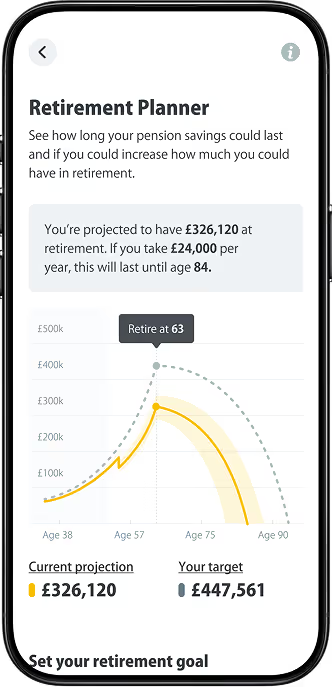
The PensionBee pension dashboard

Putting some of your extra money into your pension may be a good idea for several reasons. For starters, most good pension plans are diversified and managed by professional money managers, which helps to manage risk.

Secondly, the government adds money to your pension savings in the form of tax relief, so if you’re a basic rate taxpayer and you pay £8,000 into your pension this year, the government adds £2,000 in tax relief to bring you to a £10,000 total.

Plus, if you’re paying into a workplace pension your employer is obliged to contribute too, and some companies offer contribution matching, so if you increase your contributions they’ll do the same.

PensionBee can combine your old pensions into a new plan that you can manage online. Sign up to PensionBee here.

Investment funds

Money growth

Investment funds are a type of grouped investment. Your money is pooled with the money of other investors and used to invest in a range of assets. The idea is that your cash is diversified (spread out), which helps to manage the risk, and investment decisions are made by an experienced fund manager.

This can be a way for people without much investment experience and with a modest amount of money to take advantage of investment opportunities.

Peer-to-peer lending

If you’re up for trying something a bit different, peer-to-peer lending means you can lend money to businesses or other individuals through an online platform, making money from the interest they pay.

The main UK peer-to-peer lending platforms are Zopa, RateSetter and Funding Circle, and you may be able to earn interest of over 7%. However, it’s important to note that money you lend in this way isn’t covered by the Financial Services Compensation Scheme.

Risk warning

With all investments, your capital is at risk. The value of your investment can go down as well as up, and you may get back less than you invest. This information should not be regarded as financial advice.

Company collapses put pensions at risk
We've just heard news of the collapse of BHS, and the future of Tata Steel's UK plants is also looking gloomy. What does this mean for their employees' pensions?

Yesterday, we heard the news that 88-year old high street retailer British Home Stores (BHS) has gone into administration, putting almost 11,000 jobs at risk.

So far, shareholders have failed to find a buyer for the business, and the company’s huge pension deficit of £571m is part of the reason.

Pension Protection Fund

BHS pension scheme members will now rely on the Pension Protection Fund (PPF), which was started in 2005 to protect people in defined benefit pension schemes that become insolvent.

This will mean that those who expect to receive their BHS pension from the age of 60 could receive at least 1_personal_allowance_rate less than they expected. BHS defined benefit schemes (also called final salary schemes) were closed several years ago, but it appears that more than 20,400 past and present employees have paid into them.

The size of the BHS pension fund means that it’s likely to be one of the PPF’s biggest rescues.

The PPF is also preparing to help secure Tata Steel UK pensions, as the future of the Port Talbot plant remains uncertain.

If Tata Steel does have to rely on PPF, many of their 130,000 pension scheme members - in particular those who haven’t yet retired or those who took early retirement - could also find their expected pension amount reduced by 1_personal_allowance_rate.

{{main-cta}}

What does this mean for your retirement?

This is a worrying time for many, and it emphasises the fact that even defined benefit pension schemes are not a gold-plated guarantee of a certain retirement income.

Add to this the fact that cuts to the state pension are underway and likely to continue, and the future of tomorrow’s pensioners looks rather uncertain.

If you’re worried about your retirement income, investing in a variety of different products, including a workplace pension, a personal pension, and property and other investments, can help to spread your risk.

Here at PensionBee we’re on a mission to put you in control of your retirement savings. For more information about personal pensions, see our pensions explained article on SIPPs.

Please note that this article does not constitute financial advice. Contact a financial adviser if you need help with financial decisions.

Why fintechs should care about (un)Safe Harbor
Most fintech startups don't have an in-house legal expert, so many companies may have missed October's news that the EU's highest court has ruled that the Safe Harbor Framework, which permitted companies within the US to accept and process personal data of EU citizens on behalf of EU companies, is invalid.

There is a new buzzword in my life: fintech. And it would seem it’s not just me - many promising new financial technology initiatives are getting going in London. In my naturally unbiased opinion, PensionBee is undoubtedly the one to watch.

Fintech today is all about money - more precisely, the financial future of the customer. Protecting the personal data of those customers is a huge part of gaining trust and reliability as a startup.

Most startup teams don’t include a legal expert amongst their numbers, and fintech startups are no different. So many may have missed October’s news that the EU’s highest court has ruled that the Safe Harbor Framework, which permitted companies within the US to accept and process personal data of EU citizens on behalf of EU companies, is invalid.

This framework has been in place since 2000 and, due to the increased use of cloud computing over the last 15 years, the ruling affects almost every company doing business today, not just the giants like Facebook that were mentioned in the press.

{{main-cta}}

How many fintech startups are planning to take action to remain compliant under EU law?

At PensionBee, we decided that it was important to have a lawyer in our founding team. As soon as the court ruling was released, we were on top of the need to review our cloud service provider contracts and privacy policies. We signed up to new terms compliant with the EU ruling with a key supplier and we updated our privacy policy. As the supplier network and the UK government responds to the ruling over the coming months, we will be taking stock and staying on the right side of the law.

You don’t get this level of legal agility without investing in an in-house lawyer or an excellent outsourced legal team. Since a fintech product is effectively a legal product, you can’t get by without it.

How to plan your financial future without a financial adviser
Follow our quick-start guide to DIY financial planning to take control of your spending and saving.

If you’re feeling a bit lost with your finances, then turning to a financial adviser is an obvious option. But advisers can be expensive, and if your finances are relatively straightforward and your main aim is to get on top of your spending and make a savings plan, then it’s quite possible to do it yourself. Set aside a weekend and follow our quick start guide to DIY financial planning, also making use of the wealth of online tools out there, including downloadable budget spreadsheets and price comparison tools.

1. Get to grips with your income and outgoings

Start by making a spreadsheet that shows your income and your expenditure. You’ve probably got quite a clear idea of your monthly income, but gather your last few payslips anyway to check your take-home pay after deductions for tax, National Insurance, pension contributions and student loan payments. Remember to add on any extra income that you receive, for example from benefits, child maintenance, or pension payments.

Calculating your expenditure is always going to be a bit more complicated. Start by writing down the value of all your regular monthly payments with the help of your bank statements, online banking log, or utility bills. Common household payments include:

  • rent or mortgage payments
  • debt repayments
  • utilities like gas, electricity and water
  • council tax
  • internet and landline
  • mobile phone contract
  • music or video subscriptions
  • satellite TV
  • insurance (house, car, life, pet etc.)
  • childcare
  • gym membership
  • parking permits

Next you need to list other costs, that are likely to vary more significantly from month-to-month. You should be able to do this by referring to receipts and your online banking record, but if you find it difficult you could try keeping a ‘spending diary’ over a month instead. The kind of costs you’ll be taking into account here include:

  • food
  • transport (e.g. fuel and train fares)
  • clothes
  • car running costs
  • pet care
  • household items and appliances
  • leisure (cinema, theatre etc.)
  • miscellaneous

2. Consider your long-term goals

Getting a snapshot of your current financial situation is hugely helpful and a big step on your financial planning journey. Now you can see clearly where you’re spending your money, you can think about your long-term financial aims and how you might need to change your spending and saving behaviour accordingly.

If you’re planning a big, expensive life change like buying a house, getting married or having a child, then you need to think carefully about how much money you’re going to need and how much time you’ve got to save it.

Even if you don’t have a big milestone ahead of you, your financial goal might be to have money for a nice holiday or a new car. If this is the case, put a figure on it, and keep this aim firmly in mind when you’re overhauling your finances.

3. Trim your spending

Once you’re clear about how much you’re trying to save, it’s time to figure out how to get there. Don’t be unrealistic and aim to deny yourself all pleasures in life, but look at your expenditure spreadsheet and think about how you might be able to cut down: could you shop in a less expensive supermarket, car-share to work or even just skip your daily latte? Also consider switching your utility providers if there are better deals available (there are several website to help with this), and set up direct debits if you currently pay by a different method.

{{main-cta}}

4. Take stock of your debts

What debts do you have, including any credit cards, loans and overdrafts? If you’ve got money left over each month then it’s a good idea to pay off these debts before you start saving, as the money you’re spending on interest is likely to outweigh the amount you’d make on your savings.

Stop using really expensive credit like store cards, and possibly consider transferring your credit balance onto a card with a _personal_allowance_rate rate to give you a break from interest payments. Exercise caution if you take this option though, as when the interest free period ends, you’ll often be switched on to a really high rate if the debt isn’t paid off.

5. Set up your savings

In light of your long-term goals and considering that it’s always good to have a cushion for emergencies, set yourself a realistic monthly saving target and set up a regular payment for moving money from your current account to your savings account. An ISA is a really good option, as it offers tax-free saving. The limit to the amount that you can put into an ISA is currently £15,240 for the tax year 2015/16.

The other main method of tax-efficient saving is to save into your pension. The standard amount of tax relief is a _corporation_tax tax top up for basic rate taxpayers, meaning that if you put £8,000 into your pension pot, HMRC effectively adds another _tax_free_childcare. PensionBee can help you take control of your retirement saving by finding your old pension pots and combining them into a single, low-cost plan.

6. Financial planning for higher sums

If you’ve followed these steps but you’ve got substantial savings that go far beyond your ISA allowance and you’re already paying a significant amount into your pension, there are of course many options available to you. You could put money into property, invest in shares or bonds, or even consider peer-to-peer lending.

The decision on what to do with your money will largely depend on how much risk you want to take and how much access you need to your money. If you’re dealing with large amounts of money or your financial situation changes significantly, this could be a good time to seek professional help.

The 5 most outrageous pension fees
The PensionBee team have uncovered some of the most scandalous pension fees out there. Find out how your pension provider is taking cash from your retirement fund through extra charges that are often buried in the small print or hidden behind benign-sounding jargon.

You probably know that your pension provider charges you an annual management fee, but are you aware of the whole host of additional fees that they may be taking from your pension pot? These extra charges are often buried in the small print or hidden behind benign-sounding financial jargon, but their impact can be huge: research has shown that some people could pay up to two thirds of their money in fees over the course of a lifetime. We think this is pretty outrageous, so we’ve uncovered some of the most scandalous pension fees out there.

1. The service or policy fee

You may think that the cost of managing your pension is covered by your annual management charge. While that’s a reasonable assumption, it’s not necessarily the case. Some providers stick on a separate policy fee, apparently to cover ‘administration costs’.

2. The contribution fee

Your pension provider is happy when you put money into your pension, right? Well if so, contribution fees are a funny way of showing it. Some providers will take a cut of your contributions, for example taking 2% of each payment you make into your pension pot, on top of the annual management fee they’re charging.

3. The inactivity fee

If you stop paying into your pension, you may be penalised in the form of an inactivity fee. These fees are often given a positive spin, referred to as ‘active member discounts’. However you dress them up, these are essentially charges that you have to pay because you’re no longer paying money into the scheme, perhaps because you’ve changed jobs.

{{main-cta}}

4. The exit fee

So you may face a fee for keeping your money where it is, for adding more money to your pension pot, or for stopping your contributions. But if you try to move your pension away from the scheme… Yep, you guessed it, you may get hit with a fee there too. Although we know from experience there are costs associated to move a pension, some providers try to lock you in by charging steep exit fees if you try to move your money to another provider.

5. The platform fee

Sounds mysterious, doesn’t it? We’re not sure why it’s necessary either, but some providers have found another fee to add in the form of a ‘platform fee’, apparently for the privilege of using their service.

These are just some of the fees that you may be paying, out of a total of around 18 different charges levied by pension providers. At PensionBee, we do things differently. We charge a single annual management fee. There are no hidden service fees, platform fees, or any other kind of fees.

Risk warning

As always with investments, your capital is at risk. The value of your investment can go down as well as up, and you may get back less than you invest. This information should not be regarded as financial advice.

Thank you! Your submission has been received!
Oops! Something went wrong while submitting the form.

Recent articles

Put your pension
in the palm of
your hand

Combine your old pension pots into one new online plan. It takes just a few minutes to sign up.

Be pension confident!

Be pension confident!

Combine your old pension pots into one new online plan. It takes just a few minutes to sign up.
Combine your old pensions into one simple plan
Invest with one of the world’s largest money managers
Make paper-free online withdrawals from the age of 55
Pay just one simple annual fee
  • Sign up in minutes
  • Transfer your old pensions into one new online plan
  • Invest with one of the world’s largest money managers
  • Pay just one simple annual fee
Capital at risk
Button with Google Play logo and text 'Get it on Google Play' on a black background.