







On average, we’re living longer than before.
In 1917, King George V started the tradition of the monarch congratulating people on reaching their 100th birthday. That year, he sent 24 telegrams.
Fast forward to 2026 and it's very different. Today, King Charles III and the Queen write thousands of birthday cards each year to new centenarians.
Living longer is undoubtedly a good thing. But it does bring up key considerations, in particular how we fund those extra years.
Longer lives = more money to fund them
As we live longer, we need more money to support ourselves.
According to the Office for National Statistics (ONS) Life Expectancy Calculator, a 50-year-old man today has an average life expectancy of 83. He also has around a one-in-three chance of living to 90.
For women, average life expectancy is 87, with an almost one-in-two chance of reaching 90.
Not only that, but 8% of 50-year-old women and 4% of 50-year-old men today will make it to 100 and that coveted monarch’s message.
That would be a whole second half of a lifetime of spending to take into account.
The importance of planning for the future
With all these extra years, a part of our lives naturally extends: our working lives, our retirements, or whatever’s in-between.
Whichever it is for you, that could be more years than you expected to need to fund.
This is why planning ahead’s so important, ensuring as far as possible that you have enough savings for the future.
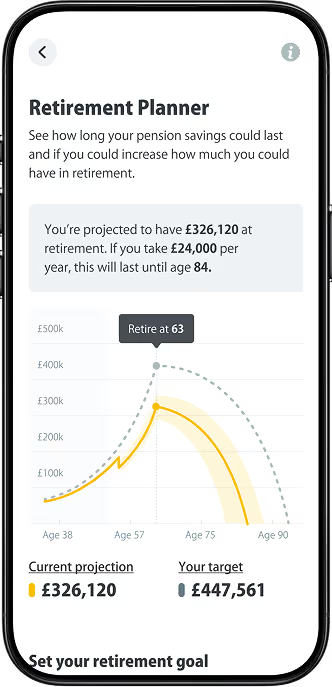
PensionBee’s Pension Calculator could help. Using it, you can input:
- your current age, and when you’d like to ideally retire;
- how much you have in pension savings;
- your ideal monthly retirement income; and
- how much you (and your employer, if relevant) are paying in.
You can also toggle for different levels of investment growth, whether you take your 25% tax-free cash at 55 (57 from 2028), and whether to include the State Pension.
The calculator then gives you an idea of how long your savings might last.
{{main-cta}}
3 ways to make sure you have the savings you need
The calculator arms you with helpful information. It might show you that you have enough for your lifetime.
Or it might reveal a shortfall. In that case, it gives you an opportunity to look at what you can do about it.
There are plenty of practical steps you can take to forward plan and build savings that’ll support you for the future.
Here are three.
1. Work for longer
Perhaps the easiest and most straightforward answer is to work for longer.
That way, you can keep earning and contributing to your pension (more on this in a moment), reducing the risk of running out of savings.
However, there are factors that could make this more difficult than you expect.
For one, the rise of Artificial Intelligence (AI) is changing the workforce. That’s removing roles that existed historically, and demanding new skills, especially in the digital space.
It can also be harder for older people to find work. Research shows that those aged between 50 and State Pension age (66, rising to 67 from 2028) are even more likely than younger people to be out of employment, education, or training.
So, while working for longer is an option, it might not be as easy as you think - or at least, it might look a bit different to your current situation.
2. Save more into your pension
Rather than continuing to work, you could simply save more into your pension during your working life.
By saving more and building a larger pot, you may be able to stop working when you currently plan to.
The combination of tax relief - government money you can receive on eligible personal contributions - and investment returns can help grow your pot. Paying more in can help you make the most of both of these features.
Plus, the earlier you start, the more you can take advantage of compounding - that’s growth on growth.
Compounding can supercharge the value of your pension savings. The longer you give it, the more time it has to snowball and build up.
3. Consider flexible retirement options
If both the options above sound appealing in different ways, you could combine them.
Instead of working for longer with no plan to stop, you could instead transition more gradually into retirement. This is often referred to as ‘flexible’ or ‘semi’ retirement.
For example, you might reduce your working hours and go part-time. You could move into a consultancy role, or even become self-employed, choosing as and when you work.
This could allow you to keep earning for a little longer, boosting your income and pension savings in your final years of work.
It can also be a gentler shift from your career into post-work life, making it less of a sudden jump and more of a natural progression.
Resources to help you plan for the future
Find out more about saving what you need for the future with PensionBee.
- Visit the Retirement Hub, where you’ll find planning tools, checklists, and how to find an expert to help you.
- Hear from PensionBee customer Nigel about how having the PensionBee app has let him reimagine life in retirement.
- Listen to Philippa Lamb and her panel discuss how to prepare for a 100-year life on The Pension Confident Podcast.
Summary
No matter which part of your life will be longer, or how you intend to fund it, all this shows the value of planning for your future.
By doing so, you’ll either gain the confidence that you’re well-positioned to have what you need.
Or you’ll give yourself the space to make changes now that’ll put you on track toward your target.
Planning now can remove some of that uncertainty and give you the chance to make sensible, long-term decisions around work and your pension.
Risk warning
As always with investments, your capital is at risk. The value of your investment can go down as well as up, and you may get back less than you invest. This information should not be regarded as financial advice.
Period | Market Event | FTSE World TR GBP (%) | 4Plus Plan (%) |
|---|---|---|---|
4Plus Plan’s inception – 6 Sept 2013 | QE Tapering, China Interbank Crisis and its aftermath | -5.44 | -2.41 |
3 Oct 2014 – 15 May 2015 | Oil price drop, Eurozone deflation fears & Greek election outcome | -5.87 | -1.77 |
7 Jan 2016 – 14 Mar 2016 | China’s currency policy turmoil, collapse in oil prices and weak US activity | -7.26 | -1.54 |
15 June 2016 – 30 June 2016 | BREXIT referendum | -2.05 | -1.07 |