







Are you on track for your dream retirement? Here’s what the Retirement Living Standards say




It’s difficult to know exactly how much you need to save for retirement. And it can be even harder to set the time aside to figure it out, especially when you’re busy working in the middle of your career.
But you don’t want to arrive at your ideal retirement age only to find out that you don’t have enough to do everything you want.
That’s why Pensions UK tries to help you answer this question with its Retirement Living Standards.
Showing you how much you might need for your retirement
Pensions UK is an industry body working on behalf of pension providers and savers. It aims to ensure that everyone’s able to retire with confidence. Its Retirement Living Standards are a useful tool for this.
Alongside Loughborough University, the campaign group speaks to members of the public from across the UK. It then uses the collected data to work out how people spend their time in retirement, and what their lifestyles cost.
From there, it creates the Retirement Living Standards. These show you what annual income you'd need to enjoy a minimum, moderate, or comfortable standard of living in retirement.
Pensions UK carries this research out each year to ensure the figures are accurate and in line with the current cost of living.
It just published its latest findings for the 2026/27 tax year. The table below shows you what income you’d need for these standards of living, depending on whether you’re a one or two-person household.
The differences between these standards of living could be larger than you think.
For example, a minimum lifestyle might sound like it’d be enough for you. But it assumes that you forgo things that you might see as basics, such as a car. You’d only be able to take a single week-long holiday in the UK each year, too.
A moderate lifestyle gives a bit more wiggle room. You’d have more money to spend on things like food, transport, and your home. You’d also be able to go on a three-star, all-inclusive holiday in the Med for a fortnight.
Meanwhile, a comfortable lifestyle would give you financial freedom alongside a few luxuries. That might be upgrading that three-star holiday to a four-star trip, or being better able to financially support your loved ones.
It’s also notable that the required income doesn’t double for two-person households. In fact, the same £45,400 income would give one person a comfortable retirement, but could provide a moderate standard of living for two people.
By sharing costs, two people can make a smaller income go much further by sharing costs. Whereas, a single person is responsible for all their outgoings. They have to cover bills which may be as high as couples, reducing how much they can spend on luxuries.
This phenomenon is sometimes referred to as the ‘Singles Tax’, and makes planning even more important if you live by yourself.
Just 9% of savers will achieve a comfortable retirement
These figures underline just how important it is to set money aside for your future.
In 2026/27, the full new State Pension pays £241.30 a week - that’s £12,547 a year. That isn’t even enough to fund a minimum lifestyle for a single person.
So, not saving for retirement could leave you with a shortfall. That’s a situation that’s facing millions of people, according to Pensions UK.
Their data shows that 82% of the working population will reach a minimum standard of living. However, that falls to 23% for a moderate standard, and just 9% for comfortable.
If a comfortable retirement sounds like what you want, you might need to plan ahead.
Inflation can push up how much you’ll need
Another factor to consider with these figures is how inflation can push them up over time.
Inflation measures the rising cost of living. Over time, goods and services become more expensive, meaning your outgoings increase. As a result, you’ll need enough in your pension to account for your lifestyle becoming more expensive over time.
The table below shows the Retirement Living Standards from 2025/26.
Over just one year, the annual retirement income you’d need has risen fairly substantially. This makes it important to consider inflation when planning for a retirement that will likely last upwards of 20 years.
Use PensionBee’s Inflation Calculator to see what your pension could be worth, adjusted for inflation.
How you can use the Retirement Living Standards to plan for later life
The Retirement Living Standards are by no means an exact science. They aren’t personalised to you, so what you need could be more or less than these figures. And that’ll entirely depend on what sort of lifestyle you want.
But they could be a great starting point for understanding what you want to achieve in retirement, and how much you’ll need to do so.
You might discover that you already have enough for the lifestyle you want. In that case, you could retire sooner than you might’ve first planned.
Or you could see that your ideal retirement is a bit more expensive than you thought. Armed with that knowledge, you’d be able to start making decisions with your money. That might be increasing your pension contributions so you’re able to reach your savings target.
To give you a clearer idea of what you could have, you can use PensionBee’s Pension Calculator.
When using the calculator, you input a few details such as your:
- current age;
- target retirement age;
- current combined pension pot;
- personal monthly and one-off contributions;
- employer contributions; and
- desired annual retirement income.
You can also choose to include the full new State Pension, and whether you want to take your 25% tax-free lump sum from 55 (57 from 2028).
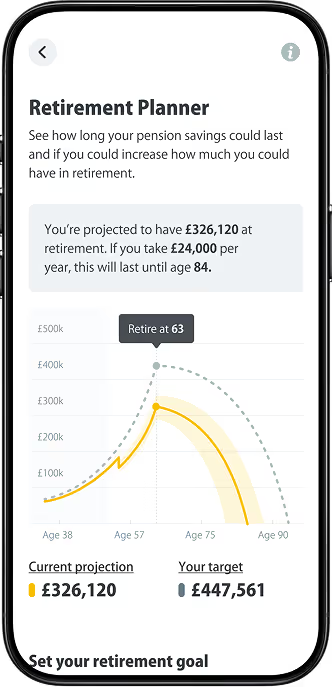
From there, the calculator will show you how long your savings could last, depending on how much you withdraw.
{{main-cta}}
Save for the retirement lifestyle you want with PensionBee
With PensionBee, you can combine your pensions into one pot that you can manage easily online.
Choose a pension plan that suits you, or stick with our default options. Contribute when and how much you like (subject to contribution limits), building a pot over time that’ll help you achieve your retirement goals.
Then, from 55 (rising to 57 from 2028), you can start drawing down from your fund. Whether that’s buying an annuity or making Automatic withdrawals, you have options for accessing your money so you can enjoy later life.
Risk warning
As always with investments, your capital is at risk. The value of your investment can go down as well as up, and you may get back less than you invest. This information should not be regarded as financial advice.
Period | Market Event | FTSE World TR GBP (%) | 4Plus Plan (%) |
|---|---|---|---|
4Plus Plan’s inception – 6 Sept 2013 | QE Tapering, China Interbank Crisis and its aftermath | -5.44 | -2.41 |
3 Oct 2014 – 15 May 2015 | Oil price drop, Eurozone deflation fears & Greek election outcome | -5.87 | -1.77 |
7 Jan 2016 – 14 Mar 2016 | China’s currency policy turmoil, collapse in oil prices and weak US activity | -7.26 | -1.54 |
15 June 2016 – 30 June 2016 | BREXIT referendum | -2.05 | -1.07 |











%201.png)