







Introducing a new return metric to your BeeHive: Personal rate of return



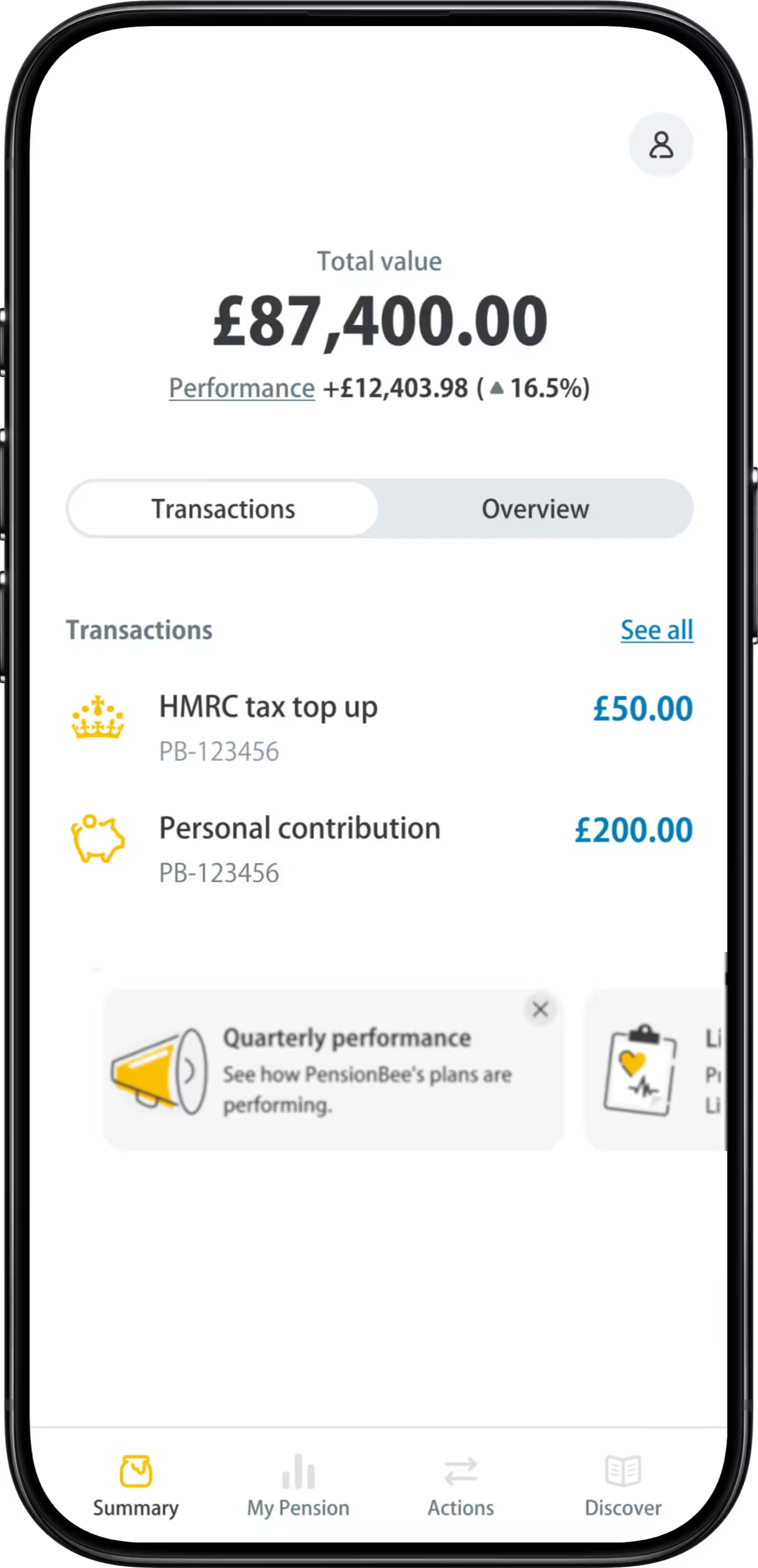
We’re adding a personal rate of return metric (also known as internal rate of return, or IRR) alongside your current simple return metric in your BeeHive’s ‘My Pension’ tab. Simple and personal rate of return metrics calculate performance differently. But a personal rate of return provides a clearer reflection of your pension's performance.
We're gradually rolling it out to customers. So, if you check your account through our website or an Android device, you’ll soon see this new metric. We’ll then start making it available to customers using iOS devices.
The benefits of a personal rate of return
A personal rate of return provides a more accurate picture of your personal investment performance. It also presents performance in a way that’s more consistent with standards across the broader financial industry, making comparison easier.
Pension balances change over time in a variety of ways: transfers in, ongoing contributions, withdrawals (currently available from age 55, rising to 57 in 2028), as well as the impact of fund performance and fees.
The personal rate of return takes all this into account. It’s the most effective way to measure your personal investment performance. Unlike other metrics, it factors in both the size and timing of your contributions and withdrawals. This provides a much clearer and fairer picture of how your account has performed over a specific time period.
It’s different from the return you’ll see on a fund factsheet or external fund site, which doesn’t reflect your personal cash flows (contributions and withdrawals). The more you contribute or withdraw from your pension, the more important it is to look at a metric that reflects your personal investment journey over time.
Current return metric: simple return
A simple return compares your current pension balance to the total net amount (net money in) you’ve paid in.
In basic terms, it looks at:
(Pension balance - net money in) / net money in
This calculation works well for a single lump-sum contribution, where no money is added or withdrawn. It’s shown as a percentage (%) return.
But, if you regularly contribute, transfer a pension, or withdraw from it, the simple return can distort your actual performance because it doesn’t consider the exact timing of those transactions.
Additional new return metric: personal rate of return
The personal rate of return gives a full picture of how your money has actually performed over time.
It takes into account the size and timing of:
- transfers in;
- contributions;
- HMRC tax top-ups;
- referral rewards; and
- withdrawals.
It also reflects:
- fund performance; and
- fees charged.
Factoring in when and how much money you added or withdrew gives a fairer reflection of your personal investment performance.
To calculate it, we use an internal rate of return (IRR) formula to give a percentage (%) return for a given time period. This approach works well for calculating investment returns involving multiple cash flows, which is common with pensions, given their long-term nature.
Example: last-minute end-of-tax- year top up
In the UK, the tax year ends on 5 April. It’s common for savers to make a final pension contribution just before the deadline to use up their annual allowance, which may be lost after tax year end.
The scenario for tax year 2025/26
- 6 April 2025 (start of tax year): You contribute £10,000 to your pension.
- 6 April 2025 - 31 March 2026: Markets perform well, and your investment grows by 20%, increasing to £12,000 (net of fee).
- 1 April 2026: With the tax deadline approaching, you contribute an additional £40,000 (including the HMRC tax top up).
- 1 April 2026 - 5 April 2026 (end of tax year): Markets remain flat during those final few days. Your total balance is now £52,000.
What a simple return shows
A simple return compares your ending balance to the net amount you invested.
- Total contribution: £50,000 (£10,000 + £40,000).
- Ending balance: £52,000.
- Simple return: 4%.
Now you log onto your BeeHive and see a 4% return. You think, “The market went up 20% this year, why did I only make 4%?”.
The reason is that the simple return treats your full £50,000 contribution as though it were invested at the start of the tax year. It dilutes your 20% gain because it spreads it across £40,000 that wasn’t actually in the account until 4 days before the end of the tax year.
What personal rate of return shows
A personal rate of return looks at how long your money was actually invested.
- Original contribution: £10,000 (invested for the entire year, 365/365 days).
- Recent contribution: £40,000 (added a few days before the year ended, 4/365 days).
- Personal rate of return: 19.2%.
Now you log onto your BeeHive and see a 19.2% return. The market went up 20% this year, and the return on your original contribution better reflects that.
The personal rate of return doesn't let a last-minute contribution skew your return performance because it’s based only on the money that was actually invested.
Let us know what you think
You’ll soon see both performance metrics in your BeeHive’s ‘My Pension’ tab. This update doesn’t affect your pension balance or how your money is invested in your chosen plan.
As mentioned, we’re rolling out this feature gradually, so you may not see it in your PensionBee account immediately, but it’ll be available soon.
Got any questions or comments about this change? Email us at feedback@pensionbee.com.
Risk warning
As always with investments, your capital is at risk. The value of your investment can go down as well as up, and you may get back less than you invest. This information should not be regarded as financial advice.
Period | Market Event | FTSE World TR GBP (%) | 4Plus Plan (%) |
|---|---|---|---|
4Plus Plan’s inception – 6 Sept 2013 | QE Tapering, China Interbank Crisis and its aftermath | -5.44 | -2.41 |
3 Oct 2014 – 15 May 2015 | Oil price drop, Eurozone deflation fears & Greek election outcome | -5.87 | -1.77 |
7 Jan 2016 – 14 Mar 2016 | China’s currency policy turmoil, collapse in oil prices and weak US activity | -7.26 | -1.54 |
15 June 2016 – 30 June 2016 | BREXIT referendum | -2.05 | -1.07 |












%201.png)