










The following is a transcript of a bonus podcast episode of The Pension Confident Podcast. Listen to the episode or scroll on to read the conversation.
PHILIPPA: Hi, welcome to another ‘Behind the Pensions’ bonus episode. This time, Andy’s going to be telling us all about his pension journey.
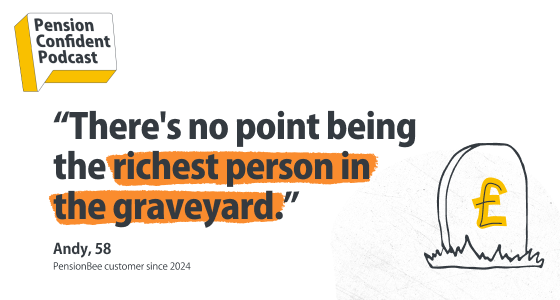
ANDY: There’s no point being the richest person in the graveyard. Life is for living, but at the same time, I need to make sure I’ve got enough there to live.
PHILIPPA: This series is all about listeners like you telling us all about their pension hopes and plans. Andy, who you just heard there, he spent more than two decades living and working abroad. And when he came home to the UK, he really started focusing on his pension situation because he wants to retire and also because he’s lived with Multiple Sclerosis (MS) since 2008, so he needs to factor that into his retirement budget.
I’m Philippa Lamb, and if you haven’t subscribed to The Pension Confident Podcast yet, click that subscribe button right now and you’ll never miss an episode.
Meet Andy
PHILIPPA: Here’s Andy introducing himself properly.
ANDY: OK, I’m Andy Newman, [I’m] 58 years old, based in the South East of the UK. So, and my work, I’m actually an Independent Contractor, specialising in ethics. So, I’m a - for want of a better word, I’m an Ethics Officer. Yeah, I think with, I mentioned around my MS, so of course I’m always and I - you never really know what the future is going to hold. I want to just make sure I keep myself comfortable, that I’m provided for. At the moment, obviously, I’m still working.
My plan is to retire in the next year or so if I possibly can. So, I’ve got other kinds of irons in other fires, as far as property and investments as well. But really just trying to make sure that I’ve got the money there so I can - I wouldn’t say I’m an extensive holidaymaker now, because my accessible - or my mobility issues don’t make that quite so easy. Just so really, I can still live a comfortable life and have a happy life, then I’ll be quite happy.
I’m trying to diversify a little bit so at least I’m a bit covered if there’s a stock market crash or Donald Trump does something else crazy, then I’ll make sure I’m pretty covered. I think house prices are normally quite a stable, quite a safe way of investing. And then, but then there are other ways to actually grow your money a lot quicker. And I’ve been quite pleased with looking at my PensionBee [account], looking at it’s grown about 10% since I’ve had it, which is quite nice to see.
PHILIPPA: Now, pensions expert Veronica Morozova from PensionBee has been listening to that with me. Hi, Veronica.
VERONICA: Hi, Philippa.
PHILIPPA: Welcome back. An Ethics Officer, he’s planning to retire within the year, he’s watching his pension go up and down daily, he’s already thinking about diversification. So, he’s clearly someone who’s done the work. But he has this additional challenge of MS and that potential for really substantial care costs later on that he needs to factor in, right?
VERONICA: Yeah, I think we all at one point or another wonder about our future care costs. But if you know you have a diagnosis like this, you probably might want to plan for it a bit earlier. He only really seriously started thinking about his pension four or five years ago, so the position he’s in now, he’s built relatively quickly.
PHILIPPA: Yeah, so thinking about that question about care costs, I mean, how do you plan for that?
VERONICA: Yeah, it’s definitely one of those areas where state provision really doesn’t go as far as people might expect, unfortunately. In England, if your savings are above £23,250, you’re not entitled to help with the cost of care from your local council.
PHILIPPA: Wow.
VERONICA: So, if you plan to move into a care home, you won’t get help if you own a property, for example. So, someone like Andy with a known diagnosis, that makes early and deliberate planning really important -
PHILIPPA: yeah -
VERONICA: and care costs can be substantial and are often difficult to predict. So, building a meaningful buffer in your retirement plan is one of the best approaches.
Consolidating pensions and working abroad
PHILIPPA: One of the other troubles for Andy was locating his old pension pots. It’s a problem a lot of people run into. He spent more than 20 years working overseas, and that added a whole extra layer of complexity, didn’t it, to his pension picture?
ANDY: So, 2001, I went and I managed to find a job working in the Czech Republic. The idea was I was only going to go for a couple of years, get some experience, come back and continue my career [in the UK]. And it didn’t quite work out that way. So, I ended up spending 21 [to] 22 years overseas. But then, of course, I was diagnosed with MS back in 2008. The condition slowly got worse, so I made the decision to then move back to the UK, just over three years ago.
When I was living abroad, then realised there were some former pensions I had which were sitting pretty dormant, and then it was a case of trying to put it all together. Then I was in - I was overseas, but then repatriating, realising, “Oh, I need to start up a SIPP, I need to get something started”, and bringing in something which was called a ‘QROPS’. Like a Qualified Recognised Overseas Pension Scheme, so bringing that back inshore. So that was some of the challenges. So, a little bit, it felt a bit like starting from the very beginning because I hadn’t been in the UK system for quite a while.
PHILIPPA: So, Andy’s got a lot to deal with, hasn’t he? And he’s talking about consolidating old pensions, we hear about that a lot. Just remind us, why it matters [and] how it works.
VERONICA: Many people in the UK have multiple old workplace pensions that they might have lost track of, especially people that have frequently changed jobs, moved between employers, worked abroad - like Andy, or maybe they had a period of self-employment.
PHILIPPA: Uh-huh.
VERONICA: And so, the government’s Pension Tracing Service is really helpful with helping you locate lost or dormant pension pots, and it’s free to use as well.
PHILIPPA: And consolidating it all into one place, it can be advantageous, can’t it? It means, you know exactly what you’ve got, you can manage it more easily.
VERONICA: Exactly. And with PensionBee, you can combine your pensions online and see everything in one place. Consolidation might not be for everyone. You do need to check the terms of your pensions with existing providers and look out for exit fees and other things. So, it does require a little bit of research, but consolidation can be very helpful, yes.
PHILIPPA: Yeah, just depends [on] whether it suits you. Worth looking into.
VERONICA: Yeah.
PHILIPPA: Now, Andy also mentioned ‘QROPS’. Now, this isn't something that most listeners, I don’t think, will have come across. What is it? And why do people in his situation need to think about it?
VERONICA: Yeah, it sounds very jargony, doesn’t it? ‘QROPS’. So, it stands for Qualifying Recognised Overseas Pension Scheme. So essentially, it allows UK pension holders to transfer their pots into an approved overseas scheme when they move abroad.
PHILIPPA: OK.
VERONICA: So, for people like Andy who return back to the UK, those savings can be transferred back onshore, but the rules are quite complex, and it’s advisable to seek professional financial advice to figure out the logistics of it all.
PHILIPPA: OK, because State Pension, that’s also affected, isn’t it, when you live abroad?
VERONICA: Yes, exactly. So, State Pension is affected because you need 35 qualifying years of National Insurance Contributions to receive the full new State Pension. And you need at least 10 qualifying years to receive any State Pension at all.
PHILIPPA: And if you’re abroad, presumably your National Insurance Contributions can stop, but you can make voluntary contributions, right?
VERONICA: Yes, exactly. You can make voluntary contributions to protect your entitlement, so it’s worth checking your State Pension forecast through the government gateway at GOV.UK.
PHILIPPA: You can just go on the site and see where you’re at, can’t you?
VERONICA: Yes, exactly. So, it’s always worth checking and because you can always play catch-up with your NI contributions as well.
Tax relief and self-employment
PHILIPPA: So we asked Andy that horrible question we ask everyone in this series, “What does he wish he’d known earlier about pensions?”. And he did, he did have an immediate answer, didn’t he? He said it was tax relief, and it was a conversation with a friend that really brought it home to him.
ANDY: Generally, what I’ve been doing, I try to have one regular amount go in each month, but then that’s as a personal contribution. But then, of course, speaking with my accountant, being an independent contractor, like self-employed, it’s my own company, all of my earnings going to that company and then suddenly realising, “Well, if I don’t, if it just sits in the company, then I get stung for Corporation Tax”. So, then I suddenly realised, and also getting the advice, try and maximise from a tax perspective what I can put into my pension, to put it aside.
I think one of the main, main things is around the HMRC contributions. So of course, particularly for personal contributions, that it’s going to be like topped up. So probably if I’d realised a good few years ago - in fact, I was even talking with a friend and he was saying about his children, about doing it. If they start doing it now, if they’re in their 20s, how much they can actually build up even just by putting £50 or £100 a month. But of course, at that age, they’re thinking about mortgages and holidays and everything.
PHILIPPA: So, for anyone out there who’s self-employed and has their own company, there’s a tax incentive, isn’t there, to pay into their pension through the company, but how does that work?
VERONICA: So, if you operate through a limited company, employer pension contributions paid directly from the company are considered to be a legitimate business expense.
PHILIPPA:OK.
VERONICA: So, they reduce the company’s taxable profit and lower the Corporation Tax bill.
PHILIPPA:OK.
VERONICA: They’re also not subject to employer National Insurance Contributions and they’re also not subject to employee National Insurance Contributions either.
PHILIPPA: OK, so that would suggest that contributing through your company, it’s far more tax efficient usually than paying yourself a salary, paying the Income Tax and the National Insurance, and then just contributing from what’s left?
VERONICA: Yes. Yes, exactly. And I think, as Andy found, a good accountant is often the key to unlocking this. It’s also worth knowing about yourself so you can ask the right questions to a professional.
PHILIPPA: Now, even if you’re not self-employed or contributing through a company, that government top up that Andy talked about, it’s something so many people either don’t know about, or they don’t think about until it feels too late. Just lay it out for us.
VERONICA: Essentially, basic rate tax relief works like this: for every £80 that you contribute personally, the government automatically adds £20, making your total contribution £100.
PHILIPPA: OK, so simple as that. Tax relief isn't just a bonus, it’s essentially free money from the government. And then that grows. I mean, the key point here is that grows inside your pension too with compounding. So really, really helpful.
VERONICA: Yes, exactly. And Andy’s insight applies to everyone, essentially. The contributions you delay aren't just the payments you miss, they’re growth and top ups that you miss out on too.
PHILIPPA: Yeah.
Planning for an uncertain future
PHILIPPA: Now, Andy has done a lot of the right things, not least because he knows he might have even higher care costs at some stage than the rest of us. But when we asked him how he feels about his pension and retirement now, he said that thing that I think so many of us feel: he could always have done more. And then he put it in a way that really stopped us in our tracks.
ANDY: One time I was talking with my dad when I was seven [years old] or something like that, and almost like saying, “Well, so what are you going to do if you run out of money?”. And I think I just said, “I’ll just write a cheque”. If you haven’t put into your pension, you can’t draw down from a pension. Exactly the same as writing a cheque on a bank account that’s empty. I feel as though I’m in a good place as far as my pension planning is concerned. It probably could always be better, but you end up saying, well, there’s no point being the richest person in the graveyard. Life is for living, but at the same time, I need to make sure I’ve got enough there to live.
PHILIPPA: Yeah, “There’s no point being the richest person in the graveyard”. That really cuts the heart of what retirement planning is all about, I think, doesn’t it?
VERONICA: It’s quite a tricky one, isn’t it? For most people, calculating how much is enough is like just one of the hardest questions when it comes to retirement planning because you’re essentially trying to put a number on an unknown future lifespan and lifestyle that you might want. And the challenge gets significantly harder when you’re living with a progressive and unpredictable condition like Andy’s. So, you do have to plan for a range of retirement scenarios from relatively stable to significant care needs.
PHILIPPA: Yeah, so Andy’s diversified approach - this pension, property, ISAs, investments - this sounds really sensible, doesn’t it? No single income source is ever going to be a silver bullet.
VERONICA: Yes, exactly. And, PensionBee’s [Pension] Drawdown Calculator can actually really help model different retirement income scenarios and doing things like checking in on your pension regularly, as Andy does, is a healthy habit. Seeing it grow is genuinely motivating. And the most important first step is deciding what kind of retirement you want and then working backwards to understand what it costs.
PHILIPPA: Yeah, and if you need help doing that, you can always find yourself an [Independent Financial Advisor] (IFA), right?
VERONICA: Exactly, yes. It’s always advisable, especially in these unpredictable scenarios, to get professional advice.
PHILIPPA: So, our thanks to Veronica, and thanks of course to Andy for sharing his story with us. If you’d like to find out more about pensions and retirement planning, head to the show notes for this episode. We’ve shared a lot of resources for you there. You can explore them. You don’t need to be a PensionBee customer to use them, so take a look.
Here’s a last reminder that anything discussed on the podcast shouldn’t be regarded as financial advice or as legal advice, and when investing, your capital is at risk. Thanks for being with us for this customer story. We’ll see you next time.
Risk warning
As always with investments, your capital is at risk. The value of your investment can go down as well as up, and you may get back less than you invest. This information should not be regarded as financial advice.
Period | Market Event | FTSE World TR GBP (%) | 4Plus Plan (%) |
|---|---|---|---|
4Plus Plan’s inception – 6 Sept 2013 | QE Tapering, China Interbank Crisis and its aftermath | -5.44 | -2.41 |
3 Oct 2014 – 15 May 2015 | Oil price drop, Eurozone deflation fears & Greek election outcome | -5.87 | -1.77 |
7 Jan 2016 – 14 Mar 2016 | China’s currency policy turmoil, collapse in oil prices and weak US activity | -7.26 | -1.54 |
15 June 2016 – 30 June 2016 | BREXIT referendum | -2.05 | -1.07 |











%201.png)