










The following is a transcript of a bonus podcast episode of The Pension Confident Podcast. Listen to the episode or scroll on to read the conversation.
PHILIPPA: Welcome to ‘Behind the Pensions’. This time we’re going to be hearing from Nigel.
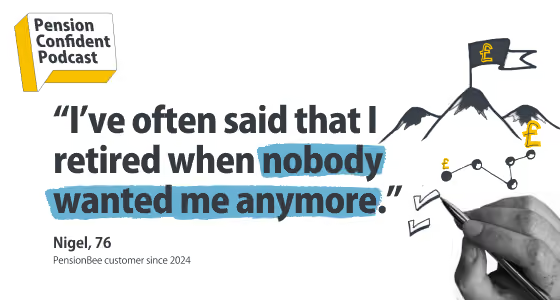
NIGEL: I’ve often said that I retired when nobody wanted me anymore.
PHILIPPA: What you’re about to hear is the latest in our stories from listeners about their pension journeys. They’re all so interesting. Full of useful lessons for everyone, whether you’re just starting out or like today’s guest, Nigel, already retired and looking back on financial decisions he made earlier - and what he wishes he’d known then.
I’m Philippa Lamb. If you haven’t subscribed to The Pension Confident Podcast yet, why not click that button right now so you never miss an episode? Just before we hear from Nigel, here’s the usual disclaimer. Please remember anything discussed on the podcast shouldn’t be regarded as financial advice or legal advice, and when investing your capital is at risk.
Meet Nigel
PHILIPPA: Let’s meet Nigel.
NIGEL: I’m Nigel Backwith, and I’m retired [and] 76 [years old]. Life before I retired was in several different phases really. There was the latter stage, after I’d done 25 years with the same organisation, where I had the opportunity to work on different projects really as just a self-employed individual. So I was very self-motivated and it always had something to do with technology.
But before that, it was an intense professional career. So, you know, it was the 06:20 train commute into central London five days a week, and sometimes, going into London on a Sunday morning into the office simply because it was the only time I could get any free headspace.
And bringing up two children - I think my Dad might’ve said to me on more than one occasion, “Are you putting stuff aside for your old age and whatever?”. And I’d say, “Well, I would’ve liked to, and I did plan to, but this came up and that came up and so on”.
PHILIPPA: I think we all know how that is. Pensions expert, Dani Skerrett, from PensionBee is here with me. She’s been listening along. Hi, Dani.
DANI: Hi, Philippa.
PHILIPPA: Nigel saying there he’d like to have planned more, life got in the way. I mean, it’s true for many of us, right?
DANI: Yeah, it’s such a relatable story and I think shows the importance of talking about money. Like, thankfully his Dad did say to him, “Are you thinking about this?”. And we hear that from people all the time: “Oh, it was my friend that mentioned saving for a time” and “Oh, it was my grandparent that told me about saving” -
PHILIPPA: yeah -
DANI: it’s so important to talk about it. And I think Nigel represents everybody really. You’re working, you might be bringing up a family, you’re commuting to and from work, you’ve got lots of things to think about. And that future plan you only really start thinking about maybe later in life when it’s closer. I remember in Episode 37 when we spoke with the Behavioural Psychologist, Neil Bage -
PHILIPPA: on the podcast, yeah? -
DANI: on this podcast, and he said that people just really struggle to think of ‘future them’, and that's it, isn’t it? You can’t picture yourself older.
PHILIPPA: It’s true. Yeah, it’s really hard to visualise yourself later, isn’t it? And I can speak from experience, even as you get closer to that, because I’m older than you, it’s still hard to imagine yourself older.
DANI: Yeah.
PHILIPPA: And in the end, for him, for Nigel, it was a work promotion, wasn’t it, that really got him thinking about saving into his pension in a really major way?
The tax benefits of saving into a pension
NIGEL: I started thinking about my retirement when I became a Partner in the firm, I think. That would’ve been in my early 30s, and I started understanding that there were things called ‘private pensions’. I started to look at whether there was any reason at that point in time to put money away in a pension - and the biggest reason for doing it was the fact that it could go away tax-free. I could lower my tax bill year-on-year by doing it. Of course, it meant that there was less money around to fund monthly outgoings, and it was a balancing act, but it was worth putting some away just to get the tax benefit at the time.
PHILIPPA: So, Dani, on the podcast, we always go on, don’t we, about the tax benefits of saving into a pension. For people who don’t know anything about pensions, just remind us how that works.
DANI: Yeah, definitely. We always come back to the same kind of points here, where pensions are tax-efficient when you’re putting money in and when you’re taking money out. So those are kind of the two things to keep in mind.
So on the way in, usually you benefit from something called tax relief. So this is where the government tops up your eligible personal contributions. For most people that are basic rate taxpayers, that’ll be a 25% top up. So think of it: for every £100 you put into your pension, you get given £25 from the government making the total contribution £125. That’s done automatically for basic rate taxpayers, so you don’t have to think about it.
If you’re lucky enough to be a higher or an additional rate taxpayer, you can claim even more tax relief, but you have to contact HMRC or do that within your Self-Assessment tax return to get that extra tax relief. But everybody that’s a basic rate taxpayer is getting that basic 25% uplift, so it’s definitely not to be sniffed at.
PHILIPPA: Yeah, it’s serious money, isn’t it? Just going to say that again. So £25 for every £100 you pay in, free from the government.
DANI: Exactly. And if you’re in a workplace scheme and you’re auto-enrolled into that, it sort of means that you’re putting personal contributions in, you’re getting the tax relief, that top up from the government, and you’re getting employer contributions put in. So you’re kind of paying into your pension three times.
PHILIPPA: And as you say, at the other end, when you start taking money out of your pension, it’s tax efficient then too.
DANI: Yeah, so that’s the other side of it, is the withdrawal, which you can only do from age 55, and that’s increasing to age 57 from 2028. But when you get to those ages, you can take 25% of your pot tax-free [up to a cap of £268,275], and you won’t pay Income Tax on that.
PHILIPPA: Depending how big your pension pot is, that’s a serious saving.
DANI: It is, yeah. And it doesn’t have to be in a lump sum either. So you could withdraw, you could take lots of little withdrawals and take 25% of each of those tax-free to kind of keep the balance there, or you could take out that lump sum completely tax-free depending on what you want to do. Important to remember that that allowance, that 25% tax-free that you can take, is overall. It’s not per pot you have, not per scheme. It’s your entire -
PHILIPPA: sadly -
DANI: pension savings put together.
PHILIPPA: Got it. So, no question, some of this can feel complicated. Nigel, he chose to go to an [Independent] Financial Adviser (IFA), didn’t he?
Should you use a financial adviser?
NIGEL: We went with an active manager for a couple of years, and I was shocked at the charges. And I - and the markets hadn’t done well during that period of time. And in fact, I didn’t - I’d never followed markets before, but because this money was now being “actively managed”, I was sort of following the markets. And I had an overall loss in one particular 12-month period, and I had to pay the fees for the active management, and I was paying the [Independent Financial Adviser] (IFA). You know, and I looked at it and I just thought, “Well, this is silly”.
And I was chatting to my son, who's a young full-time employed guy, and I said, “Do you, are you doing any pension stuff?” He said, “Yeah, I’m putting a little bit aside and I’m using this platform called PensionBee”. And he showed it to me and it was a bit of an eye-opener for me. Although I’m very app savvy and tech savvy because that’s my background. But I looked at it and I thought, “Well, this is dead easy”.
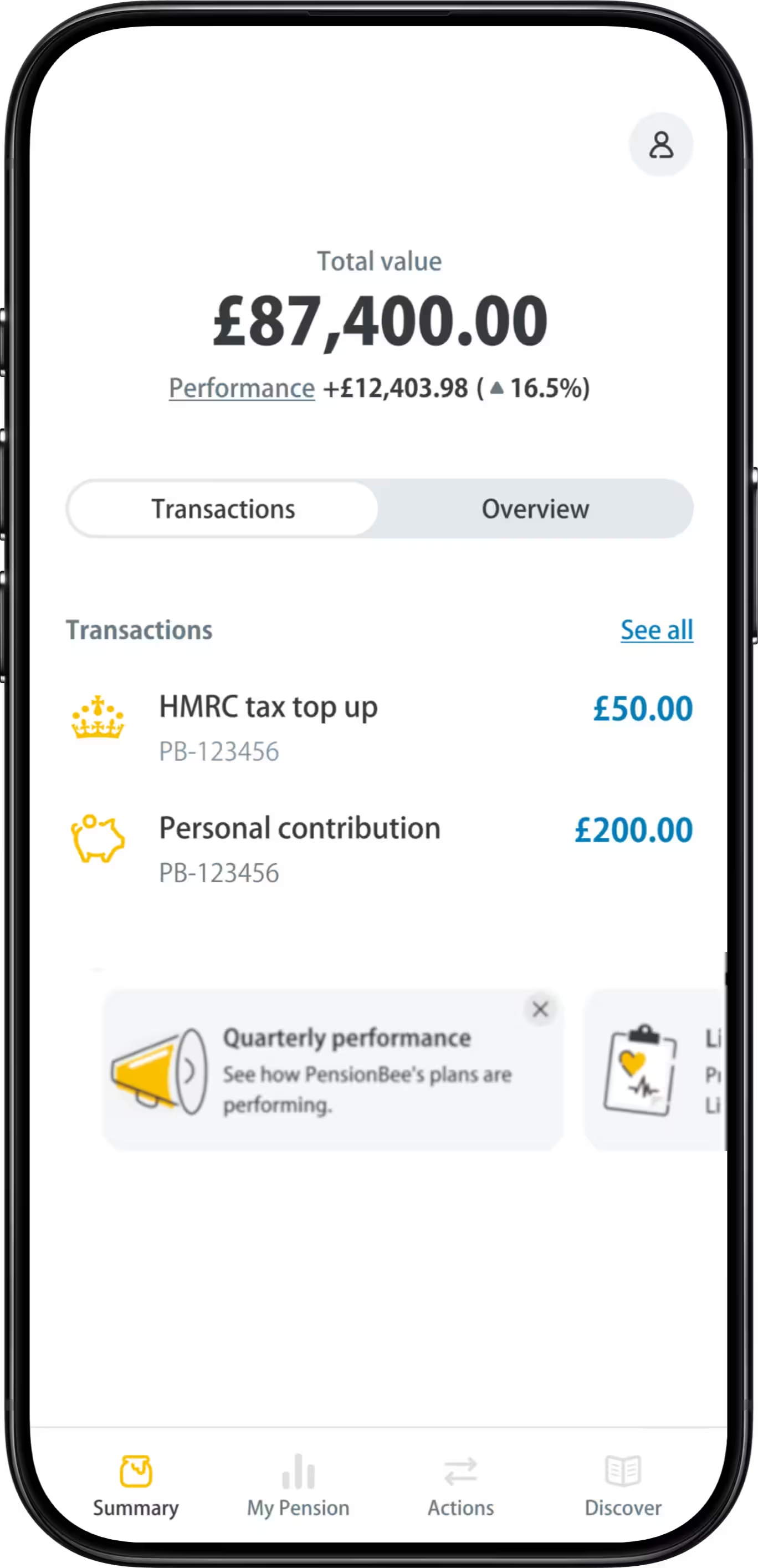
Having moved to the PensionBee app, I find the ease of just flicking it open and seeing the information there about, the value today and the other breakdowns. It’s quite comforting. And I also am comforted by the fact that I’m not constantly worrying about the creaming off the top.
PHILIPPA: Yeah, so as Nigel said, he had a particularly bad year, and he ended up both losing money and paying big fees on his pension. Obviously, it’s not great. It can happen. He obviously didn’t want that to happen again though, because he started looking around for other options. And he liked the idea of managing his pension on an app.
DANI: Yeah, I think it’s really interesting that he’s kind of had both experiences here. He’s paid for an “IFA”, an Independent Financial Adviser, and he’s also done a bit of managing his own savings on, on a provider’s app.
I’d say with independent financial advice, that can be very helpful if you have big sums of money, if you have big pension pots, and the rules are complicated and you have a complex tax situation. That can be helpful for peace of mind, but you have to pay for it. It’s - your provider’s not going to give you that advice, so it’s definitely an option. But -
PHILIPPA: I mean, that can save you [from] making expensive mistakes, in fairness, can’t it?
DANI: It can, yeah, it definitely can. You can look to your provider for guidance though, and you can, you can get your provider to explain the different fees that you might be paying and the different things involved in that pension plan. So I’d maybe suggest doing that first, and then if you feel like it’s a complex situation, then paying for that advice.
PHILIPPA: Just to be clear, your pension provider, they aren’t going to give you advice. They’ll explain things -
DANI: exactly -
PHILIPPA: but they won’t advise you.
DANI: They’ll give you guidance, but they won’t give you advice. You can’t get financial advice without paying for it.
PHILIPPA: Yeah, it’s important to understand that.
DANI: It is. And I think on the point of fees, they can be complex. You know, some providers might have multiple different fees that all add up to a certain percentage. You could be paying for initial advice fees, you could be paying for ongoing management fees, you can be paying exit fees.
PHILIPPA: Yeah, that could all be quite opaque in the terms and additions, can’t it?
DANI: It can. And the great thing to say here about PensionBee is that we have a really simple fee structure, which is just one annual fee, which is the management fee. So it can be between 0.5% or 0.95%, but it’s just one fee.
PHILIPPA: Yeah. So at least there’s clarity.
DANI: There’s clarity there and there’s no sort of hidden charges. Nigel also mentioned, you know, following the markets and the markets having a bad year and things like this. And I think it’s really important to remember that with pensions, it’s a long-term investment. And so for some people, they might like to follow markets and understand why their balance might be moving with the stock market -
PHILIPPA: yes -
DANI: And that’s important to understand, and it can give you clarity, and it can give you a bit more confidence of exactly where your money’s invested and how it fluctuates and how it grows, hopefully. But if you’re a long way from retirement, it might not be sensible to have that eye on markets moving.
PHILIPPA: This is an interesting thing and depends how people feel about it, doesn’t it? Because, you know, if you love that sort of thing, if you love watching the markets and you love seeing what’s happening on a daily basis, fine. But it’s important not to let it freak you out because, as you say, long-term investment, there’s going to be ups, there’s going to be downs.
DANI: Exactly. He also mentioned things like actively managed, and without going into it on the podcast, we have a lot of explainers on the PensionBee website about what an actively managed pension is and what a passive managed pension is. So it’s worth also reading some explainers, and again, if you don’t understand, asking your provider, “Am I in an actively managed fund? Am I - what am I doing?”. So that you know and you can have a bit more confidence around where your money is.
PHILIPPA: It’s like all financial products, isn’t it? You really, really do need to understand exactly what you’re getting into before you commit. I mean, obviously in the end, Nigel retired, and since then he’s had the chance to mull over a bit what he might’ve done differently about retirement planning.
How much do you actually need for retirement?
NIGEL: I’ve often said that I retired when nobody wanted me anymore, and that didn’t happen straight away. It wasn’t like a cutoff. It was [a] full-time professional career, decided to do something different, went into a senior executive position, didn’t like it, and then got involved in what you might call “bits and pieces”.
I wasn’t focused enough on it in terms of was there a number I was aiming for, did I know what that number should be, was it easy to calculate? Looking back, yes, it would’ve been very easy to calculate even if you just say there’s this pot of money and I expect to live for another 25 years, so I’ll divide it by 25 and see how much a year it is. I mean, I know it’s not as simple as that, but it’s not far off. At the end of the day.
DANI: Yeah, it’s interesting, isn’t it? He’s thinking about that total pot and sort of calculating it. I think it’s hard to think of the total end number. I think it’s much easier -
PHILIPPA: yeah -
DANI: to break down and think about the annual income you want to take.
PHILIPPA: Yes, I think that’s right because it’s so far away, isn’t it? It’s hard to know what that money will be worth anyway in 10, 20, 30 years’ time.
DANI: It is, yeah. There’s loads of different benchmarks or forecasting you can do. And one sort of rule to have a look at, and you don’t need to necessarily follow it, but a good rule to have a look at is a 4% withdrawal [rate]. So this is a sustainable withdrawal method that was developed in the ‘90s by a Financial Planner in the US, and he had looked at historical stock market and bond performance and came up with this 4% withdrawal being a sustainable method.
And what it means is: if you take 4% of your [pension] pot every year, it should last 30 years or more.
PHILIPPA: OK.
DANI: So that’s quite good because then you can sort of apply that to whatever your end pot is. So say for example you have £300,000, you can sustainably take 4% of that, which would be £12,000 a year. And the idea is that [it] would last 30 years or more. There’s a couple of caveats around that’s based on you not changing your investment strategy so not moving your money around or I guess following the market. And that’s based on you not taking any other withdrawals other than that 4% a year.
PHILIPPA: OK. Yeah, I mean, looping back to what I just said earlier about it’s hard to imagine what the money will buy you by the time you come to spend it. You know, I’m thinking about inflation.
DANI: Exactly. Something to consider. And I think with that 4% withdrawal strategy, you can also apply an inflation percentage to it.
PHILIPPA: And it’s probably smart to do that, isn’t it? To get a really realistic idea of how much money you’re going to need.
DANI: Exactly. Because we’re talking about the money lasting 30 years or more, inflation is certainly going to fluctuate and play a part in that over [those] 30 years.
PHILIPPA: Yes.
DANI: So using that, that first rule, so again, you have £300,000 in your pension pot and you’re taking 4% a year. If you adjust for inflation in that first year, you’d take 4% and that would be £12,000. In that second year, you adjust for inflation of 2% and you’d withdraw £12,240 and so on.
PHILIPPA: Yeah, but as you say, over a 30-year retirement, those numbers are really going to ramp up, aren’t they? So yeah, definitely something to think about.
DANI: So if you’re finding it hard to imagine how much money you might need and how that income breaks down and what you can afford per year with that income, there’s a brilliant website called Pensions UK. And they have what they call Retirement Living Standards, which they update each year, and it gives you an idea of what you can afford at three different income levels. Whether you’re a single person or whether you’re in a couple. And so that might be another sort of guide. And you know, these aren’t one-size-fits-all, these different benchmarks and guides, but they’re helpful to have a look at.
PHILIPPA: Yeah, we’ll put a link in the show notes. Now happily, Nigel is enjoying life in retirement. He’s seeing the benefit of making all those contributions.
Nigel’s life in retirement
NIGEL: My situation in retirement is that I’m, I think the technical term is, I’m in drawdown. I’ve reached a point where I can’t top up anymore, and I’m drawing effectively a monthly income, a salary if you will. You know, I get the equivalent from PensionBee of a payslip with a tax deduction and the tax code. So that’s how it works.
So I could take more if I wanted to fund a bit of a holiday, or I could take less if I felt that my tax bill for the year was going to be far too high in an upper tax bracket. So there’s flexibility there. Retirement has given me quite a lot of freedom. It’s not bottomless freedom. You’ve still got to budget and look after things, but if you’re careful, there’s enough to have a holiday a year and do things like that.
Retirement isn’t the end of a journey. Retirement is the next chapter, and I’m lucky enough to be, you know, fit enough, and my brain still seems to work well enough, and my hand-eye coordination when I’m playing my musical instruments is maybe not what it used to be, but it’s still good enough that I can get a great deal of enjoyment out of both of those activities. Cycling and music.
PHILIPPA: Yeah, I mean, as he says, if you’re fortunate enough to be in good health, retirement, it’s not the end, it’s the next phase.
DANI: Yeah, exactly. We talk so much about building up your pension pot, which is very important, and the different things you can do to sort of track how much you’re saving and project what your future income could be. But it’s even more important to think about what you actually want to do with that money. Like, that’s what life is all about. It’s lovely to hear about the different hobbies and activities that he has.
PHILIPPA: Yeah, the cycling, the music. He’s obviously got loads going on.
DANI: Yeah, it’s lovely to hear about what his pension pot has been able to give him in retirement and that makes it easier. I think when you think about the activities and the lifestyle you want to have, that’ll make it easier to save, that will make it more motivating to put a little bit extra in if you can, and I think it sort of brings to life what a pension is and what retirement is. Those are two words that I think can be quite scary. People don’t want to talk about it. But if you think about what you want to do in later life, that can make saving a little bit easier.
PHILIPPA: Yeah, because I tell you what I’m getting from this series, you’re hearing lots of people talking about their retirement and their pensions journeys, but they’re all doing that thing and they’re visualising how they want their lives to be. When they get to that point, obviously Nigel’s there already, but you know, the other people we’ve talked to in the series, they’re still on their journey to getting there. But it’s a lot easier if you can to save, if you’re thinking, “Well, what will my life be like?”. Because it isn’t something you think about every day, is it? “What will life be like when I’m older?”.
DANI: Exactly and think about it like a holiday. Like, it’s fun to save up for a holiday because you’re thinking, “I’m going to be two weeks on that beach in July, I’m going to save for a year to get there”.
PHILIPPA: Yeah.
DANI: So maybe think of it like that.
PHILIPPA: Yeah, no, I think that’s an excellent idea. Thanks, Dani. Thanks to Nigel too for sharing his story with us. If you’d like to find out more about pensions and retirement planning, head to those show notes on the episode. We’ve shared lots of resources as always for you to explore for yourself. Just that final reminder before we go that anything discussed on the podcast shouldn’t be regarded as financial advice or as legal advice. And when investing your capital is at risk. Thanks for being with us. See you next time.
Risk warning
As always with investments, your capital is at risk. The value of your investment can go down as well as up, and you may get back less than you invest. This information should not be regarded as financial advice.
Period | Market Event | FTSE World TR GBP (%) | 4Plus Plan (%) |
|---|---|---|---|
4Plus Plan’s inception – 6 Sept 2013 | QE Tapering, China Interbank Crisis and its aftermath | -5.44 | -2.41 |
3 Oct 2014 – 15 May 2015 | Oil price drop, Eurozone deflation fears & Greek election outcome | -5.87 | -1.77 |
7 Jan 2016 – 14 Mar 2016 | China’s currency policy turmoil, collapse in oil prices and weak US activity | -7.26 | -1.54 |
15 June 2016 – 30 June 2016 | BREXIT referendum | -2.05 | -1.07 |











%201.png)