










The following is a transcript of a bonus podcast episode of The Pension Confident Podcast. Listen to the episode or scroll on to read the conversation.
PHILIPPA: Hi, welcome to another ‘Behind the Pensions’ bonus episode. This time we hear from Sally.
SALLY: I’m prepared to take a risk with this money for my value system. I thought rather than just talking about green issues, put your money where your mouth is.
PHILIPPA: This year we’ve been hearing listeners like you talking about their pension stories, and today we hear from Sally. She’s a 66 year old eco-driven retired Accountant from Devon, and she had to cope with a financial upheaval when she least expected it.
I’m Philippa Lamb, and if you haven’t subscribed to The Pension Confident Podcast yet, why not click that subscribe button right now and you’ll never miss an episode.
Meet Sally
PHILIPPA: Let’s meet Sally.
SALLY: Hi, I’m Sally. I’m 66 [years old]. I was 66 yesterday, so I’m still getting over that. I live in the South West of England. I trained as an Accountant a long time ago, and I think I’ve always thought money’s to be used. So, I wasn’t the kind of person early days sticking, a little bit away every month. We went travelling, we put our money into doing it, living in a house, doing it up, moving to the next house. And so, we weren’t really that way inclined. So, I’ve always had a principle of giving at least 10% of my income to charity. So, I’ve always given a little bit of this and a little bit of that, £5 standing order to whoever. I never thought to do that for a pension.
PHILIPPA: Now, Veronica Morozova from PensionBee was listening along with me. Hi, Veronica.
VERONICA: Hi, Philippa.
PHILIPPA: Sally, she’s a trained Accountant, yet she still talks about a long period of not really engaging with her pension.
VERONICA: Yeah, and that’s actually very common. Sally’s story is a really good illustration of why, because being financially literate and actively saving for retirement are two different things. One is a skill and the other is more of a habit. So self-employed people, especially, they have no Auto-Enrolment, which is the system that automatically signs employees into a workplace pension. Without an employer to set that up for you, the responsibility falls entirely on you to choose to act, and it’s very easy to keep deferring that. The money-to-be-used mindset is also common with variable income because investing in a house or a business feels more tangible than locking money away for decades.
PHILIPPA: Sure.
VERONICA: But yeah, the numbers make a compelling case for starting early. So, you can use the PensionBee Pension Calculator. So, someone starting with just £5 a month at 25 [years old] could have almost £8,000 extra at 65 [years old]. Compared to just over £4,000 extra if they start at 40 [years old]. So, it’s the same contributions, very different outcome, purely because of time.
PHILIPPA: Yeah, absolutely.
‘Present bias’ and money
PHILIPPA: Now, Sally’s relationship with money was completely altered when something utterly unexpected happened to her.
SALLY: So, my husband died suddenly in his 40s. So, wow, every - the landscape changed, everything changed. And I think it made me think, live for now. I thought, well, gosh, I could drop down dead in a year. It made me think more shorter term. So, I think the tricky thing was getting over that and starting to think, I really do need to think about reducing my income now in order to have income later. And of course, the older you get, the more nervous you get about it, really. The more you've actually got to be more sensible, you start being more sensible. Oh, I love having those kinds of conversations, and I love bringing up things like money in, when I’m talking to people, friends and everything, because everybody shuts down, nobody likes it. So, I often say, declare myself, out myself.
PHILIPPA: Isn’t this interesting? With some people who lose a spouse, I think they’d immediately double down and save harder because they’d be worried about not having that safety net. But Sally, for her, that shock of losing her husband, very understandably, I guess, it made her feel she might as well live right in the moment. And then, of course, later she had to consciously rewire that thinking, right?
VERONICA: Yeah. I think grief can really push people toward a ‘life is short’ mindset.
PHILIPPA: Yeah.
VERONICA: I think what makes Sally’s story striking is that she has the financial knowledge.
PHILIPPA: Yeah.
VERONICA: She still had to deliberately relearn how to think long-term. So, this shows that the barrier is often emotional and not just informational. And behavioural economists actually call this the present bias. We consistently overvalue the present relative to the future, and a loss like Sally’s can make that even more powerful.
PHILIPPA: Interesting.
VERONICA: Yeah, and It’s not like we’re saying the goal is to stop living for the now. It’s to make small, consistent provision alongside it so you don’t have to choose between the two.
PHILIPPA: Yeah, and it’s that thing, isn’t it? Money conversation, still one of the great last taboos.
VERONICA: That’s completely right, yeah. Research consistently finds that money is more taboo than politics or religion.
PHILIPPA: It’s amazing, isn’t it?
VERONICA: Yeah, people are just very reluctant to talk about it. And for couples this can be particularly difficult because couples can have different pot sizes, different State Pension entitlements, different planned retirement ages, and all of that affect what’s possible together. And if those conversations aren’t happening, certain assumptions can fill the gap.
PHILIPPA: OK.
VERONICA: "I assumed they had a good pension", for example, is a story that we hear about a lot.
PHILIPPA: Right.
VERONICA: So, for anyone wanting to get a clearer picture, there are some simple first steps that you can take. So, tracking down any old pensions you may’ve lost track of, like the government’s Pension Tracing Service can help with that, and it’s completely free.
PHILIPPA: So, for people who want to take that first step, they can use PensionBee’s Pension Calculator, can’t they, to see where they’re at?
VERONICA: Yes, exactly. [A] really simple tool that’s available on our website.
PHILIPPA: Yeah, and a really good place to start.
Tax efficiency in retirement
PHILIPPA: Now Sally, she also showed some real tax savvy, didn’t she, when it came to deciding how and when she was going to start drawing from her pension.
SALLY: There was a period of time when I was 55 plus when I needed some extra income, so I had to make the decision: will I start plundering my little pot of PensionBee now to keep - tide me over? If I do that, it’ll mean that I can’t put all my house money, which will eventually happen, in. As soon as you get the 25% extra from the government, yes, when you withdraw it, you have - you can only, you only get 25% of it tax-free, as I understand it. The 75% of it gets - you have to give the tax back, but 25% you don’t. So, if you do that calculation on that money, you’ve already earned 6% because that’s what the 75%, 25%, 6% looks like. So, it’s a no-brainer in one level, just sitting there, it’ll make 6%. There was another choice which I made, which is that when I started with it, I did a - the age-related one, the one that kind of moves with - if you’re getting older, it’ll go safer. And then I decided to make a choice for the green world and the non- paying the war machines world.
And I thought, well, I want to take - I’m prepared to take a risk with this money for my value system. Put your money where your mouth is. And in PensionBee, I could choose. So, I’ve chosen the green one, which of course has been fantastic.
PHILIPPA: So, Sally’s 6% calculation, does that add up?
VERONICA: Yes. So, Sally’s 6% calculation is indeed correct. Basic rate taxpayers [usually] get 25% tax relief, so [for] every £80 that you put in, the government tops up to £100. And then on withdrawal, 25% is tax-free [up to £268,250], 75% is taxed at [your marginal rate, usually] 20%.
PHILIPPA: So how much do you get back, net?
VERONICA: So, you get £85 on every £80 that you’ve saved.
PHILIPPA: Yeah, that’s really compelling, isn’t it? So, what triggers the [Money Purchase Annual Allowance] (MPAA)?
VERONICA: So, the [Normal Minimum Pension Age] (NMPA), for taking money from a private or workplace pension is currently 55 years old, but this age is set to rise to 57 [years old] on the 6 April 2028. And your annual tax-efficient contribution limit drops from £60,000 down to £10,000 (2026/27).
PHILIPPA: So that’s really worth knowing about.
VERONICA: Exactly, and it’s also really important that just taking your 25% tax-free cash alone without any taxable income doesn’t trigger it.
PHILIPPA: OK, also vital to know.
VERONICA: Exactly. So, Sally was weighing that exact trade-off: income now versus flexibility to put a lump sum back in later. So, if the sums involved are significant, it’s really worth talking to an Independent Financial Adviser (IFA) before acting.
PHILIPPA: Yeah, these are really important decisions. Now, in terms of which actual scheme you opt for, more and more people, they do want their pension to reflect their values, don’t they? So, what are the options?
VERONICA: Yes, so we call this values-based investing, and so Sally switched to PensionBee’s Climate Plan. It targets a minimum 10% annual reduction in carbon emissions from the companies in the fund each year and exceeds the EU Paris-Aligned benchmark. And her point about engagement is worth noting. She checks her pot regularly because she cares about what it’s invested in. People who stay actively engaged with their savings tend to make better long-term decisions.
PHILIPPA: Yes, so don’t forget about them.
Sally's vision of retirement
PHILIPPA: Now, Sally, she turns 66 [years old] the day before we recorded this. So, what does retirement look like for her now?
SALLY: I’ve got too many to pack into one life. I’m beginning to realise I should’ve had about three lives, and even then, I probably wouldn’t pack it all in. Certainly, lots of travelling, and when I say travelling, I mean taking a month or six weeks. I cycle, so I go on my bike and, and cycle through Europe. But I do want to paint as well. Like the little picture on the back. I do want to draw and paint more. I like being able to wake up in the morning and listen to the birds for a long time, particularly a robin who sings to me in the morning. I’m sure of it.
PHILIPPA: She’s got a clear vision of how she wants her retirement to be, hasn’t she? I mean, we could all usually spend a bit of time thinking about that.
VERONICA: Yeah, planning for a retirement that you actually want. I think retirement planning should start with the picture, really, not a number. And Sally’s vision is quite specific, and that makes it plannable. So, she’s not stopping, she’s actually shifting. And that’s really worth emphasising because retirement still gives people that image of an ending rather than a new beginning, and that just puts a lot of people off engaging with retirement planning at all.
PHILIPPA: Yeah.
VERONICA: And so, for example, the Pensions UK Retirement Living Standards that have recently been updated give a useful example of how much you might expect to need. So, for example, for a minimum it’s £13,900 for a single person (2026/27).
PHILIPPA: So that’d be a minimum standard of living?
VERONICA: Yes, a minimum standard of living. So quite frugal, I’d say.
PHILIPPA: And if you were looking for a more moderate lifestyle?
VERONICA: Yes, so Pensions UK Retirement Living Standards say that the moderate lifestyle would probably cost about £32,700 a year (2026/27), which would, again, for a single person, cover two weeks holiday abroad, maybe running a car, regular social spending.
PHILIPPA: OK, and if you wanted to push up your standard of living from there, what sort of money would you be aiming at?
VERONICA: So, for a more comfortable standard of living, it would be £45,400 a year (2026/27). These are just rough figures, and the richness that Sally personally describes, the slow breakfast, the yoga, cycling through Europe, they might not necessarily require the top bracket, but it does require not having to worry about having access to that income. So that’s what the pension is for.
PHILIPPA: Yeah, everyone has their own idea, don’t they, about what luxury feels like. For her, it’s those things. But as you say, the not worrying means she can enjoy them.
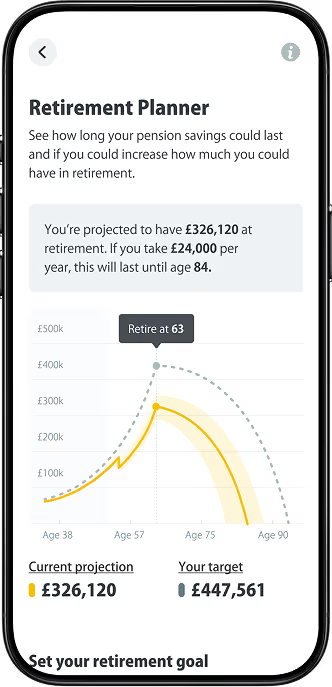
VERONICA: Exactly. And, one tool that we have is PensionBee’s Retirement Planner, which is available to customers in their online ‘BeeHive’ account, and that can really help connect a real-life vision to an actual savings target.
PHILIPPA: So, some hard numbers.
VERONICA: Exactly. So, a lot of our customers find it very helpful.
PHILIPPA: Thanks, Veronica.
VERONICA: You’re welcome.
PHILIPPA: Thanks to Sally too, of course, for sharing her story with us. Now, if you’d like to find out more about pensions and retirement planning, head to the show notes for this episode. We’ve shared a tonne of resources there for you to explore and use for yourself.
Here’s the final reminder before we go, that anything discussed on the podcast shouldn’t be regarded as financial advice or as legal advice, and of course, when investing, your capital is at risk. Thanks for being with us. We’ll see you next time.
Risk warning
As always with investments, your capital is at risk. The value of your investment can go down as well as up, and you may get back less than you invest. This information should not be regarded as financial advice.
Period | Market Event | FTSE World TR GBP (%) | 4Plus Plan (%) |
|---|---|---|---|
4Plus Plan’s inception – 6 Sept 2013 | QE Tapering, China Interbank Crisis and its aftermath | -5.44 | -2.41 |
3 Oct 2014 – 15 May 2015 | Oil price drop, Eurozone deflation fears & Greek election outcome | -5.87 | -1.77 |
7 Jan 2016 – 14 Mar 2016 | China’s currency policy turmoil, collapse in oil prices and weak US activity | -7.26 | -1.54 |
15 June 2016 – 30 June 2016 | BREXIT referendum | -2.05 | -1.07 |










%201.png)