







Bonus episode: “As soon as I left that job, the pension stopped”



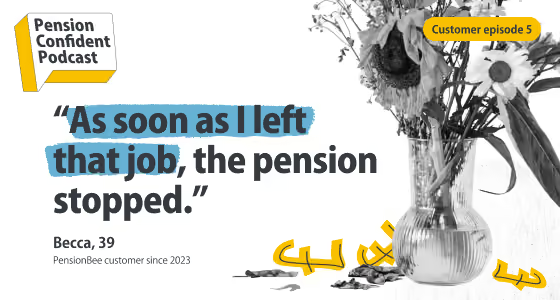
The following is a transcript of a bonus podcast episode of The Pension Confident Podcast. Listen to the episode or scroll on to read the conversation.
PHILIPPA: Recently, we’ve been enjoying hearing from listeners like you telling us about their journey with pensions. Today, we’re going to hear from Becca and how it was a friend of hers who gave her a much-needed pension wake-up call after she became self-employed.
I’m Philippa Lamb, and if you haven’t subscribed to The Pension Confident Podcast yet, why not click that subscribe button right now so you never miss an episode? Just before we hear from Becca, here’s the usual disclaimer. Please remember, anything discussed on the podcast shouldn’t be regarded as financial advice or as legal advice. And when investing, your capital is at risk.
Meet Becca
PHILIPPA: Here’s Becca introducing herself.
BECCA: My name’s Becca Poutney. I’m a Marketing Consultant that specialises in the wedding industry. I’m 39 years old and I live in Bedfordshire, just north of London. I first started tentatively saving for retirement in my first job.
So I graduated in 2009. My first couple of jobs were actually contract-based, but when I went into my first full-time employment in a radio station, they auto-enrolled me onto the radio station pension - and so I had no say over it.
But I automatically started paying a bit towards my pension. The thing is, I only stayed in that job a couple of years because my real dream was to be self-employed. So as soon as I left that job, the pension stopped.
PHILIPPA: Pensions expert, Dani Skerrett from PensionBee, is here with me. She’s been listening along too. Hi, Dani.
DANI: Hi, Philippa.
PHILIPPA: Quite a familiar story there, isn’t it, from Becca?
DANI: Yeah.
PHILIPPA: She’s auto-enrolled, which obviously is great, but when she leaves that job, the pension stops. Can you just talk us through Auto-Enrolment and what that means for employed people?
DANI: Yeah, so ‘Auto-Enrolment’ was introduced as part of the Pensions Act [2008] in [October] 2012 and it really improved pension savings for lots of workers in the UK. So, what it meant was that all eligible employees must be auto-enrolled, full-time and part-time, if they fit a certain criteria.
So that’s working in the UK, being at least 22 years old but not yet State Pension age, earn more than £10,000. If you earn less than £10,000 but above [£6,240] or thereabouts, you can ask your employer to enrol you and they can’t refuse. But within that criteria, if you’re working in the UK, you should be auto-enrolled.
PHILIPPA: And your employer, they have to pay a minimum amount of money [into your pension] every month, don’t they?
DANI: Exactly, yeah. So, under Auto-Enrolment rules, your employer has to pay at least 3% of your qualifying earnings and you as the employee will be paying 5% of your qualifying earnings. So, that totals 8%, and that will just come out of your paycheck straight into your pension. And those qualifying earnings I mentioned are between just over [£6,240] and up to [£50,270].
PHILIPPA: OK, so just to recap, if you’re an eligible employee, you’ll be auto-enrolled into your workplace pension scheme. It just happens automatically. You can opt out, but obviously it’s not a great idea to opt out.
DANI: You can, yeah. But I think Auto-Enrolment has just made it that much easier for people to automatically save into their pension. Like Becca mentioned, she didn’t think about it. I think she described it as she had no choice over it.
PHILIPPA: Yeah.
DANI: She didn’t have a say. She was just automatically enrolled, and at least for that period of time, she’s putting something away into her pension without even thinking about it.
PHILIPPA: Because it can feel a bit like that, can’t it? It’s like money comes out of your pay packet every month, but the thing to remember is your employer is paying in.
DANI: Yeah, exactly.
The Self-Employed pension gap
PHILIPPA: So for Becca, this was all fine - until she went self-employed.
BECCA: When I decided to go self-employed, pensions became tricky. They just weren’t top of my mind at all. I was a young Mum, I had two children. I was starting to go self-employed mainly so that I could spend more time with them, but also because I wanted [to] build a business in the background.
So although I went self-employed in 2015, I didn’t actually put anything at all into a pension again until 2023. So there was a huge gap where I was building my business, raising my children, and pensions, to be honest, were very low on my mind. I knew I had this tiny little pension pot that had once been saved up in the radio station, but nothing to write home about, and it just wasn’t on my radar.
PHILIPPA: So I can really identify with this. I’m self-employed myself. Pensions, I think it’s really fair to say, can feel like a massive headache for a lot of self-employed people because most of us were employed before. We were used to employers doing all the heavy lifting on this, so it’s completely new territory, isn’t it?
DANI: Yeah, it’s so much more difficult for self-employed people. I was just saying how beneficial Auto-Enrolment was, but it completely excludes self-employed people. And so many people consider themselves self-employed now. That means if you’re freelancing, if you run your own business, if you’re doing a bit of contracting - so many people fit into that self-employed category and they’re just completely not included in Auto-Enrolment.
So if you’re self-employed and looking at how you can start retirement saving, I think the key thing to look for is flexibility. The way you earn when you’re self-employed is completely different to when you’re full-time employed and on a payroll. You might have inconsistent earnings, so you might have a really, really busy season. You might have a month off where it’s much - the earnings are much lower.
PHILIPPA: Yeah, just the nature of the business.
DANI: Yeah, exactly. So I think the key things to remember are: have a good look at your situation, and within those first couple of months of being self-employed, looking at what your ingoings and outgoings are, and how much can you reasonably afford? And try and start [saving] as soon as you can, because it’ll make it much less painful when you come to thinking about it years down the line. So have a good look at your situation, ingoings and outgoings. Try and find that flexible provider because you want the ability to either dial up or down your pension contributions as things change.
PHILIPPA: Yeah, depending on what you’re earning.
DANI: Depending on what you’re earning, depending on what you’re doing. And just keep in mind the annual limits, because with a lot of self-employed people, and you’ll relate to this, you might only think about your earnings when it’s coming up to [the] end of [the] tax year -
PHILIPPA: yeah -
DANI: and you’re starting to think about the tax that you owe, and you might have a very busy season or have a very good couple of months, and you might have some extra earnings that you can put into your pension.
What stops self-employed people saving?
PHILIPPA: I think the key thing is to actually just not forget about it, isn’t it? Because you’re going self-employed, maybe you’re starting a business, there’s so much to think about, as you say, tax, all these things. It’s easy to forget about pensions, and kind of sounds like Becca did a bit, but then she did have a chat with her husband in the end.
BECCA: I spoke with [my husband] about my [pensions] a little bit over my self-employed journey because he’s in full-time employment and he has a really good pension, and we talk often about how he has a really good pension. And actually, in some ways, that just added to my guilt because I felt like, “Well, yeah, great, you’ve got a really good pension, and I have nothing, I probably should do something about it”.
And I think sometimes there’s a bit of pension envy because when your employer’s sorting it out for you and adding extra money into it and all of those great perks that they can do, and you’re self-employed, you don’t necessarily have the same power to do those things. And so in some ways it made me feel a bit guilty.
PHILIPPA: I kind of know what she means. It kind of does feel a bit unfair. You’re doing all, doing all the work of being self-employed. Self-employed, employed people don’t have to worry about this.
DANI: Yeah, you’ve got so much to think about already being self-employed, let alone your retirement savings.
PHILIPPA: So there’s nothing for us, is there, unless we do it ourselves?
DANI: Exactly, yeah. And [at] PensionBee, we’re actually calling for a reform for Auto-Enrolment to include self-employed people. So there was a campaign last year that we started called the Invisible Worker Campaign, and this includes self-employed people. But also carers, people on zero-hours contracts, gig workers, and like I mentioned, freelancers, contractors, all those people that consider themselves self-employed. And yeah, we were just highlighting the fact that they’re underpensioned, there’s much less support for them, and the government needs to do something about it. There needs to be more support for people who work for themselves in any capacity.
PHILIPPA: Yes, because there’s millions of us, right?
DANI: And a growing number, I think.
PHILIPPA: OK, well, it sounds like an excellent campaign. But until that bears fruit -
DANI: yeah -
PHILIPPA: where can self-employed people get good guidance?
DANI: It’s really difficult, isn’t it? Because like you said, with the workplace, you have colleagues, you have your manager, you have the HR team.
PHILIPPA: Yeah, you just go and ask someone, they tell you.
DANI: Exactly. With some self-employed people, they work completely on their own. So I think it’s really important to have conversations with other people that are self-employed. And so I think trying to connect anywhere you can.
PHILIPPA: Yeah, ask them what they’re doing.
DANI: Exactly. Money date, popping in a money date with yourself to like look at your ingoings and outgoings and look at your retirement planning and kind of making - romanticising it a little bit and talking about it.
PHILIPPA: I’m going to say Dani, it doesn’t sound that romantic! But I get the point that you can make a date in the diary to think about this.
DANI: Exactly. Well, we spoke about this in our ADHD episode (Episode 40). One of our guests, Krystle McGilvery, spoke about ‘body doubling’.
PHILIPPA: Oh yeah, I remember that.
DANI: That’s the first time I had heard that, but that’s essentially what a money date is, I suppose.
PHILIPPA: I guess it is. So just explain how that works.
DANI: Either being in the room with someone, or on a Zoom call with somebody - and it’s that feeling that you’re both sort of cracking on and getting that admin done together, and it’s a bit motivating. It’s kind of like going to the gym with a friend.
PHILIPPA: Yes, because then you actually do have to do it because otherwise you’re letting them down.
DANI: You’ve committed. Yeah, exactly.
PHILIPPA: There’s stuff online, I mean, like proper reliable advice online as well, isn’t there?
DANI: There is, yeah, lots of guidance. I think resources like MoneyHelper have lots of guides for self-employed people. On the PensionBee website, we have various different blogs, explainer pages, and videos tailored towards self-employed people that really help break down the jargon, especially around pension saving and personal finance.
The cost of disengagement
PHILIPPA: Now, ultimately, Becca did realise that she needed to start thinking about pensions again.
BECCA: In 2023, I realised I probably should start thinking about this pension thing. I’m heading towards 40 [years old]. I actually need to start thinking more longer term. And it was something that suddenly - I was talking to my clients about, the wedding business owners, telling them, “Are they thinking about pensions?”, but not actually doing it for myself.
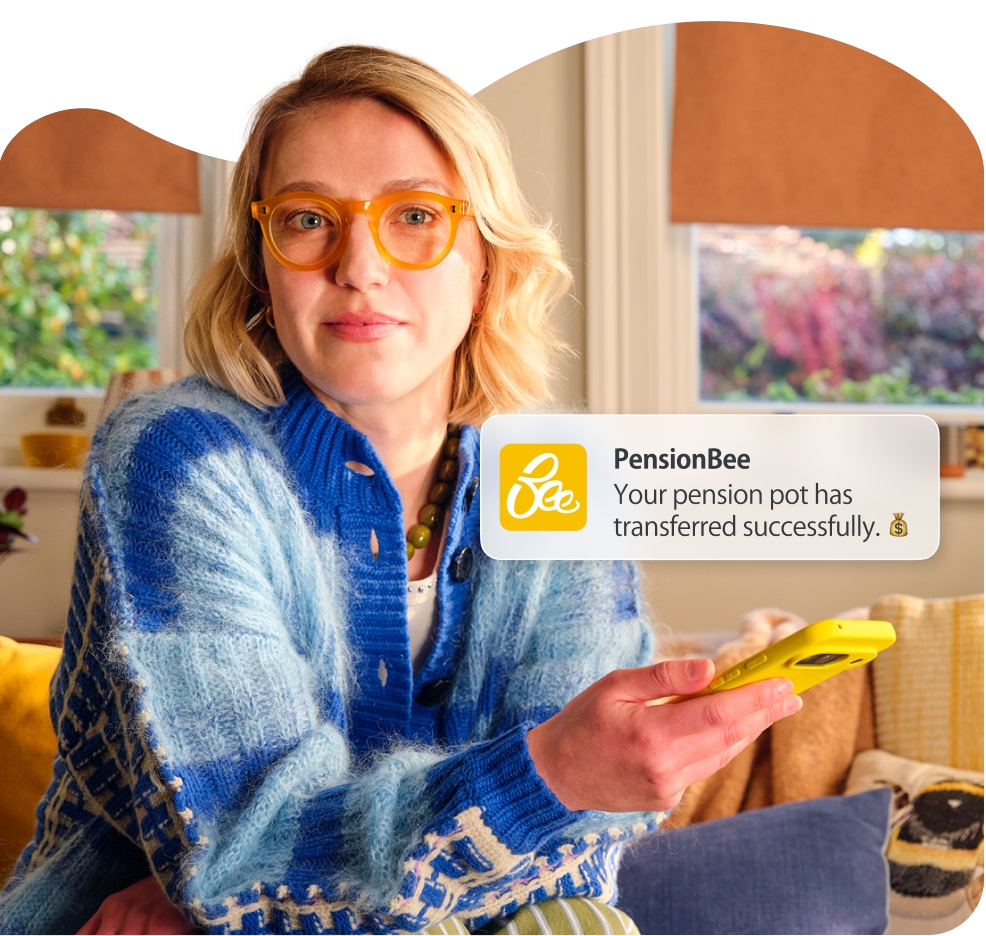
And I wanted to do it right. And then I had a really interesting conversation with a friend about this dilemma, saying, “I’m self-employed, I don’t really know what to do about pensions”. And she just said, “Oh, I actually just set up on PensionBee”.
And so I left that meeting, I went home, I got the app, I did it - and it really did only take me 10 or 15 minutes. And this huge weight dropped off my shoulders because now I wasn’t thinking, “I don’t even care about this pension thing”. At least I was doing something.
PHILIPPA: So she’s like the perfect ad for PensionBee, isn’t she?
DANI: Yeah.
PHILIPPA: But it’s a good point she’s making that it’s important, whatever you do, it’s important to do something.
DANI: Yeah, something is better than nothing is the bottom line there really, isn’t it?
PHILIPPA: So she did sort out her pension as she said, but, and this is the kind of important bit in some ways, between 2015 and 2023 she didn’t put anything into her pension at all. Obviously she had other stuff going on, there’s no blame here, it just happens, doesn’t it?
But just to highlight how important it is to try and avoid years when you don’t save at all, where would she have been financially? I’m sorry, Becca, to do this to you because this is going to be painful, but where would she have been if she had at least made some contribution in those eight years?
DANI: Comparing somebody that’s starting at either 32 years old or 40 years old with nothing.
PHILIPPA: OK.
DANI: And let’s say they’re contributing £30 a month.
PHILIPPA: OK.
DANI: Not contributing that £30 a month for that eight - during that eight year gap, the difference when you come to retire at 68 [years old] would be £5,500.
PHILIPPA: Now obviously these are estimated figures.
DANI: This is a bit of an estimate.
PHILIPPA: But even so, £5,500 gap.
DANI: And actually the amount that she didn’t put in during those eight years would’ve only been just under £3,000, but it amounts to £5,500 when you consider the compound interest and the potential investment growth that she missed.
PHILIPPA: And the tax relief.
DANI: And the tax relief that’s added on top, so it’s nearly double.
PHILIPPA: OK, so for the purpose of this, we’ve assumed there was no money in this pension pot, this imaginary pension pot at all. If there had been some money in it, say £50,000, and then there was an eight year gap when no more money was paid in, that’s even worse, isn’t it? That makes an even bigger loss.
DANI: Yeah, the gap there is then £18,000 together because you had that original £50,000 and you carried on contributing for the eight years, you get the compound interest of the stuff that’s existing there, your contributions on top and everything, so it makes an even bigger gap.
PHILIPPA: It does. So £18,000 better off, even with a basic contribution over those eight years.
PHILIPPA: Seems to me the point here is, we’re only talking - I say only - but we’re only talking about a contribution for this example of £30 a month, so not a lot of money, but the difference is really, really big, isn’t it? If you don’t pay in at all -
DANI: yeah -
PHILIPPA: you really pay for that.
DANI: Exactly. I use that £30 a month example because when my partner started his business and he went self-employed from working full-time, we were talking about setting up a pension and he was very, “I can’t afford it, I need to think about my tax bill, I need to think about what I’m going to be able to take home”. And I said, “just start with something, £10, £20, £30, what’s going to be comfortable?”. And we just sort of settled on £30.
PHILIPPA: Yeah.
DANI: And had he not done that, we’re years down the line now, he could’ve had a gap like Becca of eight years of not doing it. So I think it sounds very nominal but just start wherever you can. £30 a month, and then if you, a couple months in, you realise you can’t afford that, dial it back to £25, £20.
PHILIPPA: Yeah, or conversely, if the business is going well, you feel a bit more financially confident, pop it up a bit.
DANI: Exactly.
PHILIPPA: Even if it’s only a tiny amount.
DANI: Yeah, and I think that there’s a real satisfaction with seeing your money grow with your own contributions and the potential investment growth you’ll be getting. Add on the tax relief, think about when it comes to the end of tax year and you might have £100 or £200 spare, pop that in as a lump sum. Like, I think there’s a real satisfaction with seeing that pot grow starting with just £30. Just imagine yourself eight years down the line then looking at thousands of pounds.
PHILIPPA: I know it all sounds a bit sad, but I do feel this. It’s really reassuring, isn’t it, when you look at them and think, you say, “OK, I’m saving, there’s going to be some money there later”.
DANI: Exactly.
PHILIPPA: It’s a nice feeling.
DANI: Yeah.
Becca’s belief in teaching kids about money
PHILIPPA: So I mean, all in all, Becca’s had quite a journey with her pension and working out what to do about it. But she does know, and certainly I think she knew it before, but she certainly knows now, good housekeeping around money, this is a great lesson to teach your kids too.
BECCA: I think it’s really interesting to think about how our childhood builds our thoughts around money. My Dad was self-employed and I think that’s definitely had an impact on me, and they definitely saved for me as a child, and we weren’t able to touch that money until we were 18 [years old].
And once we were 18 [years old], we could make a decision about what we did with that money, and it actually helped me get on the property ladder. So I know that from an early age, my parents talked to me about things like business skills, but also saving for the future.
And I’m trying to do the same with my own children as well. We give them pocket money, we give them allowances, and then we encourage them to think about whether they want to save that money for something in the future or spend that money on instant gratification.
And although they’re only young, I think it’s important for them to start learning those money lessons. That definitely had an impact on me as a child and I hope I can carry that forward and have an impact on them too.
DANI: We’ve spoken about this [topic] loads on the podcast, about financial education [in schools] and parents talking to their children about money from a young age. So one of the early episodes [Episode 8] we did I think we spoke about the research from Cambridge University and the Money Advice Service [now known as MoneyHelper] that showed financial habits are formed from age seven.
PHILIPPA: Right, yeah, I remember this now. Yeah, really early.
DANI: So it seems odd to talk to your children about pensions when they’re seven or eight years old, but it definitely, definitely helps. And I think those, the mindsets that we have as adults and the ‘financial personalities’, as we call them, that we have as adults are formed from such an early age. So in whatever way you can, talking to your children, talking as a family about finances, as early as possible is definitely a good start.
PHILIPPA: Yeah, you can start them off talking about savings. I must say, I didn’t speak to my son about pensions when he was seven [years old]. But we did talk about saving and about not spending all your pocket money straight off the bat.
DANI: Exactly, and starting talking about saving is sort of a good entry because then when you start talking more about investing, because they’ve got this basic understanding of saving, it’s probably a bit of a step up, a leg up already, to understand what it means if then that money you’ve saved is invested.
PHILIPPA: Yeah, rather than it being a completely fresh thought when you’re older.
DANI: Exactly.
PHILIPPA: Thanks, Dani. And our thanks to Becca too for sharing her story with us. If you’d like to find out more about pensions and retirement planning, head to the show notes on this episode. As we said, we have shared lots of resources there for you. You can explore them, try things out for yourself, see how you feel.
Here’s a final reminder before we go that anything discussed on the podcast shouldn’t be regarded as financial advice or as legal advice, and when investing, your capital is at risk. Thanks for being with us. We’ll see you next time.
Risk warning
As always with investments, your capital is at risk. The value of your investment can go down as well as up, and you may get back less than you invest. This information should not be regarded as financial advice.
Period | Market Event | FTSE World TR GBP (%) | 4Plus Plan (%) |
|---|---|---|---|
4Plus Plan’s inception – 6 Sept 2013 | QE Tapering, China Interbank Crisis and its aftermath | -5.44 | -2.41 |
3 Oct 2014 – 15 May 2015 | Oil price drop, Eurozone deflation fears & Greek election outcome | -5.87 | -1.77 |
7 Jan 2016 – 14 Mar 2016 | China’s currency policy turmoil, collapse in oil prices and weak US activity | -7.26 | -1.54 |
15 June 2016 – 30 June 2016 | BREXIT referendum | -2.05 | -1.07 |










%201.png)