











Investing can give you the chance to grow your wealth over time. Yet many people don’t know where to start, or are even put off doing so entirely.
You might not think of yourself as an investor. But if you have a pension, you probably already are. Whether through a workplace scheme or a private pension, your provider will usually invest your contributions with the aim of growing your savings over time.
Even so, you could feel that investing isn't for you. You might be worried about losing money, think you don’t have enough to get started, or not be sure who to trust with your investments. These barriers could mean you’re missing opportunities to grow your wealth.
But if you can beat these concerns, you could start investing money now that might help you achieve financial freedom in future.
Here are five of the most common investing barriers, and how to overcome them.
{{main-cta}}
1. The fear of losing money
All investments carry risk along with opportunity, which means you could get back less than you invest.
But before that puts you off, it’s worth keeping these things in mind:
- You could ‘lose’ money in real terms by not investing - over time, inflation reduces the spending power of your money. This means that as the cost of living rises, your savings won’t go as far in the future as they would today.
- Historically, investments have outperformed cash in the long term - to combat inflation, you might save in cash with the hope that the interest you receive will outpace rising prices. While this can happen, in the long term, money invested in the stock market has been more reliable at doing so. Though it’s important to remember that past performance doesn’t guarantee future performance.
- Risk and reward are closely linked - generally speaking, the more risk you take with your investments, the higher the potential returns. You could choose lower-risk investments that might be more suitable if you’re new to investing. But bear in mind lower risk will usually mean lower returns.
Seeing your investments rise and fall in value is part of investing. By thinking about your risk tolerance and your investment time horizon, you can find a strategy that works for you.
2. Not having enough money
When the cost of living is high, investing can fall off the priority list. But, you don’t need lots of money to invest - even small, regular sums can make a difference over time.
Putting just £50 or £100 from your monthly income could help you slowly build up your investments. They could start to grow over time thanks to compounding (that’s returns on your returns).
Setting aside money to invest in your budget can help you stick to a regular plan. A common approach to budgeting is to break down your monthly income so you use:
- 50% on essential bills;
- 30% on ‘wants’ such as entertainment, shopping, dining out, and so on; and
- 20% on savings, investments, and pensions.
You can adjust these numbers to fit your lifestyle. For example, if you’re currently clearing debt (an essential outgoing), you could spend a bit less on your ‘wants’ and more on essentials.
Using a framework like this can help you balance short and long-term savings with your everyday costs.
Small contributions now could help you build a retirement pot for later life. In fact, you can open a PensionBee pension and start investing for your future with just £1.
3. The need for easy access
Money you invest in the stock market is usually harder to access than most cash savings.
It normally takes at least two days to access money held in investments in a General Investment Account (GIA) or a Stocks and Shares Individual Savings Account (ISA). It might take as long as a week, depending on your provider or what you’ve invested in.
The same is true for pensions. It usually takes around 10 days for a withdrawal to land in your bank account, especially if you’re withdrawing for the first time. For most pensions, that’s only possible from the Normal Minimum Pension Age (NMPA) of 55 (rising to 57 from 2028).
One other element to consider with GIAs is that you may have to pay Capital Gains Tax (CGT). If your investment returns in a GIA exceed your annual CGT allowance, you could have to report the tax charge on a Self-Assessment return. That could add an extra complication to accessing your invested money.
This is not a concern for ISAs or pensions where your returns are free from tax - although you may pay Income Tax on pension withdrawals, depending on your circumstances.
With all this in mind, it could be sensible to hold some cash in an easy access account for short-term goals as well as having some money invested. For example, if you’re planning a big purchase like a holiday, you might want funds immediately available. That way, you don’t have to wait to access investments or rely on credit cards.
Similarly, it can be wise to hold an emergency fund for unexpected expenses. That might be needing to pay for a new washing machine or car repairs.
Generally, a good target is having three-to-six months’ expenses in your fund. In retirement, this increases to one-to-two years’ as you’ll no longer have a regular income from work.
It can be sensible to hold money you've invested in the stock market for the long term - especially pensions which are designed to help you save for decades ahead. Leaving your investments untouched can give them the opportunity to benefit from compound growth and potential returns.
Having a mix of both cash savings and investments could be a sensible approach.
4. Not knowing who to trust
Trust in financial services in the UK is fairly low. A 2024 Financial Conduct Authority (FCA) survey found that only 39% of adults had confidence in the UK financial services industry. Just 36% said they felt most firms were honest and transparent.
When it comes to your wealth, you need to be able to trust the firm you’re dealing with. Before you choose a financial firm or product, it’s important to check:
- whether the company is authorised and regulated by a UK regulator, such as the FCA;
- what the firm does to meet the FCA’s Consumer Duty rules (if applicable); and
- if you’ll be covered under the Financial Services Compensation Scheme (FSCS).
These are fast becoming ‘hygiene factors’ of financial firms. Companies that meet these criteria could give you confidence that they’ll manage your money with care.
Bear in mind this doesn’t usually affect investment values. Your investments could still fall in value, even if the firm is regulated and acts in your interests.
5. Not knowing where to start
Many would-be investors don’t put their money in the market because they don’t know where to start.
You may not realise that if you have a workplace pension, you’re already an investor. Your provider will usually invest your pension savings on your behalf, aiming to grow your retirement pot for later life.
So, if you want to invest more of your wealth, contributing to your pension could be a straightforward way to do so.
As for investing more broadly, the key here is knowledge. The more you know, the greater confidence you’ll have. There are plenty of free resources available online to help you learn.
Remember: what you read or see online isn’t personalised advice or recommendations. It’s important to invest in what’s right for you.
If you’re still unsure, consider speaking to an Independent Financial Adviser (IFA).
Invest in your future through your pension
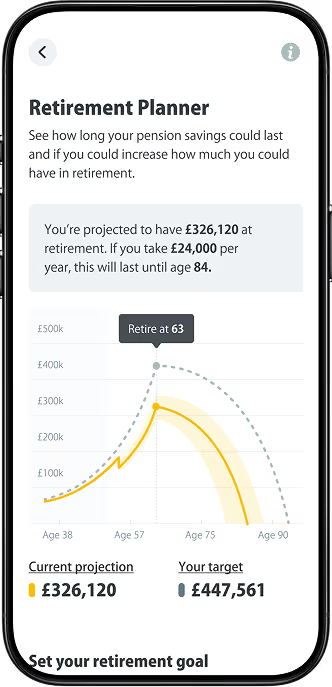
Your pension contributions are usually invested, aiming to grow your wealth for retirement over time.
If you want to invest for your future retirement, the PensionBee pension could be right for you. Choose from our range of plans, contribute easily via our website or app, and track your progress with retirement planning tools.
Risk warning
As always with investments, your capital is at risk. The value of your investment can go down as well as up, and you may get back less than you invest. This information should not be regarded as financial advice.
Period | Market Event | FTSE World TR GBP (%) | 4Plus Plan (%) |
|---|---|---|---|
4Plus Plan’s inception – 6 Sept 2013 | QE Tapering, China Interbank Crisis and its aftermath | -5.44 | -2.41 |
3 Oct 2014 – 15 May 2015 | Oil price drop, Eurozone deflation fears & Greek election outcome | -5.87 | -1.77 |
7 Jan 2016 – 14 Mar 2016 | China’s currency policy turmoil, collapse in oil prices and weak US activity | -7.26 | -1.54 |
15 June 2016 – 30 June 2016 | BREXIT referendum | -2.05 | -1.07 |












%201.png)