
PensionBee Inclusion, Equality and Diversity Policy
Our approach
At PensionBee, our vision is a world where everyone can enjoy a happy retirement. This vision, along with our mission to build pension confidence, and our values of love, quality, innovation, simplicity, and honesty, form the blueprint for everything we do.
In particular, our focus on everyone, and our value of love, reflect our desire for both our team and our customers, to include those who may not have been previously well represented within the industry and improve our ability to deliver on our vision, mission and values more generally.
We lead our approach with inclusion and equality, with the belief that when we’re delivering these principles in everything we do, demographic diversity that’s reflective of industry and society benchmarks will follow.
Aim
Our aim is for everyone to enjoy wellbeing at work. We measure wellbeing using the latest Work Wellbeing Methodology which looks at:
• Satisfaction: feeling a sense of overall satisfaction from your job;
• Happiness: experiencing regular positive emotions whilst at work;
• Stress: experiencing appropriate stress levels whilst at work; and
• Purpose: feeling a sense of clear meaning and purpose from your work.
We put wellbeing at the heart of everything we do because we believe that the wellbeing of our team, our customers, and our company are all deeply connected.
Goals
Our goals are built around the six ‘Bees’ of our wellbeing strategy which we believe drive wellbeing at work.
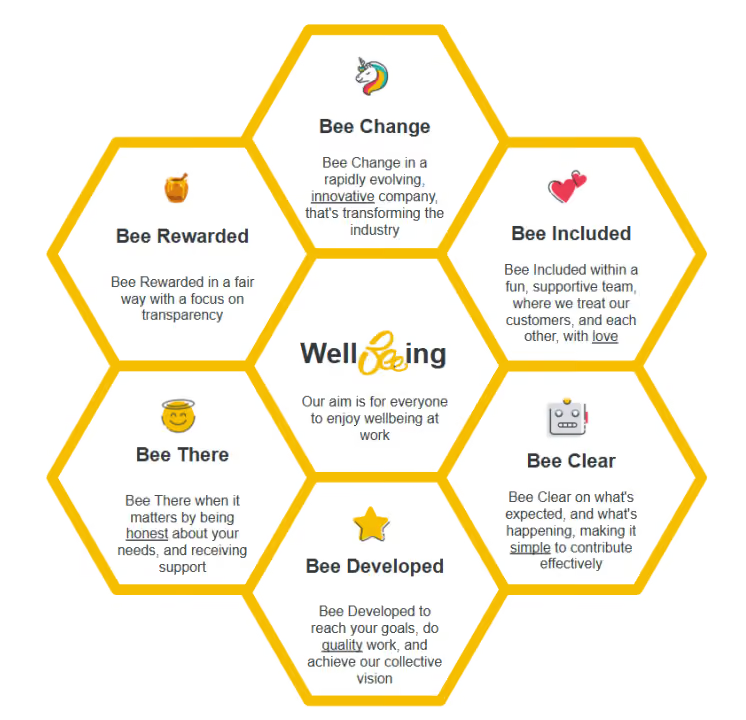
Our policy sets out in more detail our initiatives to promote inclusion, equality and diversity in each of these areas.
Measuring success
At the end of each year we review our team’s feedback, movement and demographics against our inclusion, equality and diversity approach to look for trends.
As part of this we review:
- Aggregate feedback from our Tri-Annual Wellbeing Survey;
- Team retention data;
- Team demographics compared to industry and census benchmarks in the UK; and
- Progress against the goals set by the FCA in the UK.
Our policy sets out in more detail how we measure success.
Applicable standards, definitions and concepts
Defining our values
At PensionBee our team gives high priority to our values, with people across the company taking part in a process of co-creation. Together, we defined our values:
• Love - we serve our customers and each other with care, warmth and respect.
• Honesty - we are open, authentic and accountable.
• Innovation - we lead with vision, embrace change and create positive impact.
• Quality - we deliver excellence through accuracy, security and reliability.
• Simplicity - we provide clarity in a world of complexity.
The principles of inclusion, equality and diversity demonstrate love for our team and our customers; facilitate the honesty we need to drive innovation; and enable us to attract, develop and retain a quality team, in turn supporting our broader vision.
Defining inclusion, equality and diversity
Inclusion - means feeling included, as opposed to excluded. It recognises that we all thrive in a safe, respectful and enjoyable working environment that supports our individual needs, and values our development, so that everyone can be successful as their authentic self. This includes both those traditionally underrepresented within the finance industry, as well as those feeling less included within traditional diversity initiatives.
Equality - means treating everyone fairly. Sometimes this means treating everyone with the same approach; such as when making hiring, performance, promotion, pay and disciplinary decisions using consistent, evidence or skills-based criteria. Sometimes it means treating people differently, to offer equal access to opportunities; such as when providing reasonable adjustments or flexible working arrangements.
Diversity - means respecting and valuing our differences, whether these be related to personal demographics, beliefs, circumstances or characteristics. It’s about simultaneously recognising our equal worth and commonality as humans, as well as the fact we all have unique needs, skills, and qualities to contribute based on our experiences.
Applicable legal standards
We operate globally, with a 200 strong team across both the UK and the USA. Both jurisdictions set out clear laws relating to inclusion, equality and diversity.
In the USA, the law is clear:
• We must not discriminate against anyone on the basis of race, color, religion, sex, sexual orientation, transgender status, pregnancy, marital status, national origin, age over 40, disability, genetic predisposition or carrier status, (Civil Rights Act 1964, Title VII, Age Discrimination in Employment Act 1967, Americans with Disabilities Act 1990, New York State Human Rights Law).
• We have a duty of care to provide a safe working environment, including protection from discrimination, harassment and sexual harassment (Civil Rights Act 1964, Age Discrimination in Employment Act 1967, Americans with Disabilities Act 1990).
• We must make reasonable accommodations to support people with disabilities to overcome barriers to employment (Americans with Disabilities Act 1990).
• We must pay men and women performing the same, or substantially similar work, equally (Equal Pay Act of 1963).
Failure to comply with the above, alongside creating a non-inclusive working environment, may result in significant legal and financial consequences, including costly litigation, reputational damage, and government penalties, such as those levied by the Equal Employment Opportunity Commission (EEOC) for violations of federal anti-discrimination statutes.
In the UK, the law is also clear:
• We must not discriminate, directly, or indirectly against anyone on the basis of a protected characteristic, such as age, disability, gender reassignment, marriage or civil partnership, pregnancy or maternity, race, nationality, ethnic, or national origin, religion, philosophical or political belief, sex or sexual orientation (Equality Act 2010).
• We have a duty of care to provide a safe working environment, including protection from discrimination, harassment and bullying (Protection from Harassment Act 1997).
• With a specific additional duty to take reasonable steps to prevent sexual harassment (Worker Protection (Amendment of Equality Act 2010) Act 2023)).
• We must make reasonable adjustments to support people with disabilities to overcome barriers to finding, and staying in employment (Equality Act 2010).
• As well as, give serious consideration, from day one, to any flexible working requests that enable people to balance work and personal responsibilities (Flexible Working (Amendment) Regulations 2023)).
• We’re also required to report our gender pay gap once we exceed 250 employees (Equality Act 2010 (Gender Pay Gap Information) Regulations 2017)), and new guidance has been published on ethnicity pay gap reporting, with a possibility of disability pay gap reporting to follow soon.
Failure to comply with the above, alongside creating a non-inclusive working environment, may result in costly employment tribunals with both reputational and financial risks attached, as well as court orders and fines from the Equality and Human Rights Commission (EHRC) for failure to follow gender pay gap reporting legislation.
Applicable regulatory standards (‘FCA’)
To drive change in the industry, the Financial Conduct Authority (‘FCA’) has set specific requirements for publicly listed companies in the UK. These are to:
• Report on gender and ethnicity representation at Board and Executive level in a standardised format using the tables provided.
• Provide an explanation of the company’s approach to collecting the data used for making the disclosures.
• Report on and comply, or explain basis in the company’s annual report and financial statements, whether the company has met the following ‘FCA Targets’ on its chosen reference date within the accounting period:
- at least 40% of individuals on the Board of Directors are women;
- one senior Board position is held by a woman (Chair, CEO, SID or CFO); and
- one Board member is from an Asian/Black/Mixed/Multiple/Other ethnic background.
• Consider a wide range of diversity aspects including gender, age, ethnicity, disability, socio-economic status and sexual orientation.
Our policy
In order to achieve our goals and the six ‘Bees’ of our wellbeing strategy we aim to provide inclusion, equality and diversity initiatives such as the following.
1. Bee Change
Bee Change in a rapidly evolving, innovative company that’s transforming the industry.
In order to achieve our vision of a world where everyone can enjoy a happy retirement, we need to listen to and engage with the wider communities in which we operate, and play our part in influencing positive change based on their needs.
We aim to achieve this by listening to, and amplifying consumer voices through initiatives run by our ESG team such as surveys and focus groups and using the insights gathered to feed into public campaigns to raise awareness about consumer needs and experiences to make change.
As well as taking part in volunteering and other outreach work we offer our team one paid volunteering day per year to dedicate to a meaningful cause, and aim to take part in an annual event hosting local school children at our UK office, sharing our variety of career stories in the industry.
2. Bee Included
Bee Included within a fun, supportive team where we treat our customers and each other with love.
Everyone thrives when our working environment aligns with our values. We aim to ensure this through a program of regular training and events to build awareness, understanding and connection. Such as our ‘Hive & Thrive’ program of executive sponsored events, regular socials and ‘Bee A Leader’ manager training covering topics relevant to inclusion, equality and diversity. We also offer annual training on inclusion, equality and diversity as part of our compliance test, reminding our team of their rights and responsibilities, and clear guidance set out in our People Handbook.
We also work to consistently uphold our culture for both new and existing colleagues. We aim to ensure that all new joiners understand the importance of our values through values based interview questions, and a culture based interview for senior hires. New Bees take part in an induction session on our values, culture and approach to inclusion, equality and diversity, and are required to complete our most recent annual compliance test including sections on inclusion, equality and diversity, within their first few weeks of joining.
We encourage a culture where people feel comfortable to speak up, and informally feedback to each other, or their manager, when they see or experience something that doesn’t feel right. We operate formal Whistleblowing Policy and grievance procedures, where an informal approach is no longer appropriate. We offer an anonymous feedback tool year round, which comes through directly to our CEO, COO, and senior People and Culture team members.
3. Bee Clear
Bee Clear on what's expected and what's happening, making it simple to contribute effectively.
We are clear on our zero-tolerance approach to bullying, harassment, victimisation and discrimination against colleagues, customers and suppliers or any other persons in the course of an individual's employment by PensionBee or otherwise in the conduct of PensionBee's business. Any reports of these acts will be investigated as misconduct following formal investigation and disciplinary procedures and appropriate action will be taken should a complaint be upheld. This process includes case by case review from our People Committee, and may also include internal and/or external legal advice. Particularly serious complaints or repeated instances of unacceptable conduct by individual members of the team could lead to termination of employment.
We take action to protect our team from bullying, harassment or discrimination by any third parties in the course of their employment with us. Nobody should have to tolerate abuse, even if it’s from a customer or supplier. More information is available in our public Abusive Behaviour Policy.
As well as upholding clear internal standards we also recognise the importance of working together to build change, and we believe that transparency is fundamental to driving better standards. We’re part of a variety of networking groups and collaborations, and our People & Culture team aims to attend a variety of external training annually to share best practice and learn from others.
We've also signed up to a variety of commitments, charters and pledges which we review annually. We’re a Level 2 Disability Confident Employer as part of the Government’s Disability Confident Employer Scheme in the UK. We are also an Accredited Living Wage Employer in the UK.
We commit to voluntary disclosure on numerous frameworks such as the Workforce Disclosure Initiative (WDI), as well as the Sustainability Accounting Standards Board (SASB) and Global Reporting Initiative (GRI).
We’re also committed to sharing our policies transparently wherever possible such as through the ABI Making Flexible Work Charter, ABI Transparent Parental Leave and Pay Initiative and publicly committing to the aims, goals, and terms of this policy.
4. Bee Developed
Bee Developed to reach career goals, do quality work, and achieve our collective vision.
We are committed to providing our team with plentiful opportunities for personal growth and development, helping them thrive by ensuring fair and equitable access to every step of the career journey. We believe in the importance of clear, and consistently applied policies, to ensure opportunities at PensionBee are given free from bias and based on skills-based evidence and criteria. We support our team’s growth through supportive management and feedback, as well as internal initiatives such as our ‘Bee Connected Mentoring Program’.
We use a skills and evidenced based approach to reviewing performance annually, with promotion decisions based on successful completion of clear goals. Managers are required to share goals for consistency, and senior, or rapid promotions must be approved by the Promotions Panel. In the UK, we also run calibration reporting of performance scores by manager, department, gender, ethnicity, social mobility and protected leave, and discuss significant anomalies in trends with managers.
For internal hiring, when a permanent role becomes newly available at PensionBee for which our current team are qualified, we aim to follow certain guidelines that enable a degree of consistency and fairness, although hiring for each role may require a slightly different process. To reduce biases as much as possible, we’ve made the majority of the process anonymous. However, certain roles may require a presentation or interview as part of their tasks. The structure is held to the same standards and expectations for all candidates; multiple assessors will be involved and decisions will be solely based on how well the candidates do on the tasks using a scoring system.
Several processes are also in place to ensure fair external hiring procedures. The first screening of applications is normally anonymised. From there, the hiring process must have at least two stages, and more than one person should be involved in decision making. It’s strongly recommended that one stage is a task-based assessment which simulates the work the candidate would be doing and can be anonymised to reduce bias. All hiring decisions should be recorded and where practicable details given for the reasons behind decisions should be included for candidates advancing beyond any anonymous stage to the extent necessary to demonstrate unbiased hiring procedures. Where recruiters are used, they should be briefed on the importance of inclusion, equality and diversity to PensionBee.
5. Bee There
Bee There when it matters by being honest about needs, and receiving support.
We want to tailor work to meet individual needs, as much as is reasonably possible, recognising the value this brings to creating an environment where everyone can thrive.
We aim to achieve this through supportive management and feedback practices, such as regular one to one’s and ‘Happiness!’ meetings with a manager. These provide a unique space to discuss personal wellbeing and needs.
We are committed to providing supportive adjustment to overcome barriers to thriving through tools such as reasonable accommodations for people with a disability, flexible working requests, and wellbeing action plans.
We aim to offer a package of wellbeing and leave benefits to cover a range of differing needs. This includes benefits focused around financial security, physical and mental health, disability and long-term ill health, as well as gender inclusive paid parental leave, paid time off for carers, and a range of paid time off for other life stages and events.
6. Bee Rewarded
Bee Rewarded in a fair way with a focus on transparency.
We are committed to providing a compensation and benefits package that’s transparent and regularly benchmarked, aligning hard work directly with pay.
We have a clearly defined approach to remuneration with our salary ranges shared transparently internally, and externally on job adverts. Salary increases and end of year bonuses are linked to performance reviews and must go through an approval process for consistency, and we take steps to monitor both our gender and ethnicity pay gaps internally in the UK.
We aim to ensure fair and equitable rewards by regularly benchmarking our compensation against the market and ensuring all pay increases and end-of-year bonuses go through an approval process for consistency.
Measuring success
Tri-Annual Wellbeing Survey
We run a tri-annual, global wellbeing survey (sent out in January, May and September) to review our team’s feedback against our aim for everyone to enjoy wellbeing at work, and the goals of our six ‘Bees’ wellbeing strategy. The survey is anonymous and starts with four questions based on the latest Work Wellbeing Methodology, which enables us to benchmark against a large data set. These questions focus on the core elements of wellbeing such as job satisfaction, purpose, happiness and appropriate stress.
We then ask six specific driver questions, one for each of our ‘Bees’, using a five point scale, as well as space for written feedback.
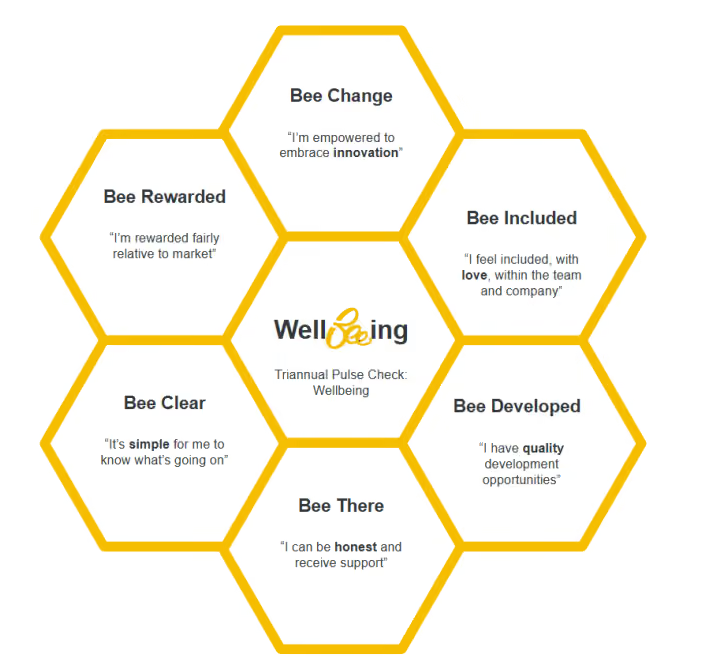
Following the survey, we analyse the results by location, and in the UK where our team size permits further breakdowns, we look at results by seniority, department, tenure and inclusion demographics, ensuring our wellbeing support applies to everyone equally.
Results are shared transparently with the team, Department Heads, and the Board, and where relevant, follow up actions are determined.
Annual Culture Review
At the end of each year we review our team’s feedback, movement and demographics against our inclusion, equality and diversity approach to look for trends.
As part of this we review:
• Aggregate feedback from our Tri-Annual Wellbeing Survey;
• Team retention data;
• Team demographics compared to industry and census benchmarks in the UK; and
• Progress against the goals set by the FCA in the UK
Results are shared transparently with the team, Department Heads, and the Board, and where relevant, follow up actions are determined.
Note on demographic data
We believe that equally talented people exist across all demographics, and that demographics don’t define someone's potential or capability. Therefore, we use our demographic data as a metric of success in the UK, as we feel that when we’re focused on our inclusion and equality goals, with time, our team will represent the demographics of the areas where we hire across all levels of the company. Due to the size of our teams outside of the UK, and the need to protect anonymity, we do not currently collect demographic data outside of the UK.
We benchmark ourselves to industry and census data, where available, to give us an idea of where to focus our approach. If we’re below industry averages, this could be more indicative of a PensionBee specific issue for us to review and plan for. If we’re at, or above industry averages, but below census levels, this could be more indicative of a societal, or structural barrier which we can still aim to collectively, and gradually, address.
For the most part what we measure is related directly, or indirectly, to protected characteristics defined within the Equality Act 2010. One exception to this is social mobility, which we measure using the occupation of the main household earner at age 14. We include this as we agree with the Government-backed Social Mobility Commission, that the circumstances of someone’s birth shouldn’t determine their outcomes in life.
We ask our team to review their demographic data upon joining, and annually thereafter, within their HR portal. They have access to their data at all times and can edit or delete it whenever they wish to. Data sharing is optional. We provide transparent information on how data will be stored and used. We ask for explicit consent to general reporting and ethnicity pay gap reporting separately.
Culture Program
Each year we use our survey feedback and Culture review to identify areas of focus and develop projects to address these priorities.
Examples of previous Culture Projects include the development of our Culture Code and People Committee, our Bee Connected! mentoring program and the launch of our ‘Hive & Thrive’ events.
Board and Executive Management
Aims
PensionBee’s approach to Board and Executive Management inclusion, equality and diversity aligns with our wider vision of a world where everyone can enjoy a happy retirement, the achievement of which is underpinned by our Values.
The Company’s aims for Board and Executive Management composition mirror that of the wider business, namely, to build a team where everyone can thrive.
Policy statement
PensionBee’s Board is committed to promoting inclusion, equality and diversity in the boardroom and aims to meet industry targets and recommendations. The selection of candidates to join the Board will continue to be based on merit and the candidate’s ability to contribute to the Board’s effectiveness.
The Board, with the support of the Nomination Committee, will continue to develop its succession plans and provide oversight of Executive Management succession arrangements, taking into account the Company’s goals concerning inclusion, equality and diversity.
Recruitment approach
For Board and Executive Management appointments, we will seek a diverse range (across multiple criteria) of credible, qualified candidates for both board and executive management roles. Specifically, we will consider candidates for appointment as non-executive directors from a broader pool including those with little or no prior publicly listed company board experience where the candidate otherwise competitively meets criteria appropriate for the role among other candidates and demonstrates an ability to contribute to the Board’s effectiveness. These same criteria would be required in circumstances where an executive search firm is engaged. We will only engage with firms that have adopted the Voluntary Code of Conduct for Executive Search Firms from the Department for Business & Trade and Department for Business, Energy & Industrial Strategy in respect of diversity.
Board and Committee review and responsibilities
The Board, supported by the Nomination Committee, is also committed to:
• Ensuring that the Board and its committees have a good balance of skills, experience, knowledge, perspective and varied backgrounds.
• Ensuring that Board appointments consider a wide pool of candidates with an array of experience and backgrounds including all aspects of diversity while not compromising on the calibre of candidates for appointment consideration.
• Ensuring the development of a diverse pipeline for director succession.
The Nomination Committee will report annually on Board and Executive Management diversity, including progress against the FCA Targets, within the Corporate Governance Section of the Company’s Annual Report and Financial Statements.
Review of the policy
The Board and Nomination Committee will keep this Policy under review to ensure its effectiveness and alignment with best practice and the requirements of the UK Corporate Governance Code and relevant legislation. The Nomination Committee reviews the Policy annually with any changes recommended to the Board.








%201.png)