
401(k) Plan Administration: How Automatic Rollovers Simplify Terminated Participant Accounts

PensionBee

July 30, 2026

|

7 minute read

Updated on:

July 30, 2026

Summary

Learn how automatic rollovers to Safe Harbor IRAs help sponsors manage terminated participant accounts.

Key Takeaways

  • Automatic rollovers to Safe Harbor IRAs can help eligible terminated participants keep retirement savings invested when they do not make a distribution election.
  • Safe Harbor IRAs provide a tax-advantaged destination for eligible small account balances while supporting participant asset preservation and liquidity requirements.
  • Automatic rollover processes can help plan sponsors and advisors reduce administrative burdens associated with inactive participant accounts.
  • A consistent rollover process may improve recordkeeping, support missing participant efforts, and promote more efficient plan administration.
  • Selecting an automatic rollover provider requires evaluating fees, participant support, compliance resources, reporting capabilities, and operational expertise.

Terminated participant accounts are a persistent administrative challenge in 401(k) plan management. When employees leave a company, they do not always take their retirement savings with them. Some forget about old accounts, are unsure of their distribution options, or leave behind small balances that can become increasingly difficult to administer over time.

Automatic rollovers can provide a practical solution for these accounts. Under applicable rules, eligible balances generally between $1,000 and $7,000 may be transferred into a Safe Harbor IRA if a former employee does not make a distribution election. This removes the account from the plan while preserving the participant's retirement savings in a tax-advantaged account.

For plan sponsors and advisors, understanding the requirements and benefits of automatic rollovers can help simplify plan administration, reduce the burden of maintaining terminated participant accounts, and support a smoother transition for former employees while keeping their retirement savings invested.

The Administrative Burden of Terminated Participant Accounts 

Job changes are common, and many employees accumulate retirement accounts across multiple employers throughout their careers. During an employment transition, retirement savings are often overlooked as former employees focus on immediate priorities such as starting a new job and managing personal responsibilities.

As a result, many terminated participants may not respond to distribution notices or make an election regarding their retirement savings. Without participant action, retirement accounts may remain in the former employer’s plan after an employee leaves the company. Over time, managing retirement savings across multiple employers may become more complex, particularly as participants accumulate additional accounts throughout their careers.

Automatic rollover provisions may help address these challenges by transferring eligible balances to a Safe Harbor IRA when participants do not make an election. This process can help preserve retirement savings in a tax-advantaged account while providing a structured approach for managing eligible small-balance accounts.

What is a Safe Harbor IRA and When Do Force-Out Rules Apply?

A Safe Harbor IRA is an individual retirement account that may serve as the destination for an automatic rollover under a retirement plan's automatic rollover provisions. It is established for eligible terminated participants who do not make a timely distribution election, allowing their retirement savings to remain in a tax-advantaged account.

Automatic rollovers generally apply only to eligible small account balances. If a plan includes automatic rollover provisions, the most common outcomes are shown below.

Account Balance Common Action
Under $1,000 A check may be issued directly to the participant
$1,000 – $7,000 Can be rolled into a Safe Harbor IRA
Over $7,000 Participant consent is generally required

Department of Labor regulations require Safe Harbor IRA investments to emphasize preservation of principal and liquidity while providing a reasonable opportunity for investment return. These requirements are intended to help protect participants' retirement savings until they decide how to manage their assets. 

Why Automatic Rollovers Matter for Former Participants

For eligible terminated participants who do not respond to distribution notices, automatic rollovers can help provide a transition path for small retirement account balances. Instead of being distributed in cash, eligible assets may be moved to a Safe Harbor IRA, allowing retirement savings to remain in a tax-advantaged account.

Automatic rollovers may provide several potential benefits for former participants:

  • Keeps retirement savings in a retirement account: Helps eligible participants keep retirement savings invested rather than receiving a taxable cash distribution.
  • Supports long-term retirement planning: Gives participants a place to hold eligible small balances while they consider their future retirement options.

While each participant’s circumstances are different, a Safe Harbor IRA may provide a structured solution that helps maintain retirement savings until a participant decides how to manage their assets.

Turn participant offboarding into a seamless process

See how an automated rollover IRA solution can help reduce leakage and streamline compliant plan distributions.

Talk to our team

How Automatic Rollovers Simplify 401(k) Plan Administration 

Automatic rollovers into Safe Harbor IRAs may provide several operational and participant-focused benefits for retirement plans. Establishing procedures for handling eligible terminated participants with small account balances can help streamline administrative processes, maintain more accurate participant records, and support the long-term preservation of retirement savings.

The table below highlights several potential considerations for plan sponsors and advisors.

Potential Benefit Why It Matters
Simplified plan administration Reduces the number of small terminated participant accounts requiring ongoing administration and oversight.
Improved data integrity Maintaining current participant records may help improve data accuracy and reduce outdated contact information within the plan.
Support for missing participant initiatives Addressing small-balance accounts earlier may help reduce the likelihood that participants become difficult to locate over time.
Consistent plan governance Applying established rollover procedures promotes uniform treatment of eligible participants in accordance with plan provisions and regulatory requirements.
Supports participant engagement Preserving retirement assets in a tax-advantaged account may help former employees avoid cashing out small balances and continue saving for retirement.

While the potential benefits of automatic rollovers are significant, achieving these outcomes often depends on how the rollover program is implemented in practice. The structure of the process, participant experience, and administrative support provided can all influence the effectiveness of an automatic rollover program. As a result, selecting an appropriate Safe Harbor IRA provider is an important consideration for plan sponsors and advisors.

ERISA Fiduciary Responsibility: How to Choose an Automatic Rollover IRA Provider 

Once a plan decides that automatic rollovers may be an appropriate solution for eligible terminated participants, selecting the right provider is an important next step. Not all automatic rollover IRA solutions offer the same level of participant support, administrative capabilities, or documentation.

While fees and principal preservation are important considerations, plan sponsors and advisors should also evaluate how a provider supports the full rollover process, from account establishment and participant communication to ongoing administration and compliance support.

Before selecting an automatic rollover IRA provider, consider the following questions:

Evaluation Area What to Ask
Participant fees Are fees reasonable and structured in a way that helps minimize the impact on small retirement account balances over time?
Principal preservation Does the provider's default investment option align with Safe Harbor IRA requirements and prioritize preservation of assets and liquidity?
Participant outreach Does the provider have processes in place to communicate with participants and help them understand their account options?
Missing participants or beneficiaries How does the provider assist with locating participants or addressing accounts with outdated contact information?
Account administration How does the provider manage account setup, transfers, distributions, and ongoing participant requests?
Reporting and recordkeeping Does the provider offer clear reporting that can support plan administration, audits, and accurate plan records?
Fiduciary documentation Does the provider provide documentation and resources that can help support a plan sponsor's due diligence and provider oversight process?

Does the provider provide documentation and resources that can help support a plan sponsor's due diligence and provider oversight process?

Selecting and monitoring a Safe Harbor IRA provider is an important part of prudent plan oversight. Establishing appropriate standards for provider selection and ongoing review may help ensure the rollover program continues to support both plan objectives and participant needs.

Supporting Better Retirement Outcomes Through Automatic Rollovers

Safe Harbor IRAs can help eligible terminated participants keep their retirement savings connected and invested while providing plan sponsors and advisors with a structured process for managing small account balances. By understanding automatic rollover requirements, evaluating provider capabilities, and maintaining effective oversight, plans can support participants while improving administrative efficiency.

PensionBee’s solution is designed to support this process end-to-end. By facilitating distributions into a Safe Harbor IRA, the platform helps ensure that terminated participant balances are removed from the plan in a compliant and efficient manner. This approach addresses a common issue identified during plan reviews with long-standing clients and during plan terminations, helping to simplify administration and support overall plan health.

Frequently Asked Questions (FAQs)

What is a Safe Harbor IRA? 

A Safe Harbor IRA is an individual retirement account used to receive distributions from retirement plans for terminated employees with small account balances (under $7,000). Under ERISA and SECURE 2.0, plan sponsors have the option to roll these balances into Safe Harbor IRAs rather than distributing them as cash.

When do force-out rules apply?

Force-out rules apply when a terminated participant's vested balance falls between $1,000 and $7,000, and the participant does not make an affirmative election about where the funds should go. Under DOL Reg. 2550.404a-2, those balances can be rolled into a safe harbor IRA. Balances under $1,000 may be distributed as cash.

What did SECURE 2.0 change about automatic rollovers?

SECURE 2.0 (Section 304) raised the involuntary cash-out limit from $5,000 to $7,000, effective for distributions made after December 31, 2023. This means plan sponsors can now process distributions for terminated participants with vested balances up to $7,000.

Why does participant offboarding matter in retirement plans?

The offboarding process is a critical moment where participants make decisions about their retirement savings. Poor communication or lack of guidance can lead to cash-outs, resulting in retirement leakage and potential taxes or penalties.

What responsibilities do plan sponsors have in selecting a Safe Harbor IRA provider?

Plan sponsors have a fiduciary responsibility to follow a prudent process when selecting and monitoring Safe Harbor IRA providers. This includes evaluating services, fees, potential conflicts of interest, and the provider’s ability to meet regulatory requirements and operational standards. 

Is selecting a Safe Harbor IRA provider a one-time decision?

No. While selection is an initial fiduciary step, plan sponsors are also expected to monitor the provider on an ongoing basis to ensure that services remain appropriate and that fees and practices continue to be reasonable. 

What factors should be considered when choosing a Safe Harbor IRA provider?

Key considerations include the provider’s fees and compensation structure, investment design, operational controls, experience with similar plans, financial stability, cybersecurity practices, and overall service quality.

What are common mistakes plan sponsors make when selecting a provider?

Common mistakes include focusing only on short-term costs, failing to evaluate long-term fees, not reviewing default investment performance over time, and insufficient documentation of the selection and monitoring process.

Why is ongoing monitoring of Safe Harbor IRA providers important?

Ongoing monitoring helps ensure that the provider continues to meet fiduciary expectations, including reasonable fees, appropriate services, and proper handling of participant assets after the initial rollover.

What is a third-party administrator's (TPA) role in automatic rollovers? 

A third-party administrator (TPA) handles the compliance and administrative infrastructure of a 401(k) plan, including nondiscrimination testing, Form 5500 filings, plan document maintenance, and processing participant distributions. Because automatic rollovers to a Safe Harbor IRA are a form of participant distribution, TPAs are typically the party responsible for executing the force-out mechanics on the plan sponsor's behalf, including required notices and documentation. Not all automatic rollover solutions offer TPAs the same level of integration, so the strength of a provider's connection to the plan's existing recordkeeping is a practical factor to evaluate. 

Are there fees associated with a Safe Harbor IRA? 

Yes. Fee structures vary significantly by provider: some charge a flat annual fee that can equal a large percentage of a small balance, while others charge an all-in percentage-based fee covering management and investment costs. Because small balances are especially vulnerable to erosion from flat fees, plan sponsors and advisors should confirm exactly how a provider's fee structure scales against balance size before selecting them. See How Junk IRAs Are Destroying the American Dream for a closer look at how fee structures at legacy Automatic Rollover (Safe Harbor) IRA providers can erode small balances over time. 

What is the difference between automatic rollover and mandatory (involuntary) cash-out? 

Both are triggered when a terminated participant does not make a distribution election, but the dollar threshold determines which applies, per DOL regulation 29 CFR § 2550.404a-2. Balances of $1,000 or less may be distributed directly to the participant, generally by check, this is the mandatory cash-out. Balances between $1,000 and $7,000 must instead be rolled into a Safe Harbor IRA to qualify for fiduciary safe harbor protection, this is the automatic rollover. The distinction matters for the participant too: a cash-out under $1,000 sends money directly to the individual, subject to mandatory 20% withholding and a 60-day window to redeposit the funds to avoid taxes and penalties, while an automatic rollover moves the balance institution to institution, so the participant never takes possession and no withholding or 60-day clock applies.

Disclaimer

Investing involves risk. This post, and any associated customer testimonial or third party endorsement, is provided solely for informational and educational purposes, should not be taken as tax, legal, financial or investment advice and is not an offer, solicitation, or recommendation to buy or sell any securities or investments.

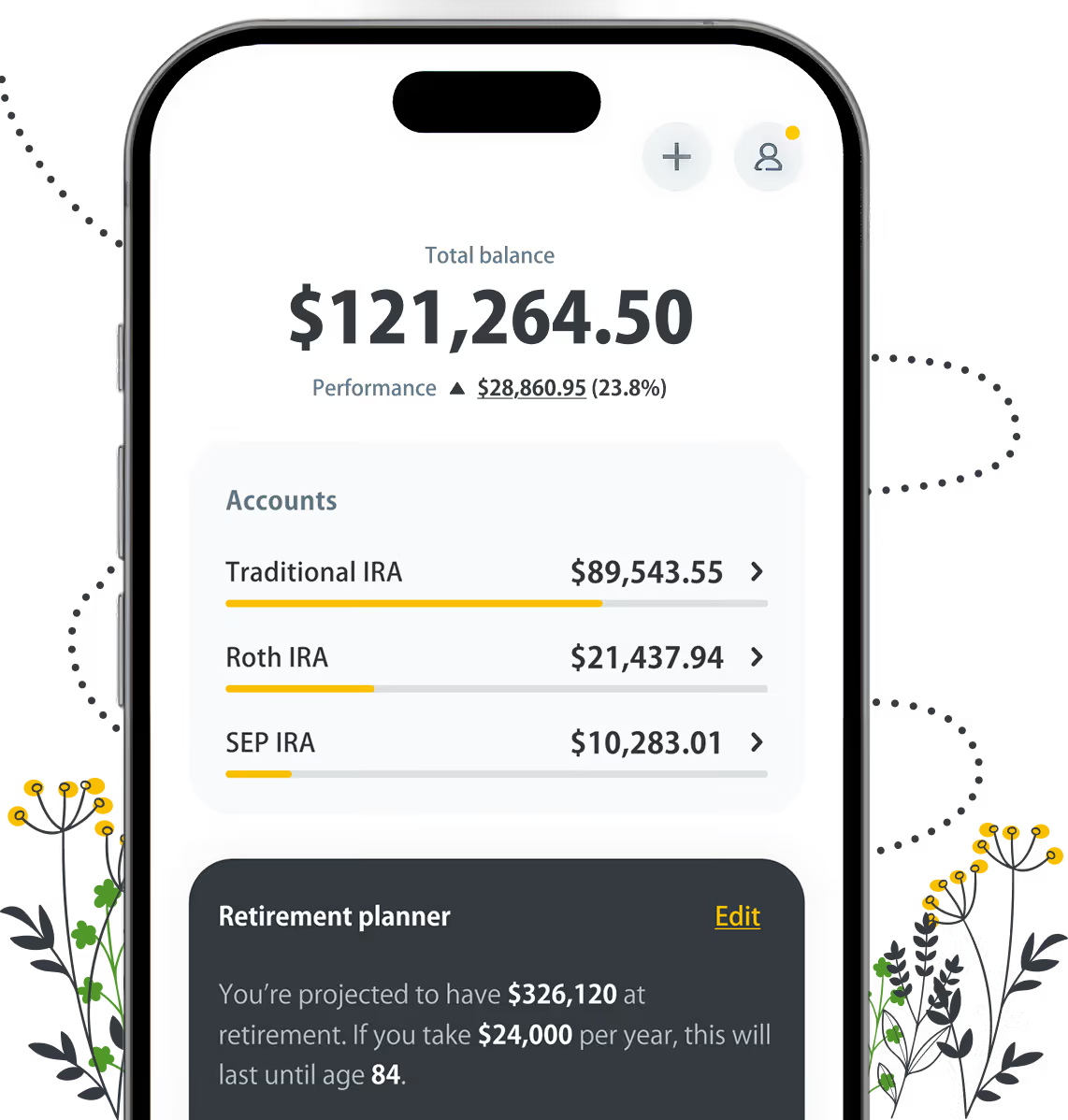
product shot showing account balance

A better way to IRA

Roll over your old 401(k)s and IRAs into one simple PensionBee IRA.
Get started
Images are hypothetical*