
Terminated Participant Accounts: The Hidden Cost of Left Behind Retirement Accounts

PensionBee

May 27, 2026

|

7 minute read

Updated on:

June 3, 2026

Summary

For plan sponsors and financial advisors, terminated participant accounts are more than an administrative inconvenience.

Terminated participant accounts can accumulate quietly, inflate per-participant costs, and introduce fiduciary exposure that often goes undetected until an audit or plan transition forces the issue. For advisors, they also represent AUM leakage: every unresolved balance is a former participant's savings sitting outside your book, with no clear path back. 

Whether the result of employee turnover, a force-out 401(k) event, or structural changes such as mergers and acquisitions, these balances require proactive management. For advisors supporting employers and retirement plan committees, understanding the role of solutions like an automatic rollover is critical, not just for compliance but for protecting participants and supporting the long-term health of the plan.

What are Terminated Participant Accounts?

A terminated participant account is an account that remains in an employer-sponsored retirement plan after an employee has separated from service. These accounts are also referred to in the industry as orphaned accounts, inactive participant balances, or, in regulatory contexts, force-out eligible accounts.

They commonly arise in 401(k) and 403(b) plans following employee separation, during plan terminations, in organizations undergoing mergers or acquisitions, or when small balances are subject to automatic distribution rules.

In many cases, when balances fall below regulatory thresholds, employers may initiate a force-out distribution. If the participant does not make an election, the balance is automatically rolled into a safe harbor IRA. While this process is intended to streamline plan administration, it can still create downstream fiduciary and operational risks if not handled properly.

Why Terminated Participant Accounts Create Hidden Costs for Plan Sponsors

The impact of terminated participant accounts doesn’t come from each account’s balance, but from how many there are overall and how they compound across the plan's administrative, compliance, and audit profile. As more accounts go inactive, they create inefficiencies in plan operations and increase risk in several distinct areas. Each of these areas carries both financial and fiduciary implications.

The True Cost of Terminated Participant Accounts

Hidden Cost Plan Impact
Recordkeeping Fees Terminated participant accounts increase per-participant recordkeeping fees and reduce overall plan efficiency.
Missing participants Missing participants require additional search and outreach efforts and may increase the risk of DOL scrutiny.
Compliance Risk Errors during distributions, rollovers, or uncashed checks can create fiduciary exposure and costly correction requirements.
Audit Complexity Terminated participant accounts make plan audits more time-consuming, expensive, and difficult to document properly.
401k Plan Termination Delays Unresolved terminated participant account balances can delay final plan termination and create additional compliance challenges.
M&A Integration Issues Legacy balances and outdated participant records can complicate plan transitions during mergers or acquisitions.

How Automatic Rollover IRAs Address Terminated Participant Balances

An automatic rollover provides a compliant way to handle small retirement account balances when participants do not respond to distribution notices. Under IRS and DOL rules, employers may transfer eligible amounts to a safe harbor IRA if the participant makes no election and the balance is below the cash-out threshold, which under the SECURE 2.0 Act is $7,000.

This structure can support fiduciary compliance, reduce plan administration costs, and facilitate plan termination and plan transitions such as mergers and acquisitions. It may also help preserve small account balances by moving them into IRAs rather than triggering cash-outs

This is not solely about moving inactive balances off the books. It reflects a fiduciary-driven process aimed at managing plan risk, supporting participant outcomes, and ensuring rollover decisions are made in accordance with ERISA standards.

Automatic rollovers made easy

We offer a leading IRA for small balance rollovers and 401(k) plan terminations, designed to simplify processes and improve plan health.

Talk to an expert

Four Plan Events That Require Automatic Rollover Processing

Automatic rollovers are commonly associated with operational changes in retirement plans, when participant balances must be processed under evolving plan structures and regulatory requirements. Identifying these situations in advance allows plan sponsors and advisors to prepare for required actions rather than address them reactively.

1. Force-Out 401(k) Provisions

Most retirement plans include force-out provisions that allow for the automatic distribution of small balances after employment ends. Balances between $1,000 - $7,000 or less may be rolled over to an IRA if the participant does not make an election.

This approach helps maintain tax-deferred treatment of retirement savings and may reduce exposure to taxes or penalties compared to a cash distribution. Balances of $1,000 or less may generally be distributed in cash or rolled over, depending on plan design and regulatory parameters.

2. Mergers and Acquisitions (M&A)

Mergers and acquisitions often result in changes to retirement plan structure, including consolidation, freezes, or terminations as part of post-transaction integration.

Common outcomes include:

  • Plan termination following the transaction close
  • Consolidation into the acquiring employer’s plan
  • Temporary freezes during system or administrative integration
  • Retention of inactive or orphaned participants due to workforce changes

During these transitions, participants may miss rollover opportunities due to communication gaps, system conversions, or uncertainty about plan changes.

3. Plan Termination

A plan termination requires that all plan assets be properly distributed before the plan can be closed. Participants who do not respond to required notices, even after documented outreach, must still have their balances resolved in accordance with plan terms and applicable regulatory guidance.

In practice, unresponsive accounts are often transferred to a safe harbor IRA through an automatic rollover, allowing the sponsor to complete the termination process. In this scenario, thorough documentation of notices, outreach, and distribution decisions is essential to support compliance and avoid delays.

4. Lost or Non-Responsive Participants

When participants cannot be located or fail to respond to required communications despite good-faith search efforts, plan sponsors must follow established fiduciary procedures for handling missing participants and their accounts.

Rather than allowing assets to remain indefinitely unclaimed, sponsors may transfer eligible balances into a safe harbor IRA, consistent with plan terms and regulatory requirements, to preserve retirement savings while supporting compliance.

This is particularly relevant during audits, plan terminations, and legacy plan cleanup efforts, where unresolved participant balances can contribute to administrative complexity and delay completion processes.

Best Practices for Selecting an Automatic Rollover IRA

Improperly managed automatic rollovers can create significant fiduciary liability for the individuals responsible for retirement plan oversight. Selecting the right provider requires more than operational convenience, it requires a defensible fiduciary process.

These best practices can help reduce risk and may lead to better results for participants.

1. Use a Qualified Provider

Automatic rollover IRA providers should offer transparent fee structures, conservative default investment options, and account designs that align with DOL safe harbor requirements.

When evaluating providers, fiduciaries should consider regulatory compliance history, participant service standards, and long-term account management practices—not cost alone.

A qualified automatic rollover IRA solution balances participant protection with administrative efficiency.

2. Document the Fiduciary Selection Process

Every provider evaluation should be supported by clear, dated documentation showing how options were reviewed, compared, and selected.

This includes fee analysis, investment review, service capabilities, and compliance considerations. In the event of a DOL audit or participant complaint, this documentation is a key element in demonstrating fiduciary prudence. If the process is not documented, it becomes difficult to defend.

3. Strengthen Participant Communication Before the Rollover

Clear and timely participant communication significantly reduces the number of individuals who trigger unintended force-out 401k distributions.

Plan sponsors should use multiple contact methods, including mail, email, and phone outreach, and maintain records of every communication attempt.

During mergers and acquisitions, communication should begin as early as possible, ideally before plan changes are finalized, to reduce confusion and improve participant response rates.

4. Address M&A Complexity Proactively

During mergers and acquisitions, fiduciary oversight becomes more complex as legacy plans, participant records, and administrative responsibilities shift between organizations.

ERISA fiduciary duties require prudent management of plan operations, accurate recordkeeping, and proper participant notification throughout the transition.

Addressing terminated participant accounts balances early helps prevent inherited compliance problems from ongoing fiduciary risk. 

5. Review Plan Design and Force-Out Thresholds Regularly

Default IRA arrangements should be periodically reviewed as part of the fiduciary duty of prudence to ensure continued alignment with regulatory requirements and evolving fiduciary best practices.

Outdated plan provisions can create unnecessary compliance risk, especially during unexpected events such as workforce reductions, acquisitions, or plan terminations.

Routine review helps sponsors stay prepared rather than reactive.

6. Review All Fees and Costs

Beyond initial setup fees, fiduciaries should assess ongoing maintenance charges, investment expense ratios, participant claim fees, and any costs associated with locating missing participants.

High fees on small balances can significantly erode participant savings and may raise fiduciary prudence concerns if they are not reasonable in light of services provided, properly disclosed, or regularly reviewed.

Fee transparency is not only a best practice, but also a core fiduciary responsibility.

Pension Bee is the Automatic Rollover Solution for Terminated Participant Accounts

Terminated participant accounts may look like administrative details, but they represent one of the most overlooked fiduciary risks in retirement plan management. For advisors and plan sponsors, the challenge is not just identifying these accounts. It is also ensuring they are managed in a consistent, documented, and defensible manner that aligns with ERISA obligations.

An automatic rollover IRA solution helps address these small balances in a structured and compliant way by transferring eligible accounts out of the plan through a defined IRS- and ERISA-aligned process. This reduces plan complexity, supports consistent administration, and can help improve the plan’s position during regulatory review or Department of Labor scrutiny.

PensionBee’s automatic rollover IRA solution handles this end-to-end. By processing distributions into a leading IRA, it helps ensure terminated participant balances are removed from the plan in a compliant and efficient manner. It provides a turnkey solution to a problem that commonly arises in plan reviews with long-tenured clients and during plan terminations, helping simplify processes and improve overall plan health.

Frequently Asked Questions (FAQs)

What is the small-balance rollover problem?

The small-balance rollover problem refers to the accumulation of small, forgotten, or force-out-eligible retirement accounts that go unmanaged after employment ends. These accounts frequently default into safe harbor IRAs with limited investment options and higher fees, where they remain without ongoing oversight or advisory attention. 

What is a Safe Harbor IRA? 

A Safe Harbor IRA is an individual retirement account used to receive distributions from retirement plans for terminated employees with small account balances (under $7,000). Under ERISA and SECURE 2.0, plan sponsors are required to roll these balances into Safe Harbor IRAs rather than distributing them as cash if the plan sponsor has adopted force-out provisions.

Why does participant offboarding matter in retirement plans?

The offboarding process is a critical moment where participants make decisions about their retirement savings. Poor communication or lack of guidance can lead to cash-outs, resulting in retirement leakage and reduced long-term outcomes.

Who is subject to ERISA?

ERISA generally applies to private-sector retirement plans. It does not cover government or church plans, plans solely for workers’ compensation/unemployment/disability, unfunded deferred compensation (“top-hat”) plans, or individually established IRAs.

What are the basic ERISA requirements for plan sponsors?

ERISA requires plan sponsors to appoint and monitor plan fiduciaries, maintain an Investment Policy Statement, benchmark and disclose all plan fees, provide participants with an SPD and 404a-5 disclosures, file Form 5500 annually with the DOL, and document all fiduciary decisions.

What are the fee requirements under ERISA?

All plan-related fees, recordkeeping, investment management, and advisory must be disclosed clearly and be reasonable relative to the services provided.

How are investments monitored under ERISA?

Fiduciaries must continuously monitor investments. This includes establishing an Investment Policy Statement (IPS), reviewing performance and fees, and replacing underperforming or imprudent investments.

What did SECURE 2.0 change about automatic rollovers?

SECURE 2.0 (Section 304) raised the involuntary cash-out limit from $5,000 to $7,000, effective for distributions made after December 31, 2023. This means plan sponsors can now process distributions for terminated participants with vested balances up to $7,000.

How should plan sponsors evaluate automatic rollover IRA providers?

Sponsors should compare fees (including annual maintenance and any transfer-out charges), yields or interest rates, capital preservation features, and the quality of participant communications. The selection process should be documented, and the provider should be reviewed on a recurring basis. Failing to do this can result in participants being defaulted into accounts that don't serve their long-term interests, which creates its own fiduciary risk.

What happens if a plan fails ERISA compliance? 

Non-compliance can result in DOL investigations, excise taxes, prohibited transaction penalties, participant lawsuits, and, in severe cases, plan disqualification. The most common triggers are fee-related lawsuits, inadequate documentation, and mishandled distributions for terminated employees.

What happens during a plan termination?

Plan termination involves fully distributing all plan assets, communicating with participants, and coordinating with service providers. It is a fiduciary process that requires careful planning, documentation, and execution to avoid delays and compliance issues.

Disclaimer

Your investment can go down as well as up. This post, and any associated customer testimonial or third party endorsement, is provided solely for informational and educational purposes, should not be taken as tax, legal, financial or investment advice and is not an offer, solicitation, or recommendation to buy or sell any securities or investments.

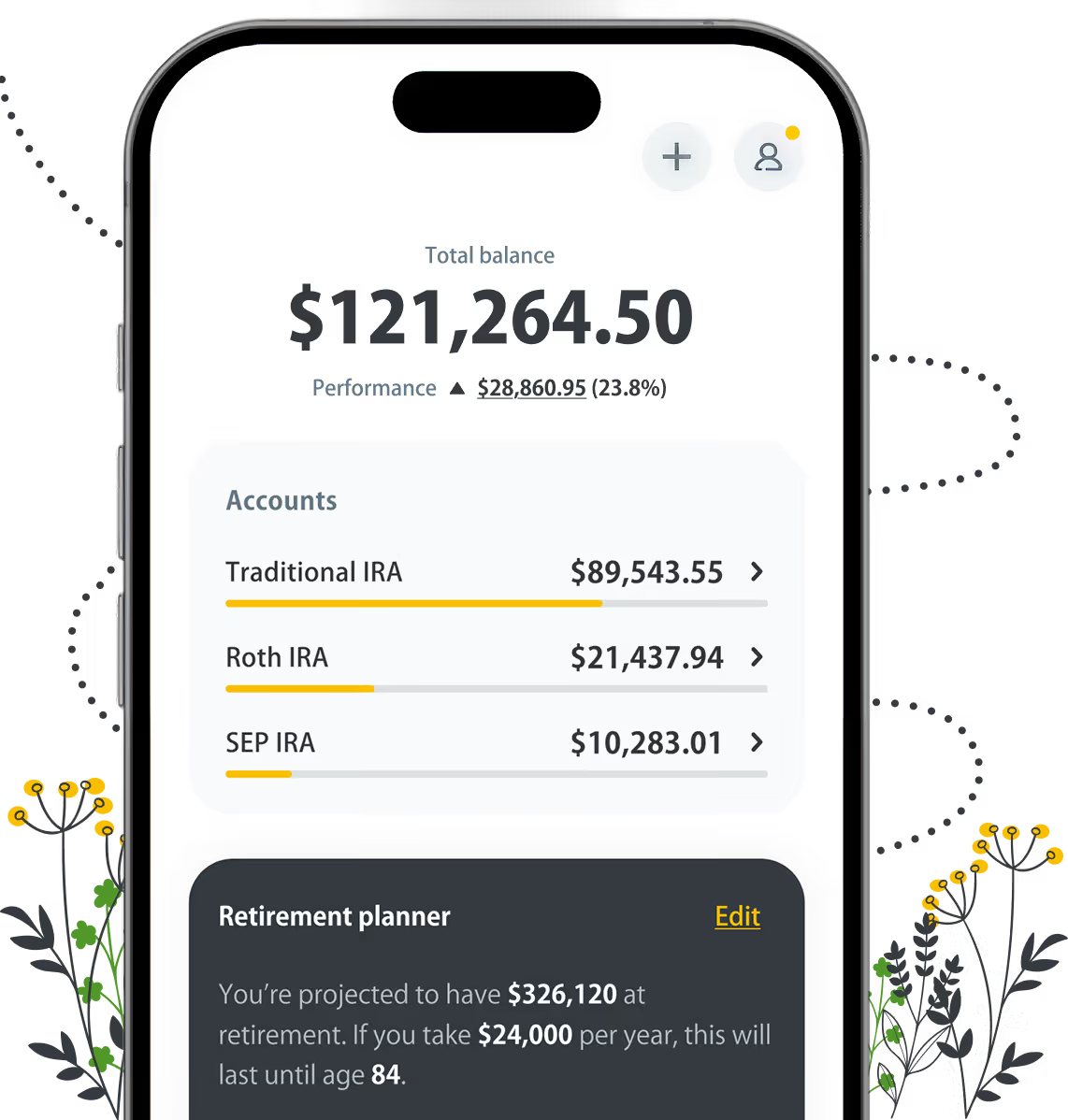
product shot showing account balance

A better way to IRA

Roll over your old 401(k)s and IRAs into one simple PensionBee IRA.
Get started
Images are hypothetical*