
How to Ensure Compliance During Corporate Plan Mergers

PensionBee

July 13, 2026

|

7 minute read

Updated on:

July 13, 2026

Summary

A guide to ensuring compliance during mergers and acquisitions, covering fiduciary documentation, data accuracy, and regulatory requirements.

Key Takeaways

  1. Before transferring any assets, compare both plans' eligibility rules, vesting schedules, loan policies, and investment lineups to catch conflicts early.
  2. Keep detailed records of how and why each decision was made to protect against audits, participant inquiries, or regulatory review.
  3. Validate records, balances, beneficiary info, and employment status before the merger, paying special attention to terminated or missing participants.
  4. Under SECURE 2.0, accounts under $7,000 can be automatically rolled over or distributed, reducing inactive accounts and simplifying the transition.
  5. Notify participants about blackout periods, investment changes, and key dates well in advance, and keep records of all communications delivered.

Mergers and acquisitions often trigger significant changes to retirement plans. Whether organizations are combining plans, transitioning to a new recordkeeper, or terminating one plan in favor of another, these transactions introduce a range of fiduciary, administrative, and compliance obligations. A successful plan merger requires thorough planning, prudent decision-making, and clear documentation at every stage.

Ways to Ensure Compliance During Corporate Plan Mergers

From the initial review of plan documents to the final distribution of assets, each step of a plan merger carries distinct legal and administrative obligations. The following practices can help plan sponsors and fiduciaries manage the process in a compliant and defensible manner.

Step 1: Conduct a Pre-Merger Plan Review

Before any assets are transferred or records are merged, plan sponsors should conduct a comprehensive review of both plans involved in the transaction. This goes beyond a surface-level check and includes key areas such as:

  • Plan documents and amendments
  • Recent Form 5500 filings
  • Nondiscrimination testing results
  • Correction history and outstanding compliance issues
  • Liabilities or obligations that may be inherited through the transaction

The goal is to build a clear picture of both plans so issues can be identified and resolved prior to closing.

Step 2: Document Every Fiduciary Decision

Throughout a plan merger or termination, documentation is often just as important as the decisions themselves. Fiduciaries should be able to demonstrate not only what was decided, but how and why each decision was made. 

According to the DOL, this includes documenting: 

  • The rationale for selecting or transitioning service providers
  • How participant accounts were mapped
  • The basis for any distribution determinations
  • How and when required notices were delivered
  • The steps taken to locate missing participants

If automatic rollovers into Safe Harbor IRAs are part of the transition, fiduciaries should also document the provider selection process and the basis for evaluating fees and services.

In the event of an audit, DOL inquiry, or participant dispute, a clear paper trail can be the difference between a straightforward review and a prolonged investigation.

Step 3: Prioritize Participant Data Accuracy

One of the biggest challenges in a plan merger is ensuring participant data is accurate and complete. Research shows that between 60-70% of M&A integrations fall short of their expected value, with data quality issues often contributing to delays and operational problems. Addressing these issues early can help organizations integrate more efficiently and reduce the risk of costly errors during and after the transition.

The most common data-related challenges during M&A’s include:

  • Inconsistent data structures between organizations
  • Duplicate or incomplete records
  • Legacy systems that are difficult to integrate
  • Lack of clear data governance or ownership
  • Limited visibility into historical records and transactions

Special attention should be given to terminated participants, missing participants, and individuals with outstanding loans, as these groups often require additional administrative oversight and can present heightened compliance risks if not addressed before assets are transferred.

Automatic rollovers made easy

We offer a leading IRA for small-balance rollovers and 401(k) plan terminations, designed to simplify processes and improve plan health.

Talk to an expert

Step 4: Address Missing Participants Before the Merger Closes

Missing participants can create administrative and compliance challenges during a plan merger, so it's important to address these issues before assets are transferred. Taking proactive steps early can help reduce delays, support smooth account transitions, and demonstrate prudent fiduciary oversight.

Plan sponsors should consider:

  • Collecting updated contact information during employee onboarding and offboarding processes.
  • Periodically reaching out to former employees to encourage them to keep their information current and review their plan options.
  • Using multiple search methods, such as certified mail, email, phone calls, social media, and public records databases.
  • Engaging a professional locator service if additional resources are needed to locate participants.
  • Establishing formal procedures for handling missing participants and defining reasonable search efforts based on account balances.
  • Maintaining records of search activities, including outreach attempts and correspondence sent to participants.

By establishing a consistent process for locating participants, plan sponsors can help minimize unresolved accounts and reduce the risk of compliance issues following the merger.

Step 5: Determine How Small-Balance Accounts Will Be Handled

During many mergers, fiduciaries must determine how to address small-balance accounts held by former employees. Force-out provisions, automatic rollover processes, and Safe Harbor IRA arrangements are commonly used to reduce the number of inactive accounts carried through the transition.

Under SECURE 2.0, the threshold for involuntary cash-outs increased from $5,000 to $7,000 for distributions made after December 31, 2023. Plans that adopt this provision may automatically distribute or roll over participant balances below this amount, subject to applicable notice and consent requirements.

Account Balance Common Action
Under $1,000 A check may be issued directly to the participant
$1,000 – $7,000 Can be rolled into a Safe Harbor IRA
Over $7,000 Participant consent is generally required

When selecting an automatic rollover provider, fiduciaries should conduct prudent due diligence by evaluating fees, services, participant experience, and default investment options.

Step 6: Develop a Participant Communication Strategy

Clear and consistent communication can help reduce uncertainty and keep participants informed throughout a plan merger. An effective communication strategy should address the transition in three phases to ensure participants receive timely information and have opportunities to ask questions.

  1. Before the merger announcement: Plan sponsors should identify the participant groups most likely to be affected, understand their concerns, and develop messaging that supports the goals of the transition. Establishing a communication timeline in advance can help ensure key milestones and future updates are delivered in a timely manner. Leadership should also be prepared to communicate the reasons for the merger and respond to participant questions.
  2. During the announcement phase: Plan sponsors should focus on sharing information through multiple channels, such as meetings, webinars, emails, and newsletters. Providing participants with opportunities to ask questions and provide feedback can help improve understanding and address concerns as they arise.
  3. After the announcement: Communication efforts should continue through regular updates on the progress of the transition. Messaging may need to be tailored to different participant groups based on how they are affected. Highlighting important milestones and successes can also help reinforce the reasons behind the merger and maintain confidence throughout the integration process.

What Happens When a Merger Leads to Plan Termination?

Not every M&A transaction results in a retirement plan termination. However, when a qualified retirement plan is terminated in connection with a merger or acquisition, it triggers specific IRS and ERISA requirements, including:

  • 100% vesting of all participants’ benefits
  • Proper handling of outstanding participant loans
  • Distribution of plan assets
  • Completion of required notices, plan amendments, and final filings

Plan sponsors should not assume that general merger integration rules govern a plan termination. Although related to a broader transaction, termination is subject to distinct ERISA and IRS requirements that must be satisfied independently within the applicable regulatory framework. 

Common risk areas include:
Area Key Risk
Plan status classification during M&A Improper identification of whether the plan is terminating or continuing as part of a successor structure.
Force-out execution Incomplete or inconsistent processing of distributions.
Locating missing participants Weak or insufficient efforts to locate terminated or inactive participants.
Rollover IRA selection Defaulting rolled over assets into high-fee or low-quality IRAs.
Fiduciary documentation Insufficient records supporting fiduciary decisions and process steps.

Maintaining Compliance Throughout the Merger Process

Mergers and acquisitions create a range of fiduciary and compliance responsibilities, from reviewing plan provisions and validating participant data to managing distributions and communicating with participants. Addressing these issues proactively can help reduce risk, support a smoother transition, and protect participant retirement assets throughout the process.

For sponsors managing terminated participant accounts and eligible small-balance distributions, an automatic rollover IRA solution can help streamline administration and support compliance objectives during both plan mergers and plan terminations. By facilitating rollovers into a high-quality Safe Harbor IRA, PensionBee can help reduce administrative burden while supporting fiduciary oversight during periods of organizational change.

Frequently Asked Questions (FAQs)

What is a Merger and Acquisition (M&A)?

A merger and acquisition (M&A) in relation to retirement plans is when two companies combine or one company buys another, and their employee retirement plans (like 401(k)s) must be combined, transferred, or closed as part of that change.

What is the difference between a plan merger and a plan termination?

A merger combines or integrates plans, while a termination ends a plan entirely. Terminations require additional steps such as full vesting, asset distribution, loan resolution, and final regulatory filings.

How do plan terminations impact retirement accounts?

When a retirement plan terminates, participants must take action to move or distribute their account balances within a defined timeframe. If no active election is made, assets are distributed according to plan rules, which may include an automatic rollover into a Safe Harbor IRA or, for smaller balances, a cash distribution or check sent to the participant. 

What happens when a merger results in a plan termination?

A termination triggers specific IRS and regulatory requirements, including 100% vesting of benefits, proper handling of loans, complete distribution of assets, and completion of required notices and filings. 

What is a retirement plan termination?

A retirement plan termination occurs when an employer formally and permanently ends a qualified plan, such as a 401(k) or 403(b), followed by required distributions and regulatory filings.

Why do employers terminate a 401(k) plan?

Employers may terminate a plan due to business closure, mergers or acquisitions, bankruptcy, low participation, or changes in retirement benefit strategy.

What are the basic requirements for terminating a 401(k) plan?

When a plan sponsor terminates a 401(k) plan, ERISA compliance generally requires a structured, documented process that ensures the plan is properly frozen, corrected, and fully distributed before final closure. The IRS provides guidance on the required actions for a compliant plan termination, which typically includes the following steps

What happens to participant accounts after a plan is terminated?

Participants must either take a distribution or roll their assets into another qualified plan or IRA. The plan cannot continue holding accounts after termination is complete.

What are the distribution options during plan termination?

Common options include a lump-sum cash distribution, direct rollover to another employer plan, rollover to an IRA, or an automatic rollover IRA for eligible small balances.

When do force-out rules apply?

Force-out rules apply when a terminated participant's vested balance falls between $1,000 and $7,000, and the participant does not make an affirmative election about where the funds should go. Under DOL Reg. 2550.404a-2, those balances can be rolled into a Safe Harbor IRA. Balances under $1,000 may be distributed as cash.

What is a Safe Harbor IRA? 

A Safe Harbor IRA is an individual retirement account used to receive distributions from retirement plans for terminated employees with small account balances (under $7,000). Under ERISA and SECURE 2.0, plan sponsors may roll these balances into Safe Harbor IRAs rather than distributing them as cash.

How does SECURE 2.0 affect force-out thresholds? 

SECURE 2.0 raised the automatic rollover threshold from $5,000 to $7,000, effective for distributions made after December 31, 2023. Plan sponsors and RIAs advising plan sponsor clients should confirm their plan documents and force-out procedures have been updated to reflect the new threshold.

How should participant communication be managed during a merger?

Communication should be structured in three phases: before the announcement (planning and messaging), during the announcement (multi-channel outreach and Q&A), and after the announcement (ongoing updates and milestone tracking).

Disclaimer

Investing involves risk. This post, and any associated customer testimonial or third party endorsement, is provided solely for informational and educational purposes, should not be taken as tax, legal, financial or investment advice and is not an offer, solicitation, or recommendation to buy or sell any securities or investments

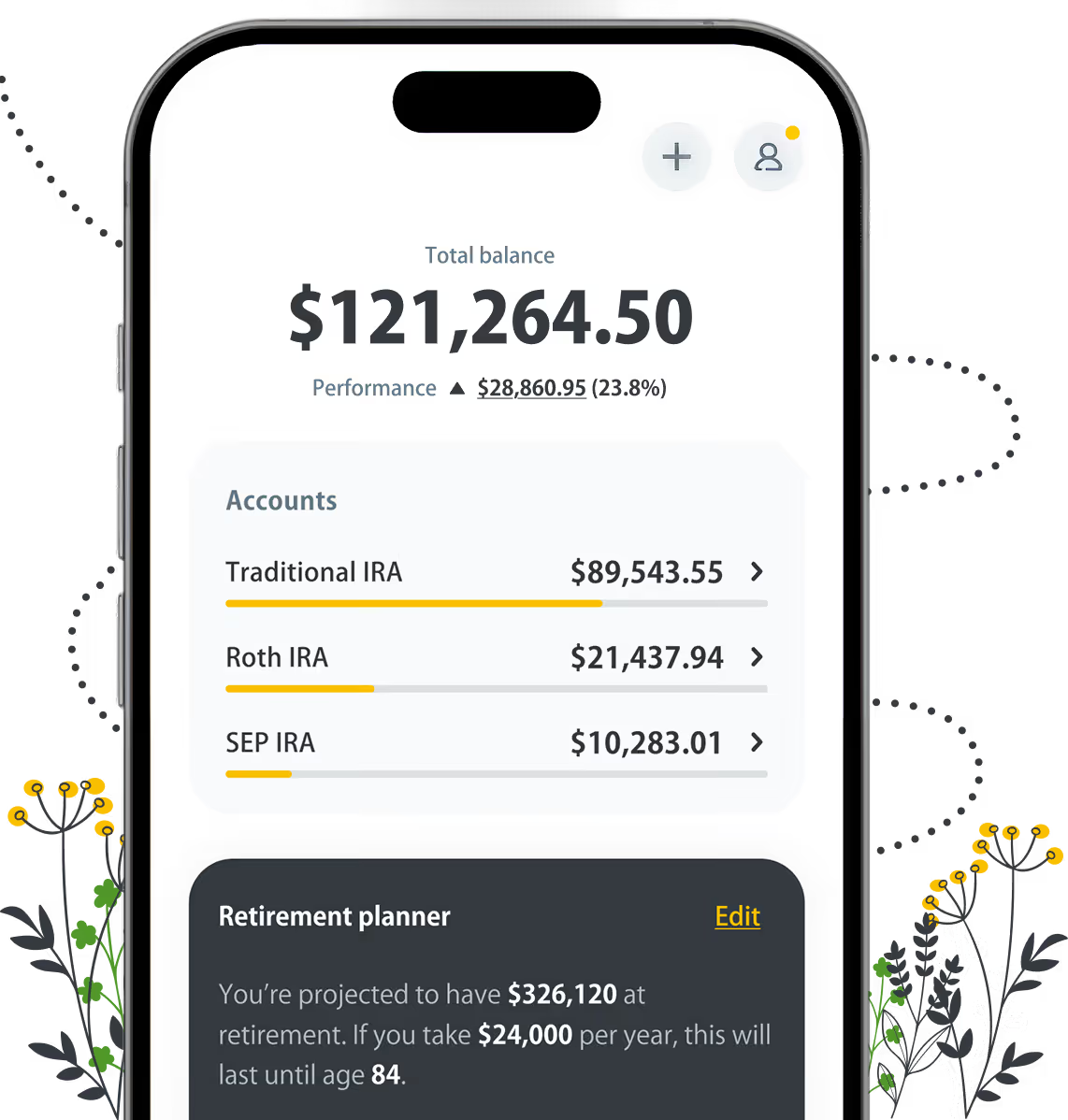
product shot showing account balance

A better way to IRA

Roll over your old 401(k)s and IRAs into one simple PensionBee IRA.
Get started
Images are hypothetical*