
Form 5500: The Complete Filing Guide for Plan Sponsors and Their Advisors

PensionBee

May 27, 2026

|

7 minute read

Updated on:

June 2, 2026

Summary

Form 5500 guide explaining who must file, which version applies, key deadlines, required schedules, potential penalties, and where PensionBee fits in for plans managing terminated employee accounts.

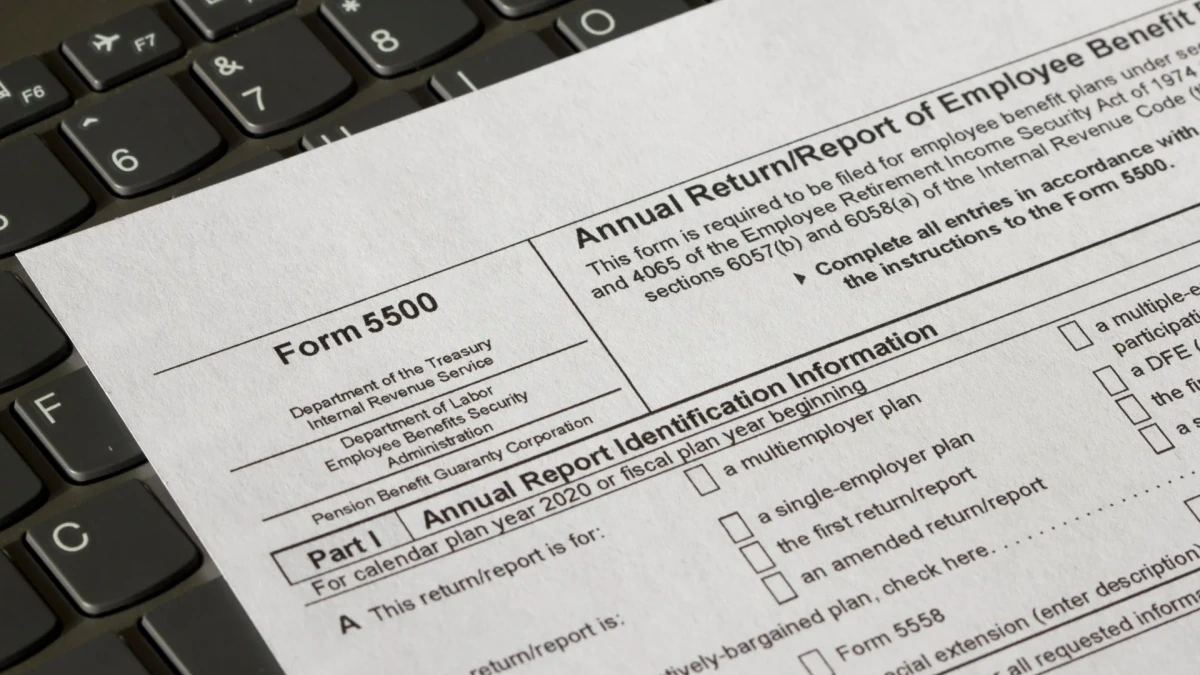
Form 5500 is an annual report that most private-sector employee benefit plans must file with the U.S. Department of Labor (DOL), Internal Revenue Service (IRS), and Pension Benefit Guaranty Corporation (PBGC) under ERISA. It discloses a plan’s financial condition, investments, operations, and regulatory compliance and is one of the primary tools regulators use to identify issues before they become enforcement actions.

For financial advisors working with plan sponsor clients, Form 5500 is more than a compliance checkbox. It provides a structured snapshot of plan health by capturing data on participant counts, fee disclosures, service provider relationships, and financial transactions. Understanding how to read it, file it correctly, and use it proactively is part of what separates advisors who add real governance value from those who do not.

This guide explains who must file, which version applies, key deadlines, required schedules, potential penalties, and where PensionBee fits in for plans managing terminated employee accounts.

What is Form 5500?

Form 5500 is an annual filing required under Title I of the Employee Retirement Income Security Act of 1974 (ERISA) for most private-sector retirement and welfare benefit plans. Filed electronically through the U.S. Department of Labor (DOL)’s EFAST2 system, it gives a transparent view of how a plan is being run, including its finances, investments, service providers, and compliance with federal law.

The three agencies that receive Form 5500 filings each use it differently:

Who Must File Form 5500?

Most private-sector employee benefit plans are required to file Form 5500 annually with the Department of Labor. Pension plans (such as 401(k) and defined benefit plans) and certain welfare benefit plans are generally subject to filing requirements, depending on size and funding status.

Plans with fewer than 100 participants may be eligible to file a simplified version (Form 5500-SF), while larger plans typically file the full Form 5500.

This requirement applies to defined contribution plans such as 401(k) and profit-sharing plans, defined benefit pension plans, and certain welfare benefit plans that provide benefits like health or disability coverage.

Exemptions: Some plans are not required to file, including most governmental and church plans, certain foreign plans, and some small or unfunded welfare plans, depending on their structure and funding arrangements.

The Participant Count Threshold Matters More Than Most Advisors Realize

Whether a plan files the full Form 5500 or the simplified Form 5500-SF generally depends on participant count, specifically whether the plan had 100 or more participants at the beginning of the plan year. That threshold influences filing requirements and can also affect audit obligations for larger plans.

One often overlooked detail is that terminated employees with remaining account balances still count as participants until those balances are removed from the plan. As a result, plans hovering near the threshold may find themselves ineligible for simplified filing or subject to additional audit requirements due to legacy small-balance accounts.

PensionBee’s automatic rollover IRA solution helps move terminated employee balances out of the plan in a compliant way, which can reduce participant counts and simplify annual Form 5500 filing obligations. For plans near the 100-participant threshold, this is often a meaningful consideration.

Which Version of Form 5500 to File

Choosing the right version depends on plan size and structure. Here's how they break down:

Form Who Files It Participant Threshold Key Notes
Form 5500 (standard) Large plans 100+ participants at start of plan year Full financial reporting, Schedule H required, independent audit required
Form 5500-SF (short form) Small plans Fewer than 100 participants Simplified reporting, no audit required, must meet investment eligibility rules
Form 5500-EZ One-participant plans Owner-only (and spouse), not subject to ERISA Required when assets reach $250,000+, or upon plan termination, can be filed on paper

A note on the 80–120 rule: If a plan filed as a small plan (Form 5500-SF) for the prior plan year, it may continue to file as a small plan even if it has between 80 and 120 participants at the beginning of the current plan year. This transition rule helps prevent plans from moving back and forth between small and large plan filing classifications from year to year.

All Form 5500 and 5500-SF filings must be submitted electronically through EFAST2. Form 5500-EZ may be filed on paper with the IRS or electronically through EFAST2.

Form 5500 Deadlines and How to Request an Extension

Form 5500 is due 7 months after the end of the plan year (the 12-month reporting period for the retirement plan), so the deadline varies depending on the plan’s year-end date. 

For calendar-year plans, the deadline is July 31. An automatic 2.5-month extension is available if Form 5558 is filed by the original due date, extending the filing deadline by 2.5 months.

Plan Year Ends Standard Deadline Extended Deadline (with Form 5558)
December 31 July 31 October 15
March 31 October 31 January 15
June 30 January 31 April 15
September 30 April 30 July 15

How to Request an Extension: Form 5558

Form 5558 is the application for a 2½-month extension to file Form 5500. 

Key facts advisors and plan administrators need to know:

  • Form 5558 must be filed with the IRS on or before the original Form 5500 due date
  • The extension is automatic once properly filed; no IRS approval is required
  • The extension provides an additional 2½ months to file Form 5500
  • The extension applies only to filing deadlines and does not eliminate or reduce penalties for late or inaccurate filings
  • An extension for Form 5500 must be requested separately,  it is not automatically granted based on other tax return extensions

For advisors: If a client realizes in late June they will miss the July 31 deadline, filing Form 5558 immediately is the appropriate step. The extension must be filed before the original due date passes

Automatic rollovers made easy

We offer a leading IRA for small balance rollovers and 401(k) plan terminations, designed to simplify processes and improve plan health.

Talk to an expert

What’s in Form 5500

Form 5500 collects key information about employee benefit plans to ensure compliance with federal regulations. The main components include:

  • Basic Plan Information: Name, type of plan, plan year, and plan sponsor details.
  • Financial Information: Assets, liabilities, income, and expenses for the plan year.
  • Compliance Questions: Confirmation that the plan follows ERISA rules and filing requirements.
  • Participant Information: Number of participants and distributions during the plan year.
  • Schedules (if applicable): Supplemental information such as insurance contracts, service provider details, financial transactions, and actuarial data for large or defined benefit plans.

Form 5500 provides a comprehensive snapshot of a plan’s operations, financial health, and compliance status, serving both regulators and plan participants.

Form 5500 Schedules: Which Ones Apply to Your Plan

Schedules provide additional detail on specific aspects of a plan. Which ones are required depends on the plan's size, structure, and activities. Here's the full breakdown:

Schedule What It Covers Who Must Attach It
Schedule A Insurance information Plans with insurance contracts for investments or benefits
Schedule C Service provider fees and compensation Large plans (100+ participants) with service providers receiving $5,000+
Schedule D Direct Filing Entity (DFE) information Plans participating in certain collective investment vehicles
Schedule G Financial transactions: loans, leases, non-exempt transactions Large plans with reportable financial transactions
Schedule H Detailed financial statements Large plans (100+ participants)
Schedule I Summary of financial statements Small plans (fewer than 100 participants) using Form 5500
Schedule MB Multiemployer defined benefit actuarial info Multiemployer defined benefit plans
Schedule R Retirement plan distribution and funding info Defined benefit and certain defined contribution plans
Schedule SB Single-employer defined benefit actuarial info Single-employer defined benefit plans

Schedule C is the one advisors should pay particular attention to with their clients. It requires disclosure of all service providers receiving $5,000 or more from the plan, which is a key data point for fee reasonableness analysis and a common focus area in DOL audits.

Form 5500 Penalties: What Late or Incomplete Filing Actually Costs

This is the section plan sponsors pay attention to. The penalties for missing or mishandling Form 5500 are significant and can come from two agencies simultaneously.

DOL civil penalties:

  • Up to approximately $2,500–$2,700 per day for late filing (adjusted annually for inflation)
  • No statutory maximum, penalties accrue until the filing is corrected
  • Higher penalties may apply if the violation is willful or intentional
  • The daily penalty amount is adjusted annually under the Federal Civil Penalties Inflation Adjustment Act

IRS penalties:

  • $250 per day for failure to file or provide required information
  • Maximum of $150,000 per plan year
  • Reasonable cause relief may apply depending on facts and circumstances

The critical detail most plan sponsors miss is that these penalties can run simultaneously. A plan that is 30 days late could potentially face both IRS and DOL penalties at the same time, increasing total exposure. However, actual amounts vary based on correction timing, filing history, and whether relief programs (such as the DFVCP) are used.

The DFVC Program: A Relief Valve Worth Knowing

The DOL’s Delinquent Filer Voluntary Compliance Program (DFVCP) allows plan administrators who voluntarily come forward to file late Form 5500s to pay significantly reduced penalties, generally $10 per day, capped at $750 per filing for small plans and $2,000 per filing for large plans.

For advisors: If you discover that a client has unfiled Form 5500s from prior years, DFVCP is often a strong correction option. Filing under DFVCP before the DOL initiates an investigation results in substantially lower penalties than waiting for enforcement action.

Using Form 5500 as a Governance Tool, Not Just a Filing Obligation 

Plan sponsors and advisors who treat Form 5500 as purely a compliance task are leaving value on the table. It provides a structured annual snapshot of plan operations by capturing participant counts, fee disclosures, investment information, service provider relationships, and financial reporting.

Reviewing it proactively each year can give advisors a concrete deliverable for plan sponsor clients:

  • Participant count trends can help identify changes in plan size classification or workforce composition over time
  • Schedule C provides a documented record of service provider compensation that can support fee and benchmarking reviews
  • Financial and audit-related disclosures in Form 5500 can help identify items that may warrant further fiduciary review.
  • Year-over-year comparisons can show trends in costs, participation, and distributions

For advisors conducting annual plan reviews, incorporating a Form 5500 analysis into the process is a clear way to demonstrate ongoing fiduciary support.

Simplifying Plan Administration for Your Clients

One of the most persistent Form 5500 complications for plan sponsors, especially those with high employee turnover, is managing terminated employee accounts with small balances. These accounts continue to count as participants in your Form 5500 filing until they're removed from the plan, which can push plans over the 100-participant threshold and trigger large-plan filing requirements, independent audit obligations, and more complex schedule attachments.

PensionBee’s automatic rollover IRA solution handles this end-to-end. It processes distributions into properly managed Automatic Rollovers or Safe Harbor IRAs and helps ensure terminated participant balances are removed from the plan in a compliant manner. For advisors, it is a turnkey answer to a problem that comes up in nearly every plan review with a long-tenured client.

Frequently Asked Questions (FAQs)

What is Form 5500?

Form 5500 is an annual report that employee benefit plans in the U.S. must file with the U.S. Department of Labor (DOL), Internal Revenue Service (IRS), and Pension Benefit Guaranty Corporation (PBGC). It provides information about the plan’s financial condition, investments, operations, and compliance with federal regulations under ERISA.

Who is required to file Form 5500?

Most private-sector employee benefit plans must file. This includes:

  • Defined contribution plans, like 401(k) or profit-sharing plans.
  • Defined benefit pension plans, which promise a specific retirement benefit.
  • Certain welfare plans, such as health or disability benefits.

Exemptions apply to some governmental, church, or certain foreign plans, depending on administration and participant location.

Which version of Form 5500 should be filed?

The applicable filing form depends on the size and structure of the retirement plan:

  • Form 5500 (standard): Plans with 100+ participants.
  • Form 5500-SF (short form): Plans with fewer than 100 participants.
  • Form 5500-EZ: One-participant retirement plans not subject to ERISA (owner-only plans, spouses), required when plan assets reach $250,000 or more, or upon plan termination.

What information is included in Form 5500?

Key components include:

  • Basic plan information (name, type, plan year, sponsor).
  • Financial information (assets, liabilities, income, expenses).
  • Compliance questions regarding ERISA rules.
  • Participant information (number of participants, distributions).
  • Supplemental schedules (insurance, service providers, financial transactions, actuarial info) if applicable.

What are Form 5500 schedules?

Schedules provide additional detail on specific aspects of a plan. Main schedules include:

  • A: Insurance Information
  • C: Service Provider Information
  • D: Direct Filing Entity (DFE) Information
  • G: Financial Transactions
  • H: Financial Information (Large Plans, ≥100 participants)
  • I: Financial Information (Small Plans, <100 participants)
  • MB: Multiemployer Actuarial Information
  • R: Retirement Plan Information
  • SB: Single-Employer Actuarial Information

When is Form 5500 due?

Generally, seven months after the plan year ends. For calendar-year plans, the deadline is July 31st. An extension of 2½ months can be requested using Form 5558, but extensions do not eliminate potential penalties.

What penalties can apply for late or inaccurate Form 5500 filings?

The DOL can impose civil penalties for late or inaccurate filings, which may be higher in cases of willful violations. These penalties can reach approximately $2,259 per day (adjusted annually). The IRS may also impose a separate penalty of $250 per day, up to $150,000 per plan year. In practice, both penalties can apply simultaneously, creating combined exposure that may exceed $500 per day.

Can I get an extension on Form 5500? 

Yes. Form 5558, filed with the IRS by the original deadline, grants an automatic 2½ month extension. Extensions do not waive or reduce penalties for inaccurate filings, they only extend the filing deadline.

What is the DFVC program?

The Delinquent Filer Voluntary Correction (DFVC) program allows plan administrators to voluntarily file late Form 5500s at reduced penalty rates, as low as $10 per day, capped at $750 for small plans and $2,000 for large plans per filing. Filing under DFVC before a DOL investigation is initiated results in substantially lower penalties.

Does a solo 401(k) require Form 5500? 

One-participant plans (owner-only, or owner and spouse) are generally exempt from ERISA and do not file Form 5500. However, they must file Form 5500-EZ when plan assets exceed $250,000 at the end of the plan year, or when the plan is terminated.

Where to file Form 5500? 

Form 5500 and Form 5500-SF must be filed electronically through the DOL's EFAST2 system (efast.dol.gov). Form 5500-EZ can be filed on paper or electronically through EFAST2.

Disclaimer

Your investment can go down as well as up. This post, and any associated customer testimonial or third party endorsement, is provided solely for informational and educational purposes, should not be taken as tax, legal, financial or investment advice and is not an offer, solicitation, or recommendation to buy or sell any securities or investments.

product shot showing account balance

A better way to IRA

Roll over your old 401(k)s and IRAs into one simple PensionBee IRA.
Get started
Images are hypothetical*