Instagram logoYouTube logoTikTok logoLinkedIn logoX social logoFacebook logo

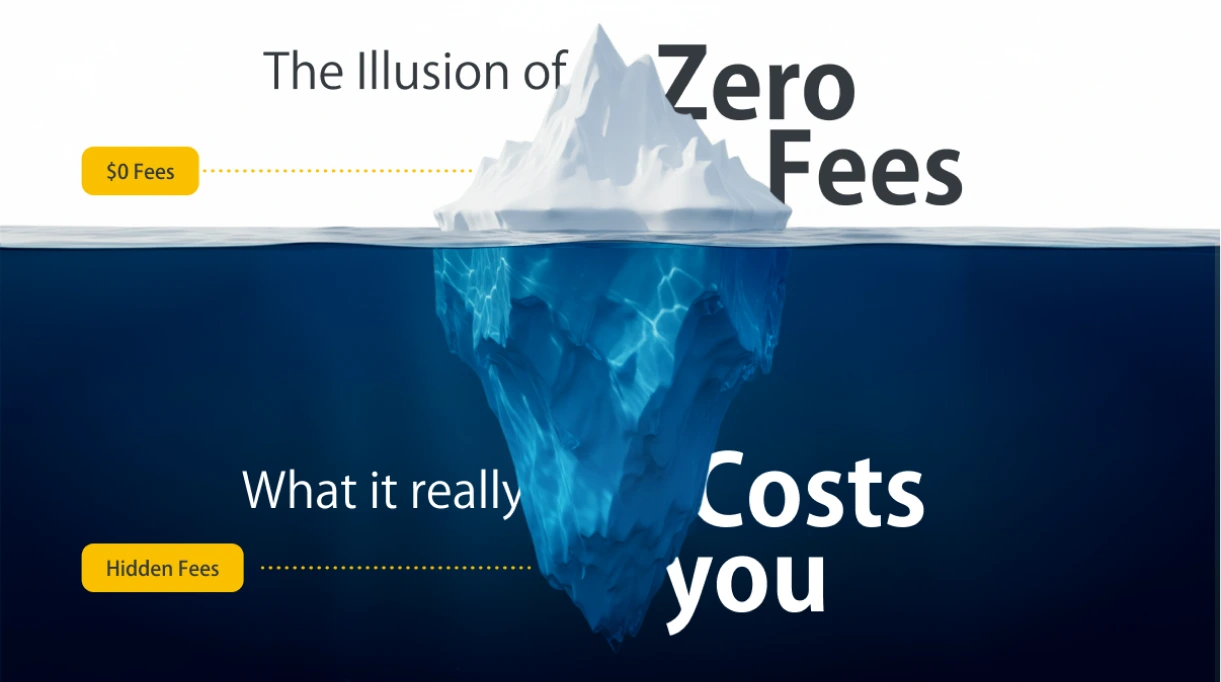
The Illusion of Zero Fees in Your IRA

PensionBee
5 minute read

PensionBee's True Cost of “Zero” report reveals the hidden costs behind zero-fee IRAs and what investors may actually pay for seemingly free retirement accounts.

Zero is a very good number.

No platform charges. No trading commissions. No management fees. Over the last decade, the financial services industry has made zero the headline, the selling point, and increasingly the standard. If you opened an IRA recently, or are thinking about it, there's a good chance that "free" played a role in your decision.

Here's the thing: the revenue didn't disappear. It moved.

In a new report, The True Cost of "Zero",  PensionBee commissioned an independent actuary and forensic financial analyst to reverse-engineer how "zero fee" platforms actually make money. What came back wasn't a simple answer. It was five overlapping charging mechanisms, each one legal, each disclosed somewhere in documents most people will never read, and none of them visible on a statement.

What Zero Actually Costs

The analysis modeled a representative saver with $107,000 in retirement savings and 20 years until retirement. That's close to the median IRA balance for a Gen X saver. 

Under the most favorable assumptions possible, including the right fund choices and the selection of the lowest-cost options throughout, zero-fee platforms still extracted a minimum of 0.16%-0.32% per year. That amounts to between $166 and $342 annually on that account, charged invisibly.

Make a few of the mistakes that many ordinary savers make, and the gap between expected and actual costs can widen quickly. Under realistic assumptions, investors could end up paying the equivalent of 1.6% per year despite assuming the platform costs 0%.

That is roughly $1,700 annually on the same $107,000 account. The cost may be disclosed somewhere in the paperwork, but it is not always easy to spot and can be buried within disclosures rather than presented as a simple annual fee. 

Here's where it goes:

The Five Places Your Money Goes

1. Cash Sweep Spreads: How Your Idle Cash Earns Them Money Instead of You

When you have uninvested cash sitting in your IRA, such as between contributions, during a rollover, or when it is otherwise idle, the platform typically sweeps it into interest-bearing accounts. The platform earns a return on that cash, while you may receive only a fraction of it. 

This is a cash sweep. 

The analysis found one provider earning a net spread of approximately 3% on swept cash. The bank pays 4–5% on this cash but passes along close to zero to customers. On a $107,000 account where cash represents 10% of the balance, that invisible spread costs roughly $261 per year. EBRI (Employee Benefit Research Institute) reports that nearly 24% of IRAs are heavily allocated in cash. Platforms that don't automatically invest your contributions have a structural reason to let that cash sit idle. Idle cash pays them, not you.

2. Securities Lending: How Your Holdings Get Rented Out

Stocks and bonds held in your account can be lent out to large institutions, who pay a fee to borrow them. Some platforms share that fee with you. Others keep most of it. One provider in the analysis retains an estimated 85% of net lending fees from its opt-in program, passing along 15% to clients. The platform also captures the full interest earned on the borrower's collateral. The risk of something going wrong, such as a borrower defaulting or collateral losing value, falls on you rather than the provider.

3. Your Payment for Order Flow: How Your Orders Get Sold

When you buy or sell investments inside your account, you may pay an indirect cost through the way your trade is executed. Some brokers don't necessarily send your order to the market offering the best available price. Instead, they route it to a market maker that pays the broker for the order and then executes the trade at a slightly less favorable price, keeping the difference. This practice, known as Payment for Order Flow (PFOF), can increase your trading costs even though it doesn't appear as a separate fee on your account statement. The practice has been banned in the UK and restricted across much of Europe because it creates a conflict of interest. Even so, it remains legal in the U.S.

Let’s Make Retirement Simple Together.

Got old 401(k)s? Rolling them into a PensionBee IRA takes only a few minutes and helps simplify management.

Get started

Be Retirement Confident.

Roll over all your old 401(k)s into a PensionBee Individual Retirement Account (IRA). It takes just a few minutes to sign up.

Get started

4. Fund Expense Ratios: The Cost Hiding Inside Your Own Choices

Unlike the first three mechanisms, this one isn't something the platform does to you. It's a cost built into the investments you pick yourself, and the platform has little reason to point that out.

Morningstar's 2026 Fund Fee Study found the average actively managed equity fund charges 0.58% a year, against 0.09% for a comparable index fund, a more than sixfold gap. On a platform with hundreds of fund options, picking the higher-cost active fund instead of the lower-cost passive one is an easy mistake to make. That single choice can cost a $107,000 balance roughly $100,000 in lost growth over 30 years. The same study also found that fund fees across the industry have declined significantly, from 0.80% in 2006 to 0.32% in 2025. Even so, that average still masks a wide range of fees for investors who haven't sought out the lowest-cost options available.

5. Administrative and Service Charges: The Fees That Show Up When You Least Expect Them

Most of the time, this really is zero. Most IRA platforms don’t charge explicit administration fees.

The exceptions show up at the edges. Traditional brokerages may still charge per-trade commissions for certain transactions. Options fees typically range from $0 to $1.00 per contract depending on the broker, with many full-service providers charging around $0.65 per contract. These fees are less common inside IRAs, where many providers offer commission-free trading for certain investments. Robo platforms tend to charge flat fees instead, like an account-closure fee of roughly $100. On a $107,000 balance, that fee is barely noticeable, less than 0.1%. But on a $10,000 account, the same flat fee takes about 1% right away.

6. The Cost of Management and Human Support: Where "Free" Becomes a Fee Tier

This is the one hiding in plain sight.

“Zero fee” is rarely a platform’s only product. It’s usually one tier in a larger structure, or it comes with conditions, like being free only under a certain balance, while marketing may imply otherwise.It can also be the most misleading of the six mechanisms. There is no complex financial structure behind it, just a “0” shown prominently while the actual percentage-based fees are disclosed more quietly.

That may be exactly why it does the most damage. PensionBee's analysis suggests this category accounts for the largest hidden drag on customer balances of all six. Even a well-known "free" robo account in the analysis charged an advisory fee of 0.27%, disclosed only in the fine print, about $290 a year on a $107,000 balance for what's largely automated management. None of this means advice is a bad deal. Access to a human adviser can be genuinely worth paying for. The problem is when someone pays for it by accident. 

Definitions Matter

Zero-fee marketing isn't neutral. It can function as a trap for mass-market investors, especially amid declining financial literacy. It obscures where costs actually sit and makes pricing harder to evaluate upfront.

Picking the right fund, monitoring your cash allocation, understanding order routing, and knowing what an SEC Rule 606(b) request even is are not things most people opening their first IRA know to do. These factors are often complex and even nearly impossible for an actual financial analyst to quantify. The analysis puts it plainly: the price tag for “zero” grows with the margin for error.

Retirement savers include everyone. Financial analysts, teachers, nurses, and construction workers all need to save for retirement. The hidden fee model quietly transfers money from those who don’t know where to look to the platforms that do.

What Transparency Actually Looks Like

PensionBee's approach is different, by design.

An annual wrap fee covers everything: diversified portfolios, a U.S.-based account manager who answers when you call, access to planning tools, and our award-winning app. It also includes a 1% match on every rollover and contribution (terms & conditions apply).

The fee is simple. Costs are transparent and clear to understand.

Zero isn't zero. It never was. The question is whether you know where the money is going.

Investing involves risk. This post, and any associated customer testimonial or third party endorsement, is provided solely for informational and educational purposes, should not be taken as tax, legal, financial or investment advice and is not an offer, solicitation, or recommendation to buy or sell any securities or investments.

Popular

1

Retirement Under a New Administration

Jatniel Brito

2

Future Planning for Couples

Jatniel Brito

3

Retirement Inequalities in 2025

Jatniel Brito

4

Retirement Planning for Women

Jatniel Brito

5

Tax Season Tips for Retirement

Summer Nevins

Be Retirement Confident.

Roll over all your old 401(k)s into a PensionBee Individual Retirement Account (IRA). It takes just a few minutes to sign up.

Get started
product shot showing the pensionbee app